
ABOUT US
TPDi is an independent, non-partisan think tank dedicated to tech policy. After 3 years of incubation, we spun-out of the Australian National University in January 2025.
Our work is grounded in the belief that technology does not determine our future, people do – through the institutions we build, the policies we shape, and the choices we make about how technology is designed, developed, deployed and governed.
TPDi’s north star is to ensure the choices we make – as individuals, communities, organisations and nations – are informed by evidence, shaped through participation, and directed towards the benefit of humanity.














Our purpose
Why we exist

Our Principles
The principles that guide our work
- Humans shape technology: technology is neither inherently good nor bad; nor is it neutral. How it is designed, developed, deployed and governed makes all the difference.
- Nothing about technology is inevitable: to shape the future we want, individuals, organisations, communities and nations must be proactive in shaping technology
- Good policy shapes good technology: policy (including regulation) is a powerful tool; we must wield it with intention to shape technology for the benefit of humanity.
- Regulation is not a dirty word: it provides the framework for economies and societies to function – effective tech regulation supports both economic growth and societal flourishing.
- To get the best outcomes, tech policy should be participatory and evidence-based: everyone has a stake in how technology is governed – tech policy should be inclusive, and informed by evidence, experience and continuous learning, not ideology, fear or hype.
Our Values
How we work
- Fearlessly independent: Our independence underpins everything we do. It is our biggest asset and contribution. We would rather fail than compromise it.
- Pragmatically optimistic: Our optimism demands action. We are excited about the potential of new technologies. But we are realistic about the world as it is. We are deliberate in shaping technology for a positive future.
- Constructively critical: Our perspective is based on critical analysis and respectful contestability. We are non-partisan. We critique everyone. Everything we do is evidence-based and constructive.
- Inclusively collaborative: Our inclusive approach is based on conviction: tech policy should not be made in silos. We engage with everyone. Collective knowledge and diverse perspectives underpin effective outcomes. Everything we do is evidence-based and constructive.
- Intentionally creative: Our team and collaborators think differently. We intentionally design creative solutions. Just as innovation drives technology, it is also at the heart of effective tech policy.
Our Theory of Change
How we create impact
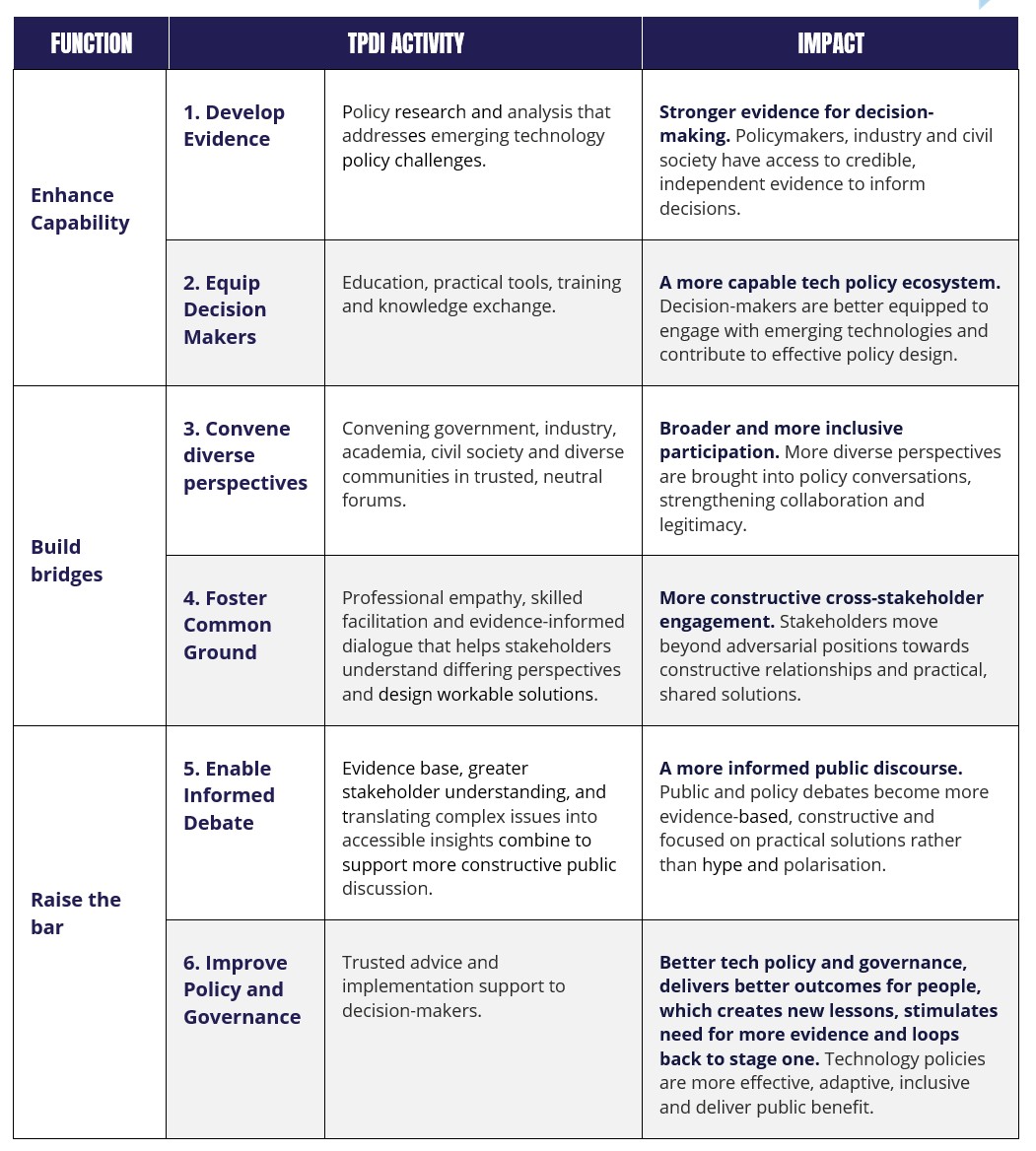
TPDi’s theory of change runs on TPDi’s four core pillars of activity (research, education, community building and public debate). Each function drives a specific outcome, and those outcomes accumulate into six kinds of impact.
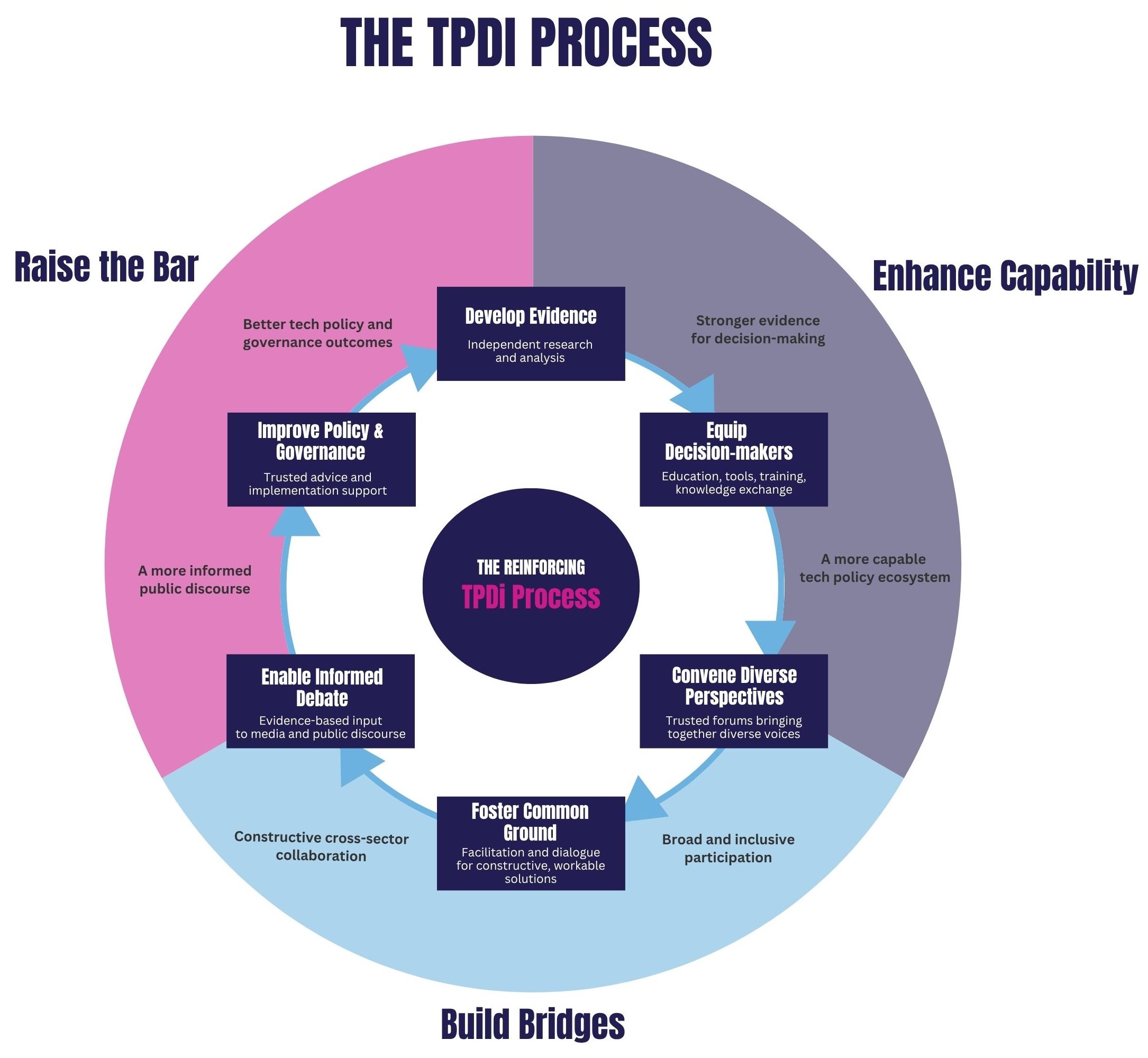
Better policies and governance generate new evidence and questions that feed the next cycle, so the process continues: a reinforcing flywheel, which we call the ‘TPDi process’, where each turn builds momentum for the next.
Our Founders
Johanna Weaver is Co-Founder and Executive Director of TPDi. She is a reformed commercial litigator, a recovering diplomat, and an escaped professor. In 2021, Johanna founded TPDi’s predecessor, the Tech Policy Design Centre at the Australian National University (ANU), after concluding her term as Australia’s independent expert and chief cyber negotiator at the United Nations. In 2022, she was appointed Professor in the Practice of Cyber and Tech Policy at ANU. She has been appointed to numerous boards, including the ICRC Global Advisory Board on Protecting Civilians from Digital Threats, the Minister for Government Services’ Independent Advisory Board, and the Data Standards Advisory Committee.
Zoe Jay Hawkins is Co-Founder and Deputy Executive Director of TPDi. Zoe brings extensive experience designing tech policy from government, big tech, academic and think tank perspectives. Zoe worked for the Australian government across communications, innovation, and foreign policy portfolios, as a ministerial adviser and in the public service. She is a Research Associate at the University of Oxford and an expert researcher for the OECD. Zoe’s work has been featured by The New York Times, TIME Magazine, BBC, The Economist, The Financial Times, Forbes, POLITICO, and Vogue.

Our Team
 Meredith Hodgman
Head of Strategy and Engagement
Meredith Hodgman
Head of Strategy and Engagement
 Helen Portillo-Castro
Head of Operations and Coordination
Helen Portillo-Castro
Head of Operations and Coordination
 Dorina Wittmann
EA to the Co-Founders and Office Manager
Dorina Wittmann
EA to the Co-Founders and Office Manager
Our Board
 Geraldine Chin Moody
Independent Board Chair, Board and Governance Principal at Directors Australia
Geraldine Chin Moody
Independent Board Chair, Board and Governance Principal at Directors Australia
 Kate Pounder
Independent Director TPDi, inaugural CEO of the Tech Council of Australia
Kate Pounder
Independent Director TPDi, inaugural CEO of the Tech Council of Australia
 Professor Elanor Huntington
Independent Director TPDi, Deputy Chief Executive of CSIRO
Professor Elanor Huntington
Independent Director TPDi, Deputy Chief Executive of CSIRO
 Dr Tobias Feakin
Independent Director TPDi, Australia’s inaugural Ambassador for Cyber Affairs
Dr Tobias Feakin
Independent Director TPDi, Australia’s inaugural Ambassador for Cyber Affairs
 Johanna Weaver
Co-Founder & Executive Director, TPDi
Johanna Weaver
Co-Founder & Executive Director, TPDi
 Zoe Jay Hawkins
Co-Founder & Deputy Executive Director, TPDi
Zoe Jay Hawkins
Co-Founder & Deputy Executive Director, TPDi
Our Special Advisers
 Julie Inman Grant
Australia’s eSafety Commissioner
Julie Inman Grant
Australia’s eSafety Commissioner
 Frances Haugen
Facebook whistleblower and online safety advocate
Frances Haugen
Facebook whistleblower and online safety advocate
 Professor Rod Sims
Former Chair of the ACCC
Professor Rod Sims
Former Chair of the ACCC
 Brett Solomon
Co-Founder of global digital rights not-for-profit Access Now
Brett Solomon
Co-Founder of global digital rights not-for-profit Access Now
 Tim Levy
Managing Director, Qoria Limited
Tim Levy
Managing Director, Qoria Limited
 Jess Wilson
CEO, Good Things Foundation
Jess Wilson
CEO, Good Things Foundation
Distinguished Technical Fellows
 Audrey Tang
Taiwan’s inaugural Digital Minister, now Cyber Ambassador
Audrey Tang
Taiwan’s inaugural Digital Minister, now Cyber Ambassador
 Sally-Ann Williams
Former CEO, Cicada Innovations
Sally-Ann Williams
Former CEO, Cicada Innovations
 Brendan Hopper
Chief Information Officer for Technology and Distinguished Engineer, Commonwealth Bank of Australia
Brendan Hopper
Chief Information Officer for Technology and Distinguished Engineer, Commonwealth Bank of Australia
Our Funders
OUR INDEPENDENCE IS OUR MOST VALUABLE ASSET: WE WOULD RATHER FAIL THAN COMPROMISE IT
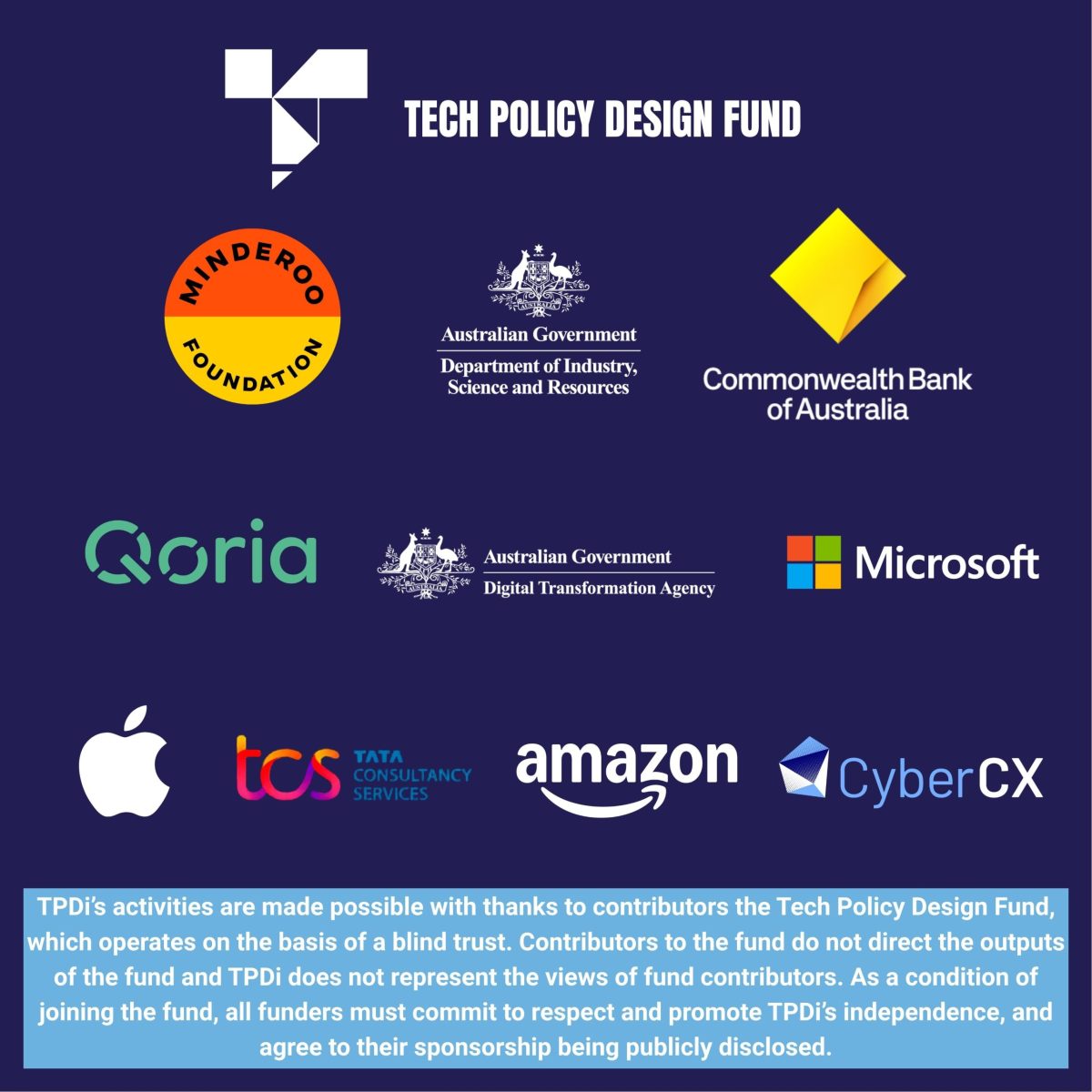
TPDi’s activities are made possible with thanks to contributors the Tech Policy Design Fund, which operates on the basis of a blind trust. Contributors to the fund do not direct the outputs of the fund and TPDi does not represent the views of fund contributors. As a condition of joining the fund, all funders must commit to respect and promote TPDi’s independence, and agree to their sponsorship being publicly disclosed.
TPDi also has a number of participation programs that TPDi uses to support diverse participation in our activities, including by civil society, children and young people.
If there is strong mission alignment, TPDi also works with other partners to deliver specific research or education programs, or engagement activities – but only when partners agree that TPDi retains sole discretion over all outputs.
Footnotes
-
\r\n
- \r\n \t
- Kranzberg, M. (1986). Technology and History: "Kranzberg's Laws." Technology and Culture, 27(3), 544–560. https://doi.org/10.2307/3105385 \r\n
- Freiberg, A. (2017). Regulation in Australia. The Federation Press, p42