
Middle Power Tech Strategy in Carney’s Honest World Order
Welcome to The Tech Policy Commons.
TPDi’s new blog is for policymakers and technologists who seek diverse perspectives. It will tackle the tough tech policy issues crossing your desk and bring you policy solutions grounded in practice.
For now, it’s a focused space for our team to share practical insights. Guest contributors in and from the Indo-Pacific will follow. And, as with all TPDi work, our blog will be fearlessly independent.
We launch with an article from TPDi Co-Founder, Zoe Jay Hawkins. She examines what the rupture of the world order means for tech policy, and outlines three strategic priorities for middle powers, like Australia, in the next six months.
Happy reading, and wishing you all the best for 2026!
Johanna Weaver
TPDi Co-Founder and Executive Director

Middle Power Tech Strategy in Carney’s Honest World Order, by Zoe Jay Hawkins
Key Messages
-
The fiction of the US-led rules based international order is over.
-
This presents an opportunity for middle powers, like Australia and Canada, to shape what comes next for tech and geopolitics.
-
Middle powers should urgently build new tech coalitions, diversify tech supply chains, and pursue tech agency.
-
Albanese should use Carney’s visit to Australia in March to advance bold new cooperation in these areas.
3 Feb 2026.
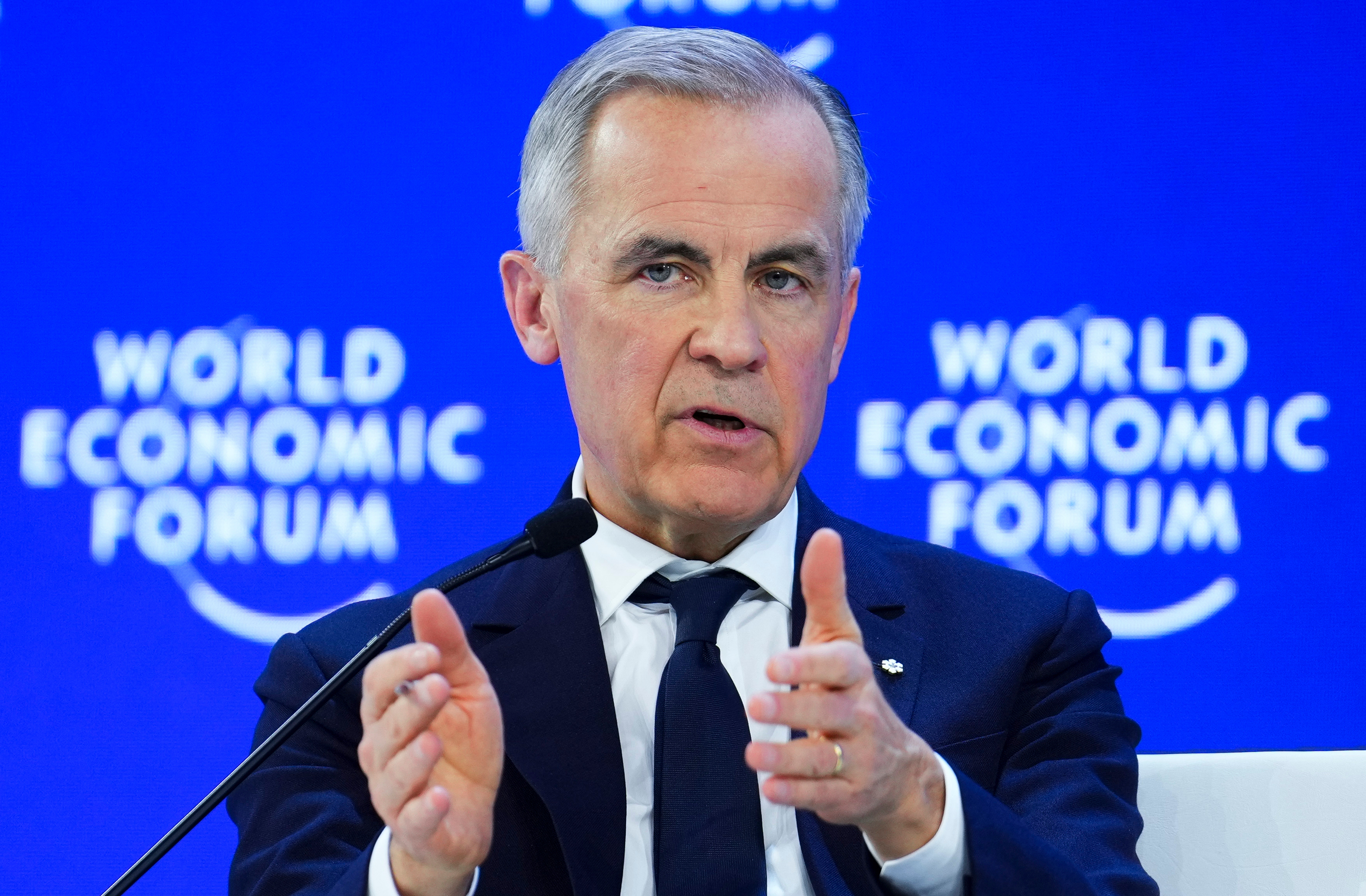
On 20 January in Davos, Canadian Prime Minister Mark Carney called time on the fiction of a US-led rules-based international order. This article examines the implications that Carney’s honest dose of realism will have on technology and tech policy.
The US-led world order did not crumble overnight. Its erosion has been well documented as norms frayed, trolling increased, and power became more openly transactional. President Trump’s coercion of allies over Greenland and erratic threats of tariffs (including in response to proposed regulation of US tech companies) are recent examples. As Carney observed, actions like these have accelerated the change from a ‘transition’ to a ‘rupture’ of the world order. In the face of this rupture, Carney called for a new world order where ‘the power of the less powerful starts with honesty.’ Johanna Weaver and I made this case ourselves in Australian Foreign Affairs in June 2025, arguing:
US global leadership is disintegrating loudly and in plain sight. This has serious ramifications for how democracies such as Australia should conceive of their role on the world stage … But first we must accept that the world has changed.
Why does this matter? Middle powers, like Australia and Canada, can help reshape the new world order if we have the courage and agility to adapt quickly. For tech and geopolitics, this creates three immediate priorities: build new tech coalitions, diversify tech supply chains, and pursue tech agency.
1. Create Strength in Numbers
Individual countries regulating US or Chinese tech now risk bilateral coercion. Middle powers should build a coalition that defends their rights to regulate technology within their own borders. We have proposed such a coalition: the Interoperable Tech Regulation Initiative (ITRI). With democratic decline and a shift to a multipolar world, this coalition cannot be limited to ‘like-minded’ liberal democracies. Through ITRI, a broader collective of ‘middle ground’ countries can share the risk and dilute the great power pressure. A broad collective would include the EU, Canada, New Zealand, Japan and Korea, but also India, Indonesia, Malaysia, Mexico, South Africa and Brazil. Modelled on the Proliferation Security Initiative, this approach sustains legitimacy around pragmatic principles of tech self-determination.
This sentiment was echoed in Carney’s commitment that Canada will form coalitions ‘with partners who share enough common ground to act together.’ Middle powers should engage broadly to form tech coalitions and preserve staying power in an uncertain world. Pragmatic collectivism is the new currency of tech power.
2. Diversify Supply Chains and Tech Stacks
Critical technologies, including AI, sit within highly globalised yet highly concentrated supply chains, exposing countries reliant on a single great power’s tech stack to coercion. A global census of US and Chinese hyperscaler infrastructure around the world showed that 18 countries are dependent on just US or Chinese companies for public cloud compute.
This dependency is not new, but Trump’s willingness to leverage it to pressure US allies and enemies alike has changed the game. Many fear it’s a short step from imposing tariffs to withholding the digital infrastructure and software on which economies, governments and militaries depend (as Ukraine has learnt with Starlink). A European Commission Executive Vice President recently called for the bloc to de-risk its tech dependence, warning, ‘in these times, dependencies … they can be weaponised against us.’
The middle power solution to these risks is not total tech self-sufficiency and isolation. As Carney notes, ‘a world of fortresses will be poorer, more fragile and less sustainable.’ Instead, we are already seeing selective reshaping of global tech supply chains. The US led the Pax Silica Declaration with Australia, the UK, Israel, Japan, Korea, and Singapore to secure their innovation supply chains, while Canada announced a new strategic partnership with China. Middle powers should diversify their partnerships to reduce concentrated reliance on a single great power. We should prioritise initiatives that increase our tech choices.
3. Pursue Tech Agency
Middle powers maintaining choice in the face of increasing great power rivalry is part of expanding from the pursuit of ‘tech sovereignty’ to ‘tech agency’. Binary sovereignty debates obscure the multiple strategic levers available to middle powers and encourage unrealistic visions of total self-reliance. For example, true AI sovereignty is impossible for all countries apart from perhaps the US and China. But what’s the alternative?
TPDi research reveals that ‘AI agency’ allows for a strategic combination of access, control, choice, and leverage across 101 critical AI capabilities (defined in the report). Like AI sovereignty, AI agency still involves establishing national control over the most critical capabilities. But it also means maintaining a choice of cutting-edge international capabilities to build tech resilience. Importantly, it also involves identifying any domestic competitive advantage that can create international leverage.
Agency delivers bargaining power, which just became way more important. As Carney put it, ‘sovereignty … will increasingly be anchored in the ability to withstand pressure.’ Middle powers should pursue tech agency so we can steer outcomes, protect national interests, and capture value in a globally connected system.
Conclusion
Whether framed as an ‘honest world order’ or Pax Transactionalis, it isn’t actually the end of rules. It’s a rupture and rapid re-writing of them. If met deliberately, this presents an opportunity. Middle powers can retain agency if we act collectively, diversify dependencies, and build leverage. Australia is uniquely positioned to lead this new way forward with Canada. As a trusted Indo-Pacific broker, Australia bridges US structures like AUKUS, the Quad, and Pax Silica with regional partnerships across ASEAN. Our commonalities – Five Eyes membership, mineral wealth, and shared democratic values – create natural alignment. But are we bold enough to step up?
When Carney visits Australia in March, Albanese should seize this moment to advance meaningful cooperation. Priorities should include bolstering our respective tech agency and launching initiatives such as ITRI. The next six months matter.
The task ahead is not to lament the rupture but to shape what comes next.
About the Author
Zoe Hawkins is Co-Founder and Deputy Executive Director of TPDi.
Zoe brings extensive experience designing tech policy from government, big tech, academic and think tank perspectives.
Zoe worked for the Australian Government across communications, innovation and foreign policy portfolios, as a ministerial adviser and in the public service. Zoe is a Research Associate at the University of Oxford and an expert researcher for the OECD.

Subscribe for regular articles from The Tech Policy Commons here