
Launch: Expanding AI Sovereignty to AI Agency
AI is reshaping global power, prosperity and security but debates about AI sovereignty are often binary, conflated, lacking evidence, and disconnected from the complex trade-offs leaders face. 𝗧𝗣𝗗𝗶’𝘀 𝗔𝗜 𝗔𝗴𝗲𝗻𝗰𝘆 𝗧𝗼𝗼𝗹, 𝗽𝗿𝗲𝘀𝗲𝗻𝘁𝗲𝗱 𝗵𝗲𝗿𝗲 𝗶𝗻 𝗶𝘁𝘀 𝗳𝗶𝗻𝗮𝗹 𝗳𝗼𝗿𝗺, 𝗼𝗳𝗳𝗲𝗿𝘀 𝗮 𝗽𝗿𝗮𝗰𝘁𝗶𝗰𝗮𝗹 𝘀𝗼𝗹𝘂𝘁𝗶𝗼𝗻.
Media Release
New research reveals Australia’s AI advantages are overlooked
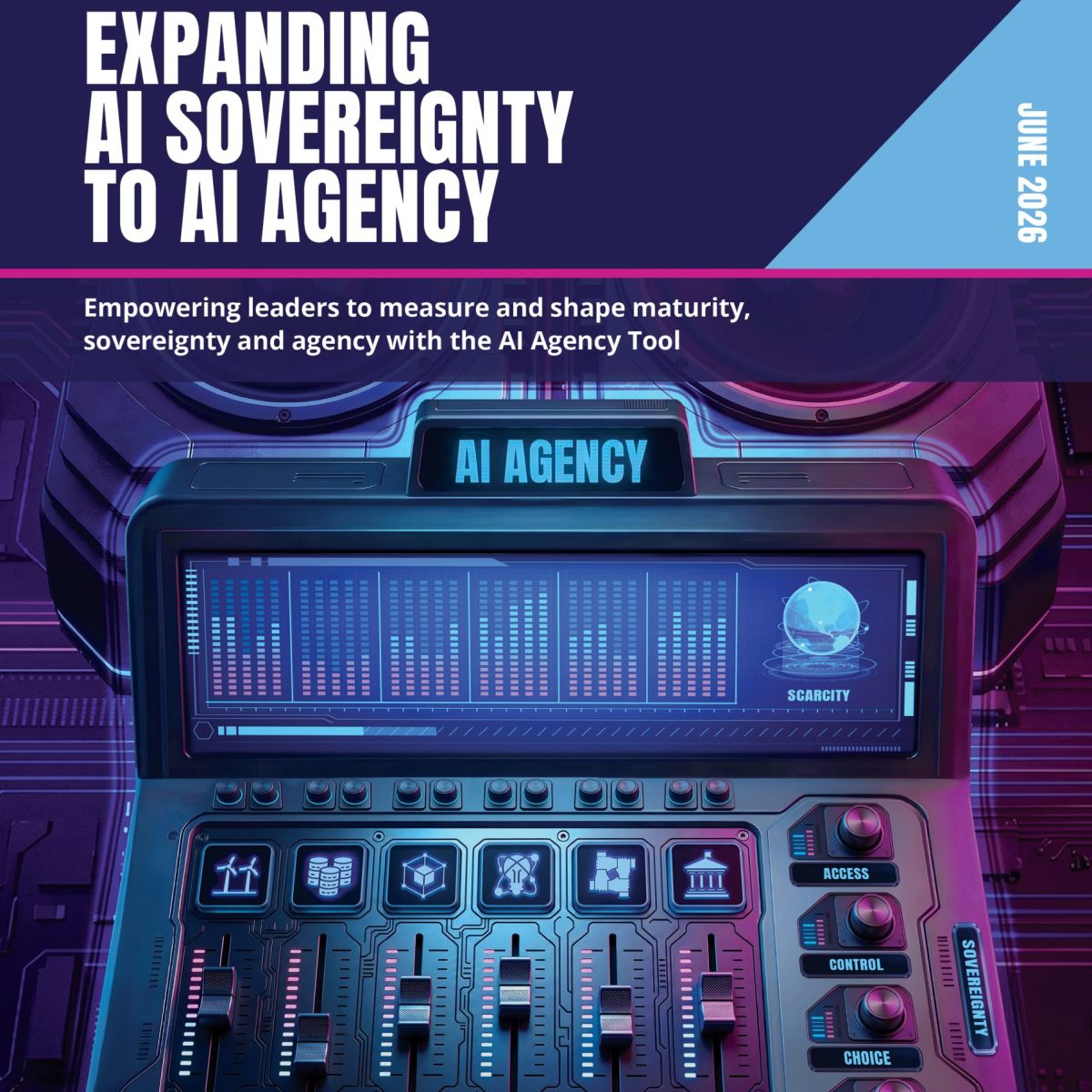
The first independent scorecard of Australia’s AI capabilities finds Australia has more AI potential than Australians think. Expanding AI Sovereignty to AI Agency is released today by the Tech Policy Design Institute.
Canberra, Monday 15 June 2026: New research reveals for the first time where Australia could lead the world in capitalising on the AI opportunity.
The report released by the Tech Policy Design Institute (TPDi) titled, Expanding AI Sovereignty to AI Agency, delivers Australia’s 2025 AI Assessment – the first comprehensive, independent, evidence-based assessment of Australia’s AI capabilities at the national level.
The report broadens the conversation from AI Sovereignty to AI Agency, which is the power of a country to shape its AI future.
Developed in consultation with more than 250 experts, the Assessment measures Australia’s agency across 103 distinct AI capabilities, then maps the findings against the Australian Government’s 2025 National AI Plan.
“The debate about AI sovereignty has become trapped in a choice between complete self-sufficiency and complete dependence. This is a false binary. The reality is that the AI supply chain is a complex global web, every country relies on others,” said Johanna Weaver, TPDi Co-Founder and Executive Director.
The research finds that while Australia has predominantly emerging maturity in AI capabilities, the national picture is far stronger than the prevailing narrative suggests. Australia holds very high agency in eight capabilities, high agency in another 58, and low agency in only two.
“The data shows Australia is in a stronger position than we give ourselves credit for, we have firm foundations and significant potential to harness,” said Zoe Jay Hawkins, TPDi Co-Founder and lead author.
The report argues that no country can or should try to excel in all 103 AI capabilities.
“The assessment allows us to understand our strengths and more deliberately leverage them to fill our weaknesses. Australia has valuable cards in its hand. The opportunity now is to play them strategically – just like the Prime Minister has leveraged Australia’s gas reserves to secure diesel supply.”
Critically, the areas already prioritised in the Government’s National AI Plan are evidence-based, but there is still work to do.
Every significant commitment in the National AI Plan aligns with the evidence on where Australia should build, leverage, or maintain its competitive advantage. The plan leans into genuine strengths – data centres and enabling infrastructure, public cloud, general AI applications, government and small-business adoption, and international engagement – harnessing existing capabilities and delivering benefits that ripple across the whole of society.
The same evidence base reveals where Australia should double down to better leverage other areas where it leads.
“For example, leveraging our potential as a regional data centre hub to help fund Australia’s clean-energy transition.”
“Or using Australia’s unique wealth of critical minerals to secure our supply of the advanced AI chips required to power our future economy.”
“Or by leveraging Australia’s data assets, some of the richest in the world, to deliver better emergency management and health outcomes for all Australians,” said Hawkins
Where Australia leads
Australia holds very high agency in 8 of 103 capabilities. The eight standout strengths are: Strategic and critical minerals; Medical data; Geospatial data; Environment and resources data; Demographic data; Infrastructure data; Model development in computer vision; and International influence and norm-shaping.
Of the eight capabilities in which Australia holds very high agency, two are backed by significant commitments in the Government’s Plan – geospatial data and international influence. The Assessment flags the remaining six as areas for the Government to prioritise next, either through more investment or greater coordination.
Investment in public sector and public interest compute; inclusive and discerning AI adoption; culturally and nationally inclusive models; and regulatory oversight were among the critical gaps the Assessment identifies for prioritisation.
The report stresses that not every gap is a failing: many capabilities the Plan stays quiet on, such as manufacturing AI chips or building frontier models, are areas where the Assessment finds Australia has a low competitive advantage.
“This research allows decision-makers to understand the full chessboard of AI capabilities and make decisions about which to prioritise in the national interest, based on evidence rather than spin,” said Hawkins.
About Tech Policy Design Institute
TPDi is an independent, non-partisan think tank committed to advancing best practice technology policy in Australia and globally. Based in Canberra, TPDi collaborates with all stakeholders in the tech ecosystem. Our mission is to shape technology for the benefit of humanity through rigorous research, innovative education, evidence-based public commentary, and community building.
About the research
Expanding AI Sovereignty to AI Agency introduces the AI Agency Tool – a structured, repeatable method to assess national AI maturity, sovereignty and agency across 103 capabilities in six layers of the AI ecosystem. The tool was developed in consultation with more than 250 experts across government, industry, research and civil society. Its first application, Australia’s 2025 AI Agency Assessment, draws on peer-reviewed research, public data and a national consultation roadshow, and is mapped against the Australian Government’s 2025 National AI Plan. This independent research was supported by the Australian Computer Society and the Department of Industry, Science and Resources. All outcomes reflect the independent views of TPDi and the authors. The full report and Assessment are available at techpolicy.au/aiagency.
In the media
- Australia has valuable cards to play in the AI future, but critical gaps remain, new report finds (ABC Business)
- An Anthropic cloud hangs over ‘sovereign’ AI policy (InnovationAus)
Insiders On Background 13 June 2026