
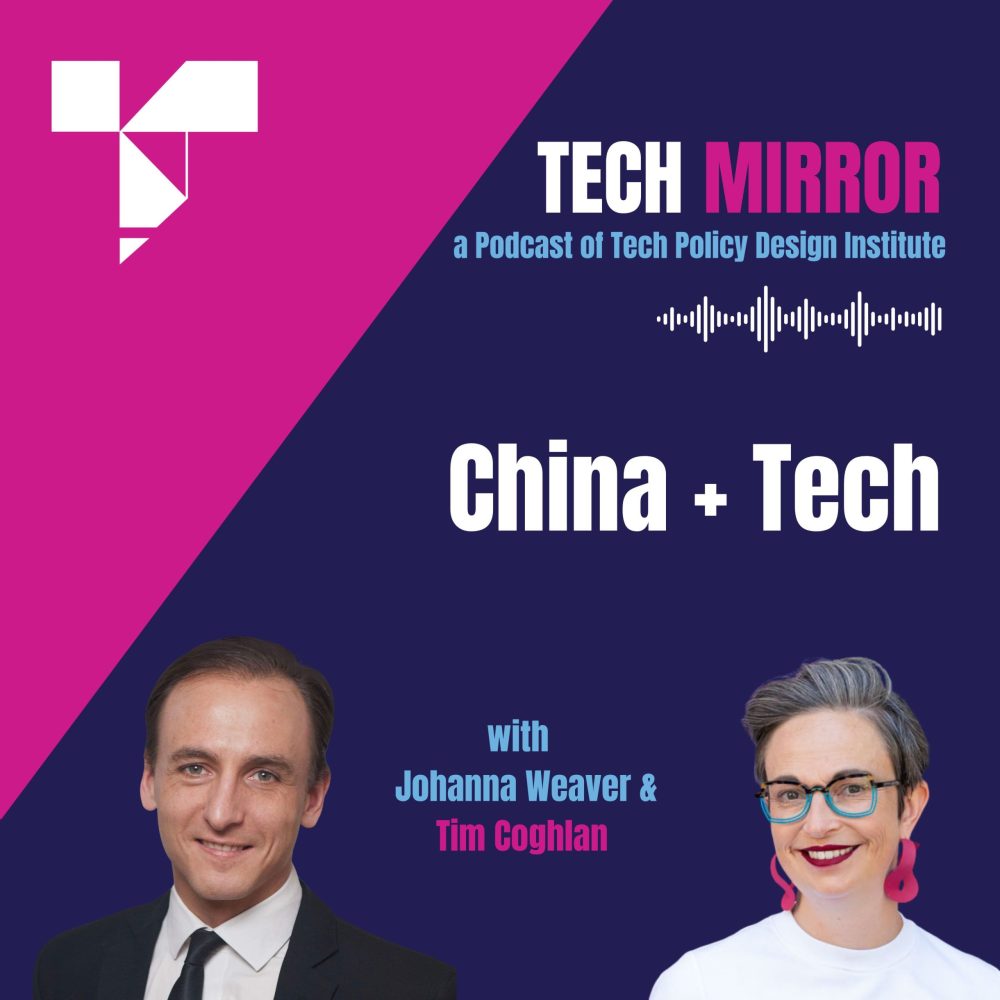
In the next deep dive into tech and geopolitics, Johanna Weaver sits down with Tim Coghlan, an Australia global tech and China economy analyst living in Beijing.They talk about geostrategic competition, from the perspective of China. Tim talks about how China has embraced AI, even down to the neighbourhood running track. From China’s strengths, to its vulnerabilities, Tim and Johanna discuss how China is moving forward as a major tech power, how its approach contrasts with the US, and what this means for middle powers like Australia.
Links
Tim’s USSC article: https://www.ussc.edu.au/intelligent-everything-china-s-policy-to-supercharge-ai-adoption
Lowy Interpreter Article: https://www.lowyinstitute.org/the-interpreter/real-ai-gap-between-china-west-isn-t-chips-or-models-stories-we-tell
Kyle Chan’s Substack: High Capacity: https://substack.com/@kyleichan
Jordan Schneider’s Substack: China Talk: https://substack.com/@chinatalk
For transcript and full show notes visit techpolicy.au/podcast
Transcript
Johanna: The Tech Policy Design Institute acknowledges and pays our respects to all First Nations people. We recognize and celebrate that among many things, Indigenous people were Australia’s first tech innovators.
Welcome to Tech Mirror. I’m Johanna Weaver and on this podcast we talk about how technology is shaping our world and how we the humans can shape technology back.
And today’s episode is the second in a dive that we are doing looking at tech and geopolitics because I think it’s very, very fair to say that there is a lot going on in terms of international geostrategic competition right now.
And to help us understand this from a Chinese perspective, our guest today is Tim Coghlan.Tim is an Australian living in Beijing, and he’s a global tech and China economy analyst.
So Tim, let’s start with how on earth did you come to be an Australian speaking fluent Mandarin, living in Beijing, focusing on these issues?
Tim: So the way I suppose I like to describe it is chasing cool, or I suppose chasing where the action is and it’s kind of a winding path that got me here. But, I was lucky to travel around Asia, as a teenager. So Thailand, Japan, and, and Hong Kong. at the time I was into kind of pop culture, so sneaker collecting and Jackie Chan movies and going to these big dynamic cities was just amazing ’cause like you could get the best better Nikes that no one in Australia had. And so I got into Asia that way.
And then China specifically, I suppose through kind of kung fu movies. And I thought, I didn’t wanna live in Australia the whole, my whole life. So what makes sense to develop a career in Asia, specifically China? and it seemed at that time, kind of early two thousands, it made sense to study Chinese and economics, you know, with China’s potential rise. So I did that at ANU a double degree, Asian Studies, Chinese and Economics. I did a year in China studying Mandarin with ANU. And then I didn’t wanna work in Australia after graduation, so I literally bought a one-way ticket to Asia. Spent a bit of time in Japan and China, and kind of never intended to stay this long, but I’ve been here for 16 years now.
Johanna: I love that. Buying a one-way ticket, that’s a pretty firm way to demonstrate your commitment, isn’t it?
Johanna: Part of the reason that we’ve reached out to you to be on the pod today is ’cause you wrote this really fabulous piece, with the US Strategic Studies Center, who are based out of Sydney on China’s AI action plan.
So what stood out to you in that plan, which was released last year?
Tim: I mean, so it’s a multifaceted plan and it comes out of the central government. So really it, it’s a core policy piece, which is essentially a directive to every institution in the country on how the central government is thinking on AI and China as a whole. So it’s kind of a whole of nation or a whole of government directive on what to go about and doing. and it comes kind of with the backdrop of the US also releasing its own plan. It comes on the backdrop of kind of general geopolitics and also how China addresses its tech sector. and with a kind of background to understand, China regulates its tech sector quite heavily.
And including back in 2021 there was quite a stringent crackdown on many areas of the tech sector. and so what that leaves is bits of the economy and tech, are a little bit weary of another crackdown. And so the counterbalance to that is the government saying, look, this is our plan, this is where we see it going, and that kind of gives a bit of free runway as long as you’re in line with that plan, whether you’re a business or an organization to just go with it and run with it.
So, that’s kind of a signal to the market that AI and tech is a okay place to go for it.
Johanna: And so we’ve now seen the five year plan that came out earlier this month There’s a lot in it, it’s not a dedicated technology plan, but it’s sort of so central to it.
Can you talk us through some of those, the central pillars and how it fits with and mirrors with the AI plan that came out last year.
Tim: Yeah, so I think the general direction of them are the same in a sense, although, as you said, the five year plan covers tech, but also multiple other things. But within the five-year plan on tech, I think it gives more specific direction on what is expected to be achieved. Whereas the initial AI plus plan was a bit more, light on specific direction.
So again, it’s kind of a whole of nation or whole of government. And the five-year plan very much ties it to the economy. I think China’s identified that tech or growth through technology, including AI, could be a key driver for China, economically, both,domestically, and potentially abroad.
And given that China’s economy is now coming off decades of high growth, a vital issue for the Chinese leadership and government is how to stimulate or maintain economic activity. So now technology’s being used as that. So in the plan, there’s specific things like AI and tech should be used, within the production. And so that has things like automation or implications for every sector to get AI into the means of production. And then kind of China’s digitized its economy, and essentially the country, and now it’s like, so now we’ve digitized, how do we actually implement that and get it to deliver good for the citizens?
And then there’s other things like increasing international talent or immigration to come into China’s tech sector and also China wanting to have an influence on AI globally. And more of a kind of a sayin the whole world’s adoption and rollout of technologies.
Johanna: I think you are uniquely positioned to answer this question, in the sense of when an Australian hears of that level of coordinated plan and direction from government, right, one of the things that we’ve advocated for, for a long time is that we have sort of coordinated technology, policy focused focal points within the ministerial level, but also in the public service, here in Australia.
And then you sort of hear this Chinese approach and obviously there are pros and cons to this type of centralized government, but how does it actually translate in practice? Is it magic? Do you now see everyone kind of falling into line behind it? ’cause I often think it’s a little bit overestimated, the impact that it has, but in the same time probably underestimated in other areas.
So where is the over and underestimation sitting?
Tim: So I guess the way I read it is kind of what I see out and about when I’m in my daily life. And especially I guess in physical tech and physical AI applications that you’re using every day or things that are new and I’m seeing is where I kind of see it play out and a fair bit of that is hit and miss.
So I’ll give you just a few examples. So in the park near my house now where for 10 years I’ve been running around the track. Now the track is an AI track, so it’s been set up to monitor people’s running around it. You have to register, but then it can track your kind of running every week and then start to give you feedback through an app on your exercise and running.
And so, you know, that’s someone at the park level like, like, okay, AI’s a thing to do, how do we do it in our park? And so it’s kind of a direct, at some degree of the government issuing a, this is all good, go for it on AI and landing into actual something you see every day.
A second example would be, I was talking to a university recently and they said to me, look, now we’ve decided our good idea is to go and train as many high schools we can on AI adoption. So they quickly hired some salespeople and started going out and meeting lots of high schools to then deliver them training. And that speed was like quick, within a month they were up and running.
And then kind of where the miss is, the other day I was in a mall and there was a yogurt shop and they were now branding their yogurt AI conceived, and that’s the absurdity – or smart if they’re following the trend of marketing.
But that’s kind of the level it gets to where a lot of organizations and private companies will just start to do AI whatever they can and some will hit and some will miss.
Johanna: I’m just fixated on the running, like you have to opt in for that, or is that something that now like everyone running in the park.
Tim: No, no. So you have to opt in. So there’s a screen in your register and it actually takes a photo of your face, and then there’s cameras around the park. So it’s doing it through facial recognition. and so yeah, you absolutely have to opt in. And I haven’t tried it, you know, for me, I’ve got my Garmin watch, which is fine.
But for me it was just a good example of someone’s thought up this, and whether it is practical or not, at least they’re having a go. So I appreciated the having a go implementing AI nature of it. Yeah.
Johanna: Yeah. Yeah. And so, I appreciate your focus is on economy and technology adoption. I think immediately when you give some of those examples, my mind goes to privacy and protections and human rights and all of these types of things. So, you know, with the caveat that it’s not your field, how do you balance that in the work that you do in China working on these issues, you’ve written before about the long-term planning and the benefit of being able to do that without the disruptions of election cycles and changes in government. So how do you thread that needle?
Tim: I mean, I’m certainly very cognizant of all the myriad ways that technology is used in China. And there’s a lot of that, and that’s spoken about the kind of the, the good advantageous side and the somewhat perhaps, less optimal side of things for certain parts of society. And so I’ve chosen, and specifically because I’m a trained economist and I’ve worked in kind of business looking at kind of China and the world from a, the word I like to choose is interoperable. So how does China interoperate with the world, the world with China point of view? And so I’ve kind of decided to focus my analysis and efforts and what I, I share about, in public forums, on the kind of economic analysis and, and these parts of it. And some of those kind of more specialized subjects.
I prefer to leave to, more informed, experts.
Johanna: And so, picking up on the areas where you focus in on, we spoke on the last episode to Martijn Rasser from the US Special Competitive Studies Project. And they’ve just started releasing tech scorecards that are comparing the US and China technology competition. And they’re measuring it across these five areas around innovation, leadership, and industrial capacity, market ecosystems, talent pipelines, and national leverage.
So when you’re looking at this from an economic analysis perspective, where do you see as China’s strongest advantages when it comes to technology and I guess AI more specifically, but recognize the many manifestations of that.
Tim: Yeah. So I guess to take this with a few different lenses, one thing that I see underlying all of those different pillars that you mentioned, and I, I had a look at that study, is what China has, which is so powerful, is the population and the labor force. And so what do I mean by that?
So partly it’s, the population is very big, but there’s, you know, there’s 12 million university graduates every year. And so you compare on scale to any other country, you have a relatively high educated population. And you also have population pressure, which puts people into a system of kind of competing with each other for jobs.
Which also means, and this is kind of Confucian comes into this and different elements of culture, that people will tend to work kind of very, very hard or at least long hours in these kind of tech companies or jobs per se. and there’s competition for those jobs, so you, you will work hard at them.
And then just the sheer amount of the working population, you can apply brute force to a lot of these issues, whether that’s kind of a fleet of people working in a factory, making tech gadgets or a fleet of engineers in a company coding out a problem. You’ve just got this workforce that is capable and can be applied to any manner of technology problems.
And, you know, I thought a bit about China’s role and Confucianism in that, and a little bit of the history of China’s economy, you can see that it went through Japan and it went through South Korea, and then onto China. And part of that is kind of a Confucian work ethic, in those countries. And China’s the last one to have developed through that.
Johanna: So that’s something which I see I think affects manufacturing, kind of AI model development, all of those different things, which is China’s really powerful thing it has. And when you say Confucian work ethic, is that the, like, I’m gonna show up and I’m gonna work hard and I’m gonna do the long hours, or is there more to what that term encompasses for you?
Tim: So I guess for me it means a few different things. One is I’m probably gonna do what I’m told, and China has a hierarchical system, so as the kind of directives come down I’m gonna follow instructions and do what I’m told to get this project done. And I worked in Chinese tech companies and that’s what I felt.
It doesn’t mean everybody’s kind of purely robotic and, there’s not a discussion around things there, there certainly is, but, the directive is set and you, you follow the directive. I think also in terms of kind of the family makeup, what I’ve realized in, in Chinese and somewhat Confucian families is that a lot of the time the grandparents will take care of the grandchildren, allowing both of the, working parents to be at work and,that kind of mid-age demographic of people powering the economy along. And I don’t think that happens in so many other countries where you’ve got generational support for the family, which enables the workers to do work.
I think the other thing is there is a bit of a degree of, perhaps isn’t the best word, but an ability to suffer through hard work and long hours of study. And the Chinese education system certainly drums that into you that you’ve gotta study hard and long hours and it is a bit of suffering so that by the time you’re in the workforce, you actually are built to, I guess suffer, whether that’s on a production line or coding all night.
I don’t see so much of that in Australia. Not that Australians can’t work hard, but it’s a little, there’s a bit of nuance in there.
Johanna: So Tim, if that’s the strengths that China brings to it, what are some of the vulnerabilities that you see in the China supply chain and I guess the efforts that they’re taking to reduce those vulnerabilities. And, you know, the obvious one here is the chips or the accelerators, but I’m sure there are others.
Tim: Yeah, so I guess in terms of stuff, and what China needs in its supply chain on, on the very kind of initial input level, there’s things like the critical minerals. And this became an issue last year, both with the US trade war, and China’s willingness to supply certain elements or minerals, I believe, to the US.
And it’s also where Australia fits in, ’cause Australia has a critical mineral supply that, that China takes. So there’s issues around critical minerals, and then there’s other inputs such as the semiconductors or chips, which have also been under trade restrictions, particularly from the US which has the best chips.
And so China’s worked to more securely shore up its supply chain, given its restrictions from the US and there’s been measures put into place such as really championing Chinese domestic firms, or organizations to try and build their own kind of chips and that’s kind of deep, deep tech and hard.
And so there’s multiple companies working on developing a China cutting edge chip, And for all kind of analysis shows that they’re getting better, but they’re behind the US.
There are other vulnerabilities, I think I see further down, I guess, the Chinese tech delivering to the world stage where I think Chinese citizens lack some of the kind of soft skills when it gets to implementing tech or selling tech to other countries. And one example is like I’ve heard, the after sales service for Chinese electric vehicle companies in Australia is quite poor.
I know from my experience too, that when it gets to that really final stage in market delivery, there’s kind of soft skills, which, I think China in general could improve on over time.
Johanna: Mm. And I, I mean, I think that’s so interesting, the point about the soft skills because, you know, it used to be that, some of those soft skills were something that US companies or US diplomacy, for example, could bring to the table and certainly far less so now. And so as a point of comparison, arguably that competitive advantage is being lost.
And people go, oh, soft skills, why does that matter? But, I’m fascinated that was one of the points that you pulled out there.
Putting aside the soft skills after sales things, what other differences is there in the approach that China takes to AI development compared to other countries like the US but maybe also Australia?
Tim: I mean, given that China and the US are clearly the dominant players in the AI space, a lot of comparison first happens between those two. And for example, looking at their AI policy papers, which both the US and China put out last year, there were stark differences in the language. So if you just take it on the language, the US policy is actually titled AI race, I think it’s race is in the title. And clearly it’s a race with China. And then, so a lot of the US language is talking about developing AI capability for the US and US allies or protecting US companies. So it, it feels like it’s the US and it’s gang of mates, so to speak. In terms of China’s language that they use on their AI policies, they don’t label it a race, although I’m sure they’ve done the analysis on where there is competition.
And then kind of beyond what’s written in the policy documents you see how at least the countries talk about it, and I think China’s, partly as the taking the opposite road to the US, talks about AI a little bit more in terms of a global public good, or how will AI and technology benefit humanity?
How can we involve the world, including the global south at a discussion on AI and global governance? So that’s the national policy levels, a little bit of difference. And in China, it very much comes from the central government. I don’t think, there’s not that I’ve seen at least it may exist different kind of state or provincials working on their own AI plans.
They probably follow Central a lot more. And then in the way I guess the big tech firms operate. So the US AI companies, open AI or the Googles or the Facebooks, they always kind of go ahead and develop their own AI and tech, which is then IP protected and, and their kind of assets than the US is working in tandem with their companies. Whereas the Chinese companies, because they’re more susceptible to regulatory environment from China, they kind of go a bit more in tandem with what the government’s thinking. And then also a lot of the Chinese, AI models are, are open source.
And so that’s something that there’s a stark difference in the models of the AI agents.
Johanna: And you referred to there too, the Chinese domestic regulatory environment. Can you talk us through the key ways that China is actually regulating AI? ’cause one of the most common questions I get when I go and talk to politicians is, which country is doing this well? And I always say, you’re not gonna like the answer that I’m about to give you, but it’s China, right? They’re the most effective country in the world at regulating artificial intelligence.
I know that’s a huge question. So if you just pick out a couple of policies that they have, what would you highlight as being, maybe particularly effective?
Tim: So I guess on the very kind of upper level, China has fenced off its entire internet from the world the Great China firewall, and so non-Chinese apps, whether they’re functional in China or not, it very much depends whether China allows them to operate.
So most of the big 10 companies, Facebook, Google, are all, generally not accessible within the country. And so China has its own foray of tech companies and apps, and so China’s got its very own domestic tech ecosystem for everything, whereas the rest of the world tends to be connected to the US.
So that’s kind of a very top layer. And then because the Chinese central government does have so much power and control over everything that happens in the country, including tech, their regulatory ability to determine what can and can’t happen, what they will or will not allow is very, very strong.
So if they don’t want something, they will kind of give signals not to venture into that territory anyway. Although they certainly sometimes let technologies develop and see how they do that, and then at some stage, step in and kind of decide, we don’t want it, we’re gonna shut it down, or this is how we’ll let it play out.
So the central power is absolute, I would say, to, to determine what can and cannot be used.
Johanna: And, I know Trump’s visit, it was going to be happening imminently. It’s now been postponed for a while. But you’ve spoken there a little bit about the difference in US tech companies and how they work with the government and, and Chinese tech companies. It’s been really interesting to watch when Trump did his big visit to UAE and other places. How many of the tech bros were in the delegation, really looking to expand trade opportunities, for those visits. What do you think will be the major tech topics that come out of Trump’s eventual visit to China?
And are you anticipating that we’ll have as many of the US tech companies traveling as part of that delegation, cognizant that many of those companies are really chomping at the bit to get into the Chinese market.
Tim: So absolutely. When Trump was doing his delegations to the Middle East, you saw Nvidia, you saw OpenAI, Microsoft, the CEOs were all there. And a lot of that was around data center investment and ai.
So the only CEO I’d envisage maybe with Trump from the tech firms would be Jensen Huang from Nvidia, ’cause Nvidia on the semiconductors has a huge business in China. But I’m not sure that that Jensen would need to be with Trump on that trip. He’s actually in China very, very regularly anyway, and, and you know, he pops up on social media eating noodles down the road. So I, I think, uh, that, that kind of business is happening anyway.
I don’t at all think that the open AIs and the AI agent models will be looking to do business with China. One ’cause I don’t think China will let them in. And I think they’ve strategically assessed. That they’re not gonna do China. In fact, their business model is the non-China version.
And so actually you see them going to Singapore, into South Korea, Australia, almost everywhere, but not China. So I don’t see that happening. I guess the other areas, Trump being a deal maker, maybe looking to do deals. I don’t see any clear announcements coming out of his visit. Probably I’d expect more like, look, we had a discussion on chips, it’s all gonna be fine, we’re working on it. We had a discussion on tariffs, it’s all gonna be fine. Maybe the TikTok issue where China would need to give, I believe, approval to release the algorithm for TikTok to be separated from bytedance to become a US entity. I think that’s still a pending issue.
Those I think are the main things. I don’t see specific new deals being done on, on that kind of trip between China and the US.
Johanna: And given the reason that this visit has been postponed, is the current war that’s, some are referring to it as the Iran war. How do you think that is going to change technology competition? So, I’m thinking here about like, we’re seeing data centers being attacked, the centrality of drones, or even, the demand for electric vehicles as the fuel becomes even more of a global commodity in demand.
What, what are the trends that you are seeing in that space from a tech and competition perspective?
Tim: So I guess the first one, which the Ukraine War kind of started with, but has now been backed up with, with this so-called Iran War is the shift in warfare towards the usage of drones. And China for sure is the leading maker of drones in the world, particularly one company, DJI. And actually the Iran war has changed what I thought would’ve been true, which a lot of war drones were Chinese made.
And that seems to be not true at all. And in fact, the economist had a, a short YouTube video out on this yesterday that Iran is making a lot of its own drones. And I think the Ukraine war, like the, the making of your own drones as an arsenal, I mean, you could 3D print the things these days. So that has also shown me that there’s a certain element of hardware tech, which I assumed would’ve had to be China made, which isn’t. So it’s changed my assumptions a a little bit on, I guess, China’s dominance in things. Certainly on data centers. There was an Amazon data center got hit by a missal or something, and so a kind of a sovereign tech capability, if you’re a country in the Middle East and you’ve adopted US hardware tech for your data centers, and then they come under attack in a Middle Eastern war, it would be smart to then want to hedge and also have non-US data centers.
And also then it ties to the business interests of us and Chinese in the entire region. Chinese tech companies have been going into the Middle East, things from self-driving cars, drone delivery, I think data centers and cloud services too. So it kind of creates, again, it’s the two main superpowers playing in the region for tech. And how does each country then think through those and, and be safe and hedge for the future.
For Australia, kind of most important that I saw that came out of this is the second that fuel prices rose, or started to rise, even hinting and kind of fuel gouging and storing up fuel. And then thinking about the National Transport Network in Australia, which is very kind of semi trailer truck and diesel dependent, kind of my mind went to, well, how do you hedge or solve that? And well, of course, electric vehicles and, well, that ties back to China, who make the best and cheapest electric vehicles.
So I’ve also read that in Australia, there’s suddenly a surge of interest in electric vehicles. So then how does Australia adopt that or how does it affect the whole industry, I guess, is yet to remain seen?
So Tim, we’ve talked there about all of the different geopolitical forces. You’ve written that for Australia, there’s no escaping being wedged between China and the United States on technology and on AI.
Do you think that there is anything that Australia can do to change the tech landscape in interesting ways? Or do you feel like this is just something that US and China competition will continue to dominate and be the main feature?
Tim: So I think the answer is, is yes to both China and the US will continue to dominate for decades, if not forever, in tech. And I’ve thought about which other countries could potentially emerge to that level, I don’t think there are any. Although it doesn’t mean it’s, it’s end game and, and nothing worth, kind of exploring.
There’s certainly other countries with good capacity to develop tech, both software and hardware. Probably the manufacturing is very hard to outcompete China. But there are countries like India, who again, have a strong population, a large population, an educated workforce, are good at things on tech.
So I’d say probably India is another one that could emerge. European countries, there’s some in there, which are sophisticated enough to build out tech. Then I’d almost tied again back to where’s the workforce and how fast can they go at that to keep up with the world? So part of that depends.
But uh, yeah, China and US are, are way out in front.
Johanna: And so with that in mind, if you were advising the Australian government and they’re thinking about China’s interests in expanding technology partnerships in the Indo-Pacific, what would you be advising the Australian government to be thinking about?
Tim: So there’s certainly a nuance in that area and what the Australian government should be thinking about in terms of technology and the economics of the region and trade and national security and that’s what I kind of see is where the two issues kind of clutter on each other, is it’s economic decisions versus national security decisions.
Any other country will also have these decisions between the China and the US, but particularly I guess in, in the Pacific, the issues for those countries when it comes to the economic costs of adopting new technologies, whether that’s data centers or 5G networks or like what AI models they allow in, they’ll also have to consider the economics where China may well offer the cheapest solution. And technologically the Chinese solutions are great. Versus potentially a US solution, which would be more costly. and how deep are the US tech companies gonna be interested in deploying their tech in country beyond kind of the big, mega countries. ’cause the US tech companies are also, they’re chasing the money – they’re, they’re financially driven. So Australia and potential allies will need to consider how they want to go about supporting, financially or through investment or work with Pacific and countries, to have influence in that sphere.
Japan, the US and Australia invested in undersea internet cables running through the Pacific and to Pacific countries. So that was a one way where there was multilateral cooperation for a technology that Australia saw in their interest in, in the Pacific.
There’s other things kind of middle powers can unite on, more globally to try and figure out, which is the kind of things Mark Carney’s been talking about lately. There’s some good theory of what could be done there, but then the practicalities of of doing it are challenging.
I think in the Lowy interview, Mark Carney i gave, he said, look, we’re talking to India about AI. so maybe again in the Indian example, or it could be another country, maybe if there’s a group buying methodology of a few different middle powers who said, India, look, can you build out our AI? We don’t want the Chinese one, we don’t want the US one, we need a third party one. It needs to be a nation state building it because if it’s a private company, they could just be acquired or, or sold. I think that’s a good theory. Whether or not you can find someone to, to build it out for you or a country is, is really tough.
Johanna: It’s interesting how much of a conversation there is around, a third option, being built, by a coalition of like-minded countries, which I find, you know, obviously that’s heavily influenced by Kearney’s recent visit. It’s interesting what people focus in on, and I think there are probably other areas where we can be much more effective and impactful as middle ground countries working together.
I was super interested when you referred to that, Tim, that you’re talking about economic and national security decisions, but you didn’t refer there to social. So how do you see that fitting into the choices that countries are making? Or, recognizing that these technologies, it’s not just the economics, it’s not just the national security decisions, it’s actually about how these technologies are being embedded in our societies and reshaping what they look like. And the reason I think that’s important to me is because I think that’s actually again, where some of Australia’s power lies in that often middle ground countries or countries in our region will kind of look and say, okay, well the Chinese tech is cheaper, and the US tech comes with, you know, different, strings attached, and we have these concerns. but the societal impact and the way that, Australian technology, responsible technology, this being kind of an opportunity for Australia in the region.
Tim: Firstly, I, I’ve skipped over kind of, because tech is so broad, when I’ve been generalized to US China, and certain techs and this and that, there is other tech out there, both software and hardware that Australia does well and certainly makes this conversation more nuanced, I guess, if we had time to dive into those.
I mean, Australia’s leadership on things such as the minimum age for social media. which is a government regulation and an app usage issue. Thinking from how society’s adapting technology, I think definitely there’s ways which Australia can punch above its weight and have a stronger voice in the global community, on issues such as that.
Johanna: We’ll unpack these issues a little bit more in the next episode where we’re gonna bring together a bunch of middle power countries to talk about what that practical cooperation might look like. So, let’s go back and have a look at the difference in the way that the US and China are talking about global AI governance.
I find this, just incredible to watch that we have China putting out their global AI governance plan at the mid last year where they’re talking about, you know, seizing the opportunity and innovation and empowerment and energy and environmental issues and, international law and norms and AI safety, kind of all of the things that you would actually expect to be pretty standard in any, us or, or like-minded country’s policies. And then you have the US approach at the moment, Michael kras, the head of the US Office of Science and Technology in the India, AI Safety Summit saying, you know, AI safety just gets in the way of innovation and US doesn’t believe in global governance, and that has been misquoted and misreported.
He then does go on to talk about how we should domestically regulate, so it was kind of saying global doesn’t work, you need to do it local. But really stark contrast and kind of a big flip, in the two countries’ positions.
So how do you think we should be thinking about or, interpreting Chinese statements about the importance of global AI governance?
Tim: So the, the way I take it is from a few different points. One, I think China has risen in its strength in the world enough, it’s had practice, so to speak, of the last few decades. Now it’s big enough and confident enough in its place in the world that it can now go out and start leading and suggesting global initiatives.
I think previously China was, China’s still very domestically focused on its issues, but it needed to first get its house in order, so to speak, before it was really willing to go out and lead in on a global stage. and that’s kind of something I’ve seen over my 20 years engagement with China, is that change.
I think the other is, I suppose the void that has been created with the US has changed in direction, has given China a natural step into that space. And so whether that would’ve happened if the US hadn’t changed direction or not, perhaps it would’ve happened, but to a lesser degree, because China is clearly seeing itself as now the partner to be trusted or the stability partner for the world.
Certainly with the global south, China sees itself as the, of the only two middle powers who cares about the global south, and is naturally just taking a role. And that’s also very strategic for China, China wants the global south and as much as the world as it can to be on its side, or at least not against it, including in the Middle East, and that’s unfolding with this current crisis. And so I think how much it was kind of pre-planned by China or they’ve seized the opportunity. I think they’ve played it quite well.
Johanna: So reflecting on my time at the UN, I mean China’s been putting forward global governance policies on AI or technology to varying different degrees for a relatively long time. But I think the difference is, they were received with a lot of skepticism and the US proposal was received with far less skepticism. And now you’re kind of seeing the Chinese proposals having a lot more credibility behind them because people are looking to the US and saying, well, you might be saying that, but you’re not sort of walking the walk as well as talking the talk. And so there’s that credibility piece.
And of course, that’s so important because the global south is also where the majority of the population is gonna be. It’s where a lot of the technological development is happening. And so again, it’s about, this is not just, how the technology is reshaping, the way we live and work and all of these things.
It’s actually reshaping global power dynamics because you’re seeing these shifts happening.
So in that context, let’s look at those power dynamics a little bit more closely. How would you describe the current relationship between the Chinese and Australian governments?
Tim: So I guess stable is, is the easiest answer, and stabilized particularly after, I guess the COVID period where it was unstable. And so I think the stability and increased level of trust through the stable relationship, gives opportunities to engage in other areas. and technology could be one of those, although I think it’s quite sensitive.
AI certainly is sensitive, but there’s definite ways or areas such as with, you know, climate change AI or health management AI, where I would like to see areas of cooperation, I certainly commend the current government for its discipline on communications around China.
And I think that’s very important, when you are conducting this kind of diplomacy that everyone’s aligned, everyone’s on the same page, and so China’s not kind of hearing different people here and there saying different things on the nightly news. So I commend and, and think that has been the right trajectory, for the relationship.
Johanna: So if you were gonna correct one misperception, or if you’re thinking about, you know, what you wish Australian policy makers or anyone involved in tech policy in Australia understood better about China, what would it be?
Tim: So my ideal would be that people just come to China more and see it, or I suppose, broaden the inputs they have on Chinese information. So what do I mean about that is, at least when I watch Australian mainstream news media, I would say the general amount of news on China is more in the threat space on the national security space, much less on the economic.
And then even much less on things like people to people relationships. I would encourage as many people as possible to get on the app Red Note. So Red Note is kind of a mash of Instagram and Pinterest, and if you just spend time on that you’ll start to get a feed of Chinese daily life. And so exposing yourself to more bits of China that aren’t just on the national news headlines, I think would over time, would broaden the spectrum of understanding and help wider engagement.
Johanna: Yeah, I think that level of cultural understanding is just absolutely key to being able to find the areas where you can cooperate, and build meaningful partnerships out. I think the cultural part is really important also in the stories that you tell about the way that technology is impacting on our lives.
And there was a really interesting piece in the Lowy interpreter, in the last month or so that was saying that, one of the biggest things, the difference between China and the West isn’t, the chips or the models, but it’s actually about China’s rhetoric of framing AI as a positive social good.
Does that ring true for you in terms of that, I guess the framing around messages?
Tim: Look, I, I think it does, but I mean, one aspect of that is I think just existing in China, because of the scale of the population and being in cities, you’re just exposed to a lot more AI stuff, including kind of physical AI. Like I mentioned, you go to the park now and there’s an AI running track. I don’t envisage that happening in Australia anytime soon.
You’ve got all the billboards from the tech companies, you know, even if it’s propaganda, explaining that AI is for the good, AI is now in this and that. And when I’m in Australia, I don’t see that so prominently just out and about at all.the other thing, which is again, in mainstream news a lot lately is AI’s effect on jobs, and the economy.
I don’t, at least the news that I perceive and get in China, that is a much smaller percentage. Employment is a real issue, but AI’s not leading the unemployment issue. Yep. So part of it is scale and what the population can get through the scale of China, which is different, but yes, the narratives are different too.
Johanna: Yeah, exactly.
We’ll do two final things. One, I would love to hear your recommendations. So, books, podcasts, newsletters that you recommend for people wanting to learn more about China.
And then I do just wanna touch on this really awesome skateboarding project that you have, coming up, not because it’s got anything to do with tech policy, but just ’cause I think it’s a really awesome example of building those cultural links that you were talking about.
Tim: The good thing is all world media is now covering China Tech. So in YouTube or any global outlet, BBC, Wired now has a special China edition, south China morning post. You can all get tech news from them. I do wanna give a shout out to some Substack authors who are independents and, and really know their China staff.
So one would be, Kyle Chan, and his Substack is high capacity. Another one is Jordan Schneider, his substack and website is China Talk. And once you’re on those, like if you follow the comments, everyone in the China AI watching community will be there, so you can find them. and get on Red Note because that’ll expose you to kind of China beyond the news, so to speak.
Outside of tech, so I’ve been a lifelong skateboarder and Australia is very strong at skateboarding, we have two gold medals, three now in total in the Olympics.
And so outside of tech and economics, I’ve done a fair few projects of people to people engagement, so China and Australia on people to people. So I thought up this skateboard diplomacy project where Australian skateboard and artistic and urban communities can interact with China. And I’m working with Big Heart, which is a charity in Australia, and the project has now received funding from DFAT via the National Foundation of Australia China relationship.
And so we’re hoping to this year bring up some skateboarders to China for engagements, and then we’ll do the reverse with Chinese down to Australia.
So that’s a kind of, that’s more of a passion project of, sports diplomacy.
Johanna: Tim, thank you so much for this conversation. I’ve learned so much. I’ve really enjoyed it. And no doubt we’ll have you on again, perhaps after Trump’s visit to do a bit of a deconstruction of how that goes. Thanks so much for your time and for sharing your insights.
Tim: It’s been a pleasure.