
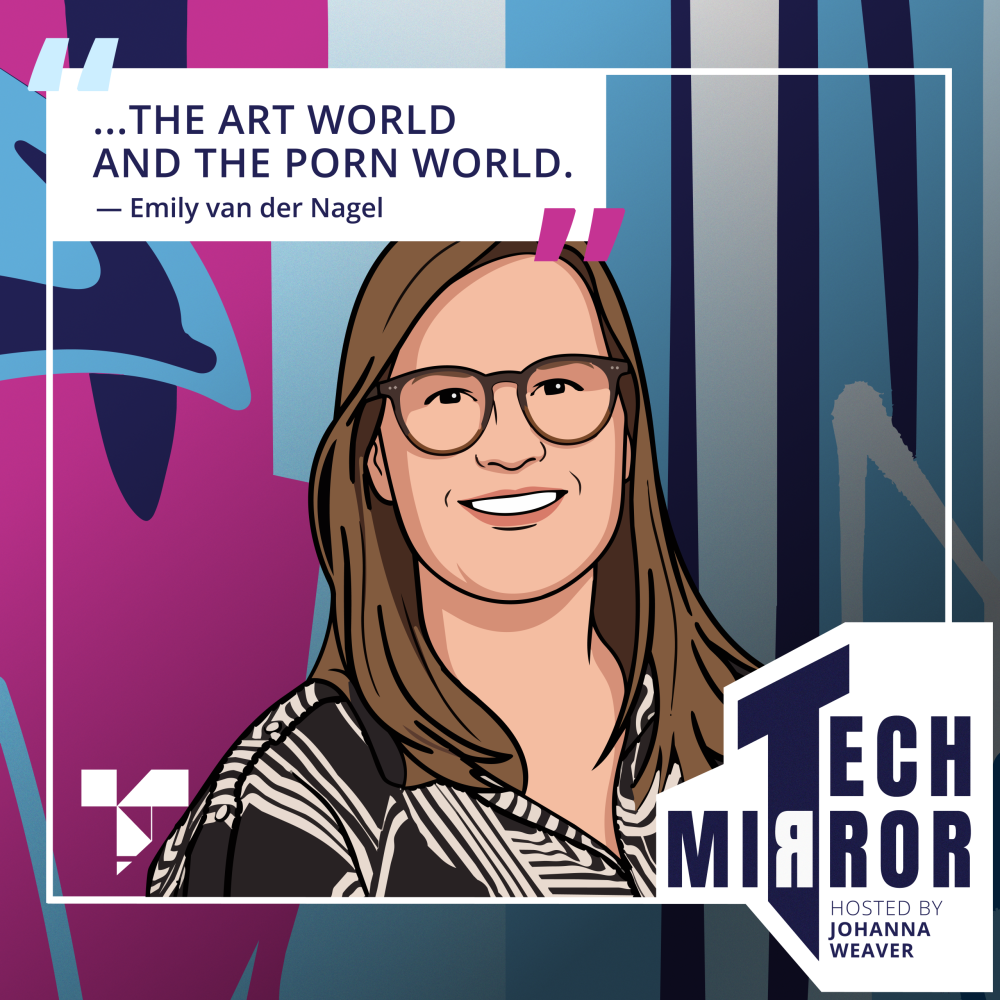
OnlyFans is often immediately recognised as an adult content platform. Yet, according to digital culture scholar Dr. Emily van der Nagel, the company sidesteps embracing the kinds of explicit material that define it. What does this mean for the creators who make their living on the platform, and for its and governments’ responsibilities?
In this episode of Tech Mirror, host Johanna Weaver and Emily explore how the OnlyFans platform design and corporate strategy shape the experiences of its creators and users. Their conversation examines questions of worker agency, platform power and regulation, copyright, the blurry line between art and porn, and what making a living through platform work can reveal about the broader digital economy and our society.
This podcast episode does include adult themes, so exercise your judgement as to if and when you listen to this episode
Links:
OnlyFans | Emily van der Nagel
Why OnlyFans had second thoughts on banning sexually explicit content | The Guardian
Competing platform imaginaries of NSFW content creation on OnlyFans | Emily van der Nagel
Digital Economy Strategy | Australian Government, Department of Industry, Science, and Resources
Transcript
Johanna Weaver: [00:00:00] The Tech Policy Design Institute acknowledges and pays our respects to all First Nations people. We recognize and celebrate that among many things, indigenous people were Australia’s first tech innovators.
Emily van der Nagel: I always think that when we’re talking about creator culture and creator economies, that we should be including adult content creators. 100%.
Johanna Weaver: Yeah.
Emily van der Nagel: I have read Australia’s Digital Economy Strategy 2030, and it does not mention porn once, and that makes me think it’s a bit of an oversight to not include some of the most profitable and the most sought-after content that content creators provide.
There are really blurry distinctions between the art world and the porn world in a lot of cases, and what counts as this or that, explicit or [00:01:00] not, pornography or art, these are deeply human questions
Johanna Weaver: Hello, and welcome to another episode of Tech Mirror. I’m Johanna Weaver, your host, and this is the podcast where we talk about how technology is shaping our world, but how we, the humans, can shape technology back. And today, I’m absolutely delighted to have as our guest, Dr. Emily van den Nagel. Emily is a scholar in digital culture at Monash University, and her work spans social media platforms, online identity, and the politics of adult content Emily has a new book out which is looking at the platform OnlyFans.
In particular, the book looks at how platform design, creator labor, and corporate strategy, which perhaps people don’t necessarily think about when they think about OnlyFans, [00:02:00] is really shaping the lives and the livelihoods of creators who use OnlyFans, but also having quite a big impact on our society as well.
Now, given all of that, today’s podcast does have adult themes. So I’ll leave it up to your judgment as to if and when you listen to this episode. But for my part, I’m really looking forward to the discussion. Welcome to Tech Mirror, Emily.
Emily van der Nagel: Thanks so much for having me.
Johanna Weaver: I think the logical place for us to start is, what is OnlyFans, for people who maybe haven’t been on the platform before?
Emily van der Nagel: It’s a great question. OnlyFans in its purest form is content subscription, much like Patreon or, or Kickstarter, for example. It’s a place where fans can go to see content that is put up by people they already know and usually love from social media. The difference with OnlyFans is that it has a huge [00:03:00] reputation for adult material, um, sexualized and erotic content, and that’s really what drives people to the platform.
It’s a, it’s of interest to me always that the uh, the comment on somebody’s Instagram post reading “OnlyFans when” is a little bit of a clue that that person might want to see more intimate content from that creator.
Johanna Weaver: And how did you, as a researcher, get into researching this particular field? Because I don’t think there are a lot of people who think that there are scholars of adult content and the platforms and the social media, and I’ve had some really fascinating conversations with you, and I love this story.
Emily van der Nagel: Um, I think getting into studying adult material specifically, you know, the not safe for work of social media, really came from the way I approached my PhD thesis, which I started in 2012. Now, that was a time when there was a real battle raging in internet [00:04:00] politics around should people on social media be allowed to be anonymous and pseudonymous.
Mm. Or should we all be using our real names? Of course, the landscape on that has changed dramatically, especially since the social media ban came into force, because it’s led to a lot more age verification systems which are in essence, identity verification systems. So when I was putting together my PhD project, I really wanted to know more about social media identities, and I found that the politics of when somebody wanted to not use their real identity on social media was the most fascinating aspect of that particular concern.
And the more I followed it, I think the more I came to really wanting to understand what drove people to Try to stay private, anonymous, and secret on the internet while still accessing parts of themselves that were actually really genuine and [00:05:00] really authentic. And I think the adult space is just so crucial for that.
It’s such a good case study for me as a researcher to explain that sometimes people work really hard to compartmentalize their identity, not because they want to bully other people, or they’re up to no good, or they’re doing something they shouldn’t, but simply because our intimate, and private, and sexual lives should be compartmentalized, and people really strive for that across platforms.
Johanna Weaver: And so when you look at OnlyFans, you, your proposition is that it’s a, a paid adult layer that sort of sits over mainstream social media. What does that show us or teach us about the way that the platform ecosystem works in terms of the, the interaction and the layering between traditional social media and a platform like OnlyFans?
Emily van der Nagel: So key to understanding OnlyFans is the [00:06:00] way that it actually does not offer discoverability, and what I mean by that is that when you go to a platform like Instagram or TikTok, there is content there for you to discover. In fact, the platform would very much like you to find things that you enjoy watching and looking at on their platforms because it means you’ll stay there longer.
OnlyFans is set up in a really different way. It doesn’t do discoverability. When you first sign up, it might show you a few recommended accounts just to get you started, but most people are coming to OnlyFans because they’re looking for somebody they already know, and that is built into the way it works, especially in terms of, um, how people on social media use social media platforms that don’t allow explicit or adult material, like Instagram, to drive their audience to their OnlyFans page, and that’s what I mean about OnlyFans being a paid and additional layer on top of existing social [00:07:00] media.
OnlyFans is not where s- you usually go to find somebody to follow. OnlyFans is a kind of paywall that people unlock to see more explicit or more intimate content from a creator they already know and are already interested in.
Johanna Weaver: And one of the interesting things about OnlyFans, which you really explore in your book, is that it doesn’t portray itself as, you know, in its, its marketing, it doesn’t portray itself as a adult content site, although that is what it is predominantly known for.
So can you talk a little bit about why that is, and then I guess what the the policy implications of that are when we’re thinking about how we might regulate something like this?
Emily van der Nagel: It’s interesting to me that OnlyFans, I believe, has missed an opportunity in not coming out more strongly to support its adult creators.
It keeps its user [00:08:00] statistics really close to the chest, only releasing required information through the House of Commons, which governs corporations in the UK, where it’s based. But what we know about OnlyFans is definitely that it makes the huge majority of its money from adult content. However, if you look at its corporate blog, for example, or its advice to creators, it uses language that deliberately sidesteps all of the adultness of what’s going on.
Only very rarely will OnlyFans the company acknowledge that it is a place where adult content and adult content creators really have to use the platform to thrive. And I feel like this is kind of a disingenuous strategy because it means that the people taking on the risk and the stigma of producing adult material are the creators and not the platform, who can very easily hand wave any accusations that [00:09:00] it is a porn platform by just suggesting, “No, it’s just for creators of all kinds.”
And of course, this has implications. In my book, I talk about the 2021 threatened ban of all adult material on OnlyFans, which was quickly revoked after enormous backlash. But what it proved, I think, was that if OnlyFans had to get rid of or stop supporting or stop, um, facilitating adult content because Several changes in the policy environment, they would.
And I feel like there’s a real kind of disingenuous approach there because if they came out more strongly and said, “Yes, we’re for adult creators. Yes, we’re for sex workers. Yes, we support them in all, all the ways that, that we can as a platform,” it would do a lot to really build a stronger level of trust between the platform and the creators that use it.
Johanna Weaver: And so when we look at, uh, the regulatory environment around [00:10:00] OnlyFans, you mentioned earlier the social media minimum age restrictions. What pieces of Australian legislation are focused on or applicable to OnlyFans, and how is that shaping the platform to the extent that it is at all?
Emily van der Nagel: Important legislation to know about in terms of OnlyFans definitely includes the ways that Australia interfaces globally with banking providers and payment providers.
It’s very interesting that Visa and MasterCard are these enormous global corporations that Australia must deal with because they are payment infrastructure that underlies a lot of what we are allowed to pay for on the internet and how, and they actually have their own rules and restrictions around what people can buy using their services.
So this is something that could be addressed at a banking layer, this, you know, more, more permissive rules around what is allowed to be processed. The other factor too [00:11:00] there is how people are identifying themselves to the platform and how that interacts with Australian legislation around identities. As in, what sort of identity documents do the Australian government consider valid, the driver’s license- Hmm
the passport? Who has access to those documents? It’s not everybody in Australia that has a passport or indeed a driver’s license. How do those government-issued identification documents interact with big platforms that suggest that they are safe because they rely on government identification documents to verify a user, and in the case of OnlyFans, their consent to upload very intimate material about themselves.
Johanna Weaver: And the work that you’ve done in drafting or writing this book, you have spoken to a lot of OnlyFans creators. What messages stood out [00:12:00] for you from those conversations, maybe which challenge the assumptions of people who are on OnlyFans or who use OnlyFans, that it’s sex work or that it’s easy money?
Having had those conversations directly in a two-way interaction as opposed to often my understanding is OnlyFans is sort of more of a one-way interaction. What was surprising that you learned?
Emily van der Nagel: I think despite my personal understanding of OnlyFans as a very adult content centric platform, there was still a reluctance with the content creators I spoke to, to describe themselves as sex workers or indeed as porn performers.
And that’s part of the reason why I use the term, the broader term of content creator throughout the book, because not every person on OnlyFans who has an account, who takes erotic or sexual images of themselves to sell, not every person who does that describes [00:13:00] themselves as a sex worker. And that’s of interest to me because I want to represent people in the way that they would like to be represented.
So for, for some of my participants, they were suggesting to me that what they do is art and they are artists and they represent themselves in the artistic way that they feel most comfortable with in terms of the genre and what they show in their photography, their videography. For other people, they hadn’t really wanted to put a label on it.
Mm. It’s, it’s just doing OnlyFans, like OnlyFans itself was the practice. And so I feel like- Going for the term content creator allows for some of that slippage in language, and it means that i- I’m m- more able to focus on the work that they do to produce content and how it interacts with a platform, and therefore with an audience, instead of simply assuming that everybody on the platform would respond well to the label [00:14:00] maybe of sex worker or porn performer.
Johanna Weaver: When you’re looking at the platform, what particular design choices in how the platform has designed to monetize content or, um, you mentioned there the non-discoverability, these choices that are made. What and why do you think those choices have been made? Here I’m kind of getting to questions around things like labor conditions, safety, intimacy, reputation, even economic security, right?
The choices that are being made by the platform around how these things are considered.
Emily van der Nagel: The platform is set up to take as much subscriber money as they can, and they’re not shy about it. Um, and I, I think that that is probably a good and as, you know, as transparent a strategy as, as they can put forward.
They will … By they, I mean platform spokespeople, including Keily Blair, who is the, the current CEO, will talk about the way that they are proud [00:15:00] that they don’t do discoverability and that they don’t host any kind of advertising at all. They say they don’t collect user data and then use it to fuel targeted advertising, and the reason they don’t do that is because they would like you to pay.
OnlyFans takes a 20% cut of every payment, leaving 80% for the creator, and there are multiple ways to pay for things built in layers in the platform. So there’s … it’s not just, um, one key unlocks absolutely everything that a creator has posted. You can subscribe to a person’s OnlyFans account. You can see, uh, what they’ve posted on their wall by paying a monthly fee.
But then within that, there’s also layers. There are also particular p- Videos or photos that are locked and that require an extra fee or a tip to unlock them and look at them. Some creators have a policy where you may only send them a direct message [00:16:00] if you tip first, and s- some will send additional extra content that might be tailored to a specific subscriber in the direct messages that also requires another fee to unlock.
Mm. So there’s lots of different levels at which payment is requested of subscribers and audiences, and that’s something that the platform is really upfront about. The idea is that fans are encouraged to financially support the people who are making the content they’re enjoying.
Johanna Weaver: Which, uh, you’re empowering people to be paid for the work that they’re doing or the art that they’re creating.
I think something that really strikes me as I’m listening to you is we talk a lot about how the design choices in traditional social media, things like imagine a world where we could go back to having a chronological feed on social media, or where your feed was filled with the people that you actually wanted to see as opposed to the ads [00:17:00] that were being served up to you.
And when I’m listening to you, and, and I have to confess, I’ve never been on OnlyFans as, as you can probably tell from some of the questions I’m asking, but when I hear you talking, there is a lot of elements of the design structure of OnlyFans that are the things that we talk about as design choices that would make traditional social media perhaps a nicer place to be.
So how do you think about that in terms of- Are there lessons that we can take from the way that OnlyFans is built that would make traditional social media a better place to be in terms of the town square?
Emily van der Nagel: I think about something that one of the content creators I interviewed for the book told me, which is that she very sincerely said OnlyFans is her favorite place on the internet.
And one of the reasons why that’s true for her is that when people come to her OnlyFans account, she has, uh, an account that’s free to subscribe to, but a lot of her content is, um, you know, [00:18:00] pay-per-view or, or pay to unlock. And the way she puts it is that when someone has come to OnlyFans to see what she has created or to engage with her, there are so few people who have come there in bad faith because they’re invested in what she has put up and what she has decided to share that week.
Whether their investment is a literal financial investment of paying money to see individual posts or whether they simply have invested their time and energy into setting up an OnlyFans account and following her from her other social media platforms to OnlyFans, she finds that the people who are there on purpose and they really wanna be there, and it changes the dynamic of the interactions that she has with her audience.
She’s comparing this to YouTube, where she also has a following, but people don’t really see that there’s a high barrier or cost to entry. So there’s something about [00:19:00] that setup in a platform that seems to enable more, I guess, bad faith engagement because anyone can get into YouTube, look at a video, leave a comment that might be rude or nasty, and then bounce out.
With OnlyFans, people are there because they’re invested in one way or another.
Johanna Weaver: The other side of it is OnlyFans is not a utopia where bad things don’t happen. And so how do you think about the content moderation or the rules and the terms of service around OnlyFans, and are there areas where you think need to be strengthened or that you’re calling for greater protections for the content creators?
Emily van der Nagel: I think the way OnlyFans is set up, because it’s [00:20:00] not so much open to the public in that you at least have to sign up with a user account to, to see most things, there’s a high level at which creators can screen and monitor who is getting in touch with them and why and how. Of course, that doesn’t… You’re right, it’s not a utopia.
Of course, this doesn’t prevent people from accessing your content in bad faith. You know, another insight from the creators I spoke with was that there are always people who are trying to, to find their content so that they can copy it, download it, and leak it on OnlyFans leak platforms for free, which creators rightly interpret as a huge violation, not only because it loses them money if people can see what they put out for nothing, but also it violates their consent.
If you as a creator are on OnlyFans and you say, “You need to pay me however much, you know, $10, $50 to see this particular piece of content,” [00:21:00] that is the consent contract. Those are the conditions under which that person is saying, “You may see this image of me.” Leak platforms really violate that kind of, of consent mechanism, and also a lot of trust.
So of course, there are ways that OnlyFans the platform could invest more in doing things like trying to digitally track and monitor the content that gets posted to their platform, whether that is technological watermarks or ways they can track and identify images from OnlyFans across the internet There are third-party companies set up like Rolta, for example, who promise to do that for creators with varying degrees of success, and there’s also technology, for example, blocking things like taking screenshots or, um, downloading material from the OnlyFans platform.
It’s always really difficult to stop people from copying and [00:22:00] downloading and leaking content altogether, but this is something that is definitely worth investing in for OnlyFans, the corporation, because that’s just another way that they build a kind of trust between themselves and the creators that make them all their money- Mm.
On their site.
Johanna Weaver: Yeah, it’s interesting, and, uh, I’ve heard Claire Pullen, uh, who’s the CEO of the Australian Writers’ Guild, talk about how adult content is often out in front in terms of the impact on content creators, and particularly around things like copyright at the moment. There’s a big conversation around essentially the issues that you’re just talking about, right?
How do we ensure that all creators have control and are paid for the work that they do? And it’s interesting hearing you talk about those dynamics that are going on with the different intermediaries, the management firms, and also questions around watermarking, et cetera. Can you tell us a little bit more about the sort of surrounding [00:23:00] industries around OnlyFans a- and how that works?
And again, I guess what I’m looking at with this is- How that might actually be sitting sort of out in front as a precursor to, you know, other types of creative industries that we have in Australia, and lessons that we can learn from that.
Emily van der Nagel: Thank you. It’s a great question, and I always think that when we’re talking about creator culture and creator economies, that, um, we should be including adult content creators.
100%,
Johanna Weaver: yeah.
Emily van der Nagel: I have read Australia’s, you know, Digital Economy Strategy 2030, and it does not mention porn once, and that makes me think it’s a bit of an oversight to not include some of the most profitable and the most sought-after content that content creators provide. So certainly, there are lessons that the broader digital economy and c- and content creation industry can take [00:24:00] away from adult content creators, some of whom are really pioneering- Mm
you know, techniques, strat- strategies, and doing a whole lot to, to fight things like copyright issues from the position and the experience they have. One of the creators who spoke to me for this project was telling me about this fascinating system that she has set up in quite a DIY sort of fashion. She calls it poisoning her photos, and what she does is she attributes every single subscriber that accesses her content with a, with a different number, and she organizes her content for OnlyFans in computer folders.
Every time somebody, you know, spends money to unlock some of her content, she sends it out in a specific way where their number that identifies who they are to her as a fan in her OnlyFans account is attached to that image. And she says people have [00:25:00] leaked her content before, and she’s been able to identify exactly who has done it, which is Something that she has followed up with personally in terms of messaging that person and saying, “I know it was you who leaked this particular thing because I can see which image I sent to you and I can, I can see that essentially I’ve, I’ve poisoned it, I’ve watermarked it myself.”
But something that’s interesting about what the repercussions of that are is that unless that fan is demonstrably from Australia, there are legal restrictions around how she can pursue that person and try to fight them formally for some kind of payback.
Johanna Weaver: Mm-hmm. Mm-hmm. And I think, uh, like what I find so fascinating about that is it is literally the questions that authors or the creators of paintings are looking at, like how do you, how do you use technology to protect the work from, for example, being, uh, sucked [00:26:00] into AI models without consent.
And these are actually a lot of the things that, um, OnlyFans, as you say, that’s an example of DIY, but there are other examples where it’s quite professional. Like, there are intermediaries that are set up offering these services to particular content providers. And I, I just think it hadn’t occurred to me until I heard the conversation with Claire, and then when I, I did, I was like, “Yeah, that’s really obvious,” because there is a monetary incentive to be doing that and to be out in front on it.
Um, you mentioned there a little bit earlier the 2021 attempted ban on explicit content. Can you talk a little bit more about that? And what both content creators but also policymakers can learn from that example
Emily van der Nagel: I call it the almost ban in my book Yeah. Because, because it was never put into effect in any meaningful way.
It was simply an [00:27:00] announcement that people mostly heard about through a tweet from the OnlyFans account, and then, uh, simply pushed back hard enough and, you know, made really compelling arguments about the value of, of, um, adult content creation and, and the work it involves, and also how their bottom line would be impacted as a company, that they changed their mind and simply put out a second announcement saying, “Don’t worry, we’re not gonna do that.
We changed our mind.” Um, so, so it’s an almost ban in the book because it never really came about. But I think what we can learn from that in terms of legislating, and this again goes back to global payment infrastructures that creators from all countries, including Australia, are really dependent upon.
OnlyFans was, in effect, suggesting that companies like Visa and MasterCard were tightening their restrictions on what payments they would process. And when these companies start to pull in and tighten their rules around [00:28:00] we don’t process payments associated with adult material or pornography, that then OnlyFans was suggesting, “Well, that makes it harder for us to continue to process those payments in a, in a back-end sense.”
So legislation should really be focused on what kind of role a bank or a payment provider can have in deciding who gets to be paid for what. It is Something to grapple with, the role of these payment providers in making rules and drawing lines around what is illegal to facilitate and what is simply culturally contentious enough to make a rule about it.
Because just like content creators who are insistent upon their work being called art and not porn, there are really blurry distinctions between the art world and the porn world in a lot of cases. Yeah. Yeah. [00:29:00] And what counts as this or that, explicit or not, pornography or art, these are deeply human questions that are not very well approached by enormous banking corporations.
And indeed, their role in trying to tease out those really complicated questions is probably not suitable to what’s going on. In the same way as big tech companies that run social media platforms have also been tasked inevitably with making rules around what is and is not allowed on the platform.
Every platform moderates content. No platform allows illegal content and illegal material on their site. So how they define what is permissible and not permissible is subject to intense scrutiny by academics who love to pick apart these documents and the language in them around, you know, where they will allow, for example, um, Instagram says, “No [00:30:00] female-presenting nipples except in active breastfeeding, except in activism, except in art, except in sculpture,” and they make all of these, these rules that just muddy the waters further.
But I think from a policy perspective, platforms allowing some content and not other content is one of the functions they should be expected to perform. Banking and payment providers, on the other hand, I feel should not have so much of a cultural role in terms of what they are allowed to call permissible or block and ban.
Johanna Weaver: Yeah. And yet actually we impose quite a lot of rules on our banking institutions in terms of, you know, transparency, the requirements that they’re not know your customer or all these types of things. And I think that just reaffirms for me, I have a statement that, uh, and actually it’s originally from Nick Davies, that tech policy is just policy, right?
It’s just public policy. And this just reaffirms, like, people wouldn’t [00:31:00] necessarily think that, you know, the rules of banking infrastructure shapes an experience on an online platform to the extent that it does, but it absolutely does. So I guess two questions that flow from me from that. One is how does OnlyFans specify what is and isn’t allowed on the platform?
And then what percentage of content on OnlyFans would be considered to be adult content?
Emily van der Nagel: So to the first question, OnlyFans has its own community guidelines, and there are actually a lot of things that are not allowed on OnlyFans that still do fall under that broader category of adult or explicit material.
So, you know, one example that I raise in the book is that OnlyFans does not permit everyday objects to be used in a, you know, in an unsafe manner, which they think is using them as a sex toy, which is really interesting for me because there are many places across [00:32:00] the internet in lifestyle magazines or women’s websites or even sexual health places that say things to you like, “You can actually use everyday objects like you know, fruits, vegetables, cucumbers, carrots, zucchinis, what have you, as sex toys, provided that you use an appropriate barrier method like a condom on them so that you don’t introduce bacteria where it shouldn’t be introduced.”
So that’s just one example in which OnlyFans has decided no vegetable insertion, whereas actually that is not necessarily an unsafe thing to do as long as you take appropriate health precautions, and that’s just a, a kind of moralistic concern that people should only use certain objects as sex toys that are only, you know, specifically designed to be sex toys and nothing else.
There’s no health reason for that. And in a similar way, there are lots of restrictions on things like particular bodily fluids being allowed or not [00:33:00] allowed to be seen. Blood is a really interesting one, where blood from, from the human body might involve or intersect with menstrual blood, for example, and how that is, that is expected or allowed to be shown is a really contentious area.
And there have been plenty of people who have run up against some of OnlyFans’ policies on, on what is allowed to be on their platform. Even as a platform that allows sexually explicit and adult material, they certainly do not allow any kind of sexual expression there.
Johanna Weaver: Pick up on the question that you … on the point you made there about the crossover between, for example, women’s [00:34:00] health websites or traditional influencers. The sort of gray line between influencer culture and adult content that is shown on OnlyFans, how has that developed and what have you seen? How does that impact the way that OnlyFans operates?
Emily van der Nagel: So I am arguing what I’ve seen on OnlyFans is essentially that the practices that creators are increasingly engaging with are entrenching influencer practice into the world of adult content creation. And what I mean by that is that it is, in a lot of scenarios, no longer enough to act as a, as a porn performer and then expect that the marketing and the promotion, uh, will be done for somebody.
Especially if a creator wants to be more independent and not work for a [00:35:00] commercial enterprise or a studio or an agency, and they find themselves on OnlyFans trying to do this on their own. A- an enormous amount of the work will be the sort of work that influencers do, which is sharing relatable yet aspirational images of their lifestyle and their everyday experiences with a big audience in order to come across as somebody worth knowing, somebody authentic, and somebody interesting that you might wanna see more of.
For influencers, this is a strategy that underpins the way that eventually they end up monetizing their content by suggesting that something they do in their everyday life is use particular brands that have sponsored them to be featured in their content. For OnlyFans creators, it means putting out an image of a person who is desirable and interesting and fun and authentic so that their audience will want to see more intimate [00:36:00] imagery from them And that’s, and that involves a tremendous amount of work.
Johanna Weaver: Yeah. And so, I mean, what you’re describing there is essentially a depiction of the gig economy, right? So it’s saying we are providing more direct access to an individual, and in some instances, that can be incredibly empowering because the individual gets much more direct, you know, f- financial benefit.
In other instances, we’ve seen that that can be quite exploitative and result in a lessening of conditions and protections, workers’ rights, for example. When you’re engaging with the content creators on OnlyFans, what proportion of them do you feel are coming at this feeling that they are being empowered by the platform versus the risk that they’re doing it because of an economic incentive or economic drivers that are
This is a good way for them to be able to make money?
Emily van der Nagel: It’s both. And the Mm … and [00:37:00] my perspective on this was, is really influenced by, um, by another scholar, uh, Heather Berg, who talks about porno dialectics, and that is an approach in which she suggests that actually we need to be able to hold two apparently conflicting perspectives, both at the same time.
Because OnlyFans can be both empowering and exploitative at the same time. Um, it is impossible to divorce the conditions of content creation on OnlyFans with the broader economic realities that we are in. OnlyFans is a kind of work. It is a kind of gig economy work, as you’ve identified, and it is one of the options, you know, for people who think they can, they can engage with that kind of work among many options.
And whether that is a kind of exploitation is just a, you know, a really hard question to answer, and I, and I think a really, um- [00:38:00] Something to, to layer on creators that they themselves have already reckoned with by the time they’re at a point where they want to upload a photo or a video. It’s, it, it’s a decision that creators make to put this content forward.
If it’s not their decision to put content on OnlyFans, you are talking about a crime and not a form of work. That I, I always want to suggest is, like, quite a different sort of conversation. Um, OnlyFans is for creators who decide to put that content up for other people’s consumption. As a form of work, it has aspects about it that are preferable to a lot of other jobs.
It has aspects about it that are more risky or more unpleasant than other jobs again. And, and I think we see this borne out in broader research about sex work that has a, a much longer history than OnlyFans, this idea that [00:39:00] when people are weighing up how to or whether to get into sex work, usually they are measuring it against a lot of other aspects and realities that, that they’re living in.
And look, the creators who have spoken to me about being on OnlyFans, for one creator in particular, she was suggesting that because of her chronic fatigue disability, that OnlyFans provided the most flexible work option that she could do from home, and that would still mean that her income was enough for her to, to afford the things she needed to live comfortably.
And so that’s a decision that she’s made in the context of all of her other options. I think the agency that individual creators have shouldn’t be minimized when we, we are all so constantly called on to be making money as individuals in an environment that is so heavily driven by what you can afford.
Mm.
Johanna Weaver: [00:40:00] Yeah. I am all for individual agency, um, but I’m also all for a society that supports people to be able to make best choices for them as individuals and not have to make tough choices if, if they don’t want to make those choices. If they do, go for it. I think one of the Really central themes to this conversation for me, Emily, is the design choices that are made, whether it’s by the platform or whether it’s in the actual design of the technology, in the terms and conditions or community guidelines that they have, or whether it’s things like the banking regulations.
If you were redesigning OnlyFans to be the best place it could be to give people that individual agency but to minimize exploitation, what are the things that you would change? And what I’m really getting here is, like, we, in the podcast, [00:41:00] talk about humans shape technology, and it then shapes us. So how would you shape it differently so that it has a really beneficial impact on the people that are using it and on the content cre- creators?
Emily van der Nagel: I think I would start not necessarily with a particular feature of the, the platform, but with the way that it’s communicated. I think I would start with OnlyFans simply being more honest about what it is and who it’s for, and, and really coming out strongly in support of sex workers, porn performers, artists, and content creators of all kinds in a way that actually includes their adult content creators in a, in a way that doesn’t further stigmatize them, includes them in the conversations, offers them any kind of support that they might need in terms of how best to communicate their [00:42:00] content without, hopefully, running afoul of, of that content being leaked and distributed without their consent.
But just importantly saying, “We’re for adult content. We support our adult content creators, and it’s, it’s our mission to be a place where that work and labor is valued and those people are valued as important cultural workers.”
Johanna Weaver: Yeah, it is kind of strange to me that they don’t already do that, given that that is the prevailing message.
Why do you think it is that they don’t?
Emily van der Nagel: Because it gives them the opportunity to sidestep any aspects of the platform that attract attention that might be negative. So for example, there has been a few instances in OnlyFans history where a very, very young creator will join. And so, so this is f- for, for example, somebody who has been, like, a kind of celebrity, uh, before they have [00:43:00] turned 18, and what they have done to make a splash and, you know, grab some publicity around their OnlyFans debut is connected to their 18th birthday.
This is not something that OnlyFans talks about in their corporate communication, on their official social media feeds, or in, in terms of press releases. Uh, when, you know, for example, Lil Tay r- did, did that strategy, announced that they had begun an OnlyFans on their 18th birthday, made a record amount of money, you know, a million dollars, the, the fastest anyone ever had on OnlyFans.
This makes people uncomfortable because i- it relies on sexualizing a minor in a way that feels a little bit exploitative, uncomfortable, a bit icky. It’s not something that the platform wanted to necessarily lean into, but they were very happy to let that go ahead and make headlines [00:44:00] and, of course, drive more audiences to seeing what this, um, v- very f- fresh adult had, uh, had come to put on the platform.
So I’m not suggesting that OnlyFans adopts a strategy of enlisting minors to drum up a lot of publicity about their transition into adulthood marked by starting an OnlyFans account. But I am suggesting that it’s very convenient that on the day that somebody debuts as a very young creator, that OnlyFans will simply put out a really benign post about its latest comedians who have participated in a comedy roast- Mm
of a celebrity.
Johanna Weaver: And I, I mean, I’m so torn listening to that, honestly, ’cause one part of me is like, “Oh, good on them. A million dollars. Like, fabulous.” And then the other part of me goes to the, exactly what you’re saying about sexualizing a minor and the challenges around that. And I think that, to me, just highlights the importance of the work that you’re doing in this space.
Emily van der Nagel: And in [00:45:00] terms of what support do adult creators need that they’re not getting, I think is something, you know- Yeah … that I, that- Yeah … that is just, like, a future research question for me as well. O- you know, OnlyFans is not the only adult content creation platform, and there’s a lot going on in the social media porn space that is going to form part of, of my own future research.
And something that I would like to know more about is more stories from different people who are doing adult content creation and who are also involved in the, in the broader kind of industry, right? Who are the OnlyFans agents? Who’s running the leak platforms? How are so many different adjacent intermediaries making money from the value, uh, that these content creators are making?
But also how we could be better, and I think how we can [00:46:00] destigmatize this form of work is so important to think more about and to ask creators more about. Because not only does it make their work and their lives safer, it also lets us learn from their experiences, which are so rich and so interesting, and have a lot to contribute to the state of the Australian digital economy, and really should be included in things like policy and in things like our imagination of and our summaries of the, the content creator industry more broadly.
These stories should include the perspectives of adult content creators because it’s, it’s such a, an area of interest, and it is definitely an area of profit- Yeah … for, for Australians and whether they’re working as creators or, or subscribing to this kind of content. And I think the more we can include those perspectives in how we understand, uh, digital society and [00:47:00] creativity, the more we’re actually going to know about how this all works.
Johanna Weaver: Yeah.
Emily, I’ve really enjoyed this. I’ve learnt so much. Thank you so much for coming on, uh, Tech Mirror. Um, if people want to get a copy of the book, where do we go?
Emily van der Nagel: It’s at a lot of bookshops that you can access on the internet. It’s also on the Polity website, which we’ll post it out to you in Australia.
Johanna Weaver: Thank you so much, Emily, for coming on the pod, and hope to talk to you again sometime soon.
Emily van der Nagel: Thanks so much for having me, Johanna.
Johanna Weaver: Well, that’s it for this episode of Tech Mirror, which is brought to you by the Tech Policy Design Institute. We’re based here in Canberra on the lands of the Ngunawal Ngambri people. If you found today’s conversation useful or thought-provoking, please do share it with a friend or a colleague, or leave a review and subscribe wherever you get your podcasts.[00:48:00]
If you’re watching, please don’t forget to like and follow. For show notes, you can visit techpolicy.au/podcast. And this podcast was made possible with thanks to the generous contributions from government, industry, and philanthropy to the Tech Policy Design Fund, the full details of which are available on our website.
The team at Audiocraft produced this pod on the lands of the Gadigal people of the Eora Nation. Music is by Thalia Skopelis. A big thank you also to the team at the Tech Policy Design Institute, without whom this pod would not be possible. Thank you for joining us, and as always, get in touch and get [00:49:00] involved