
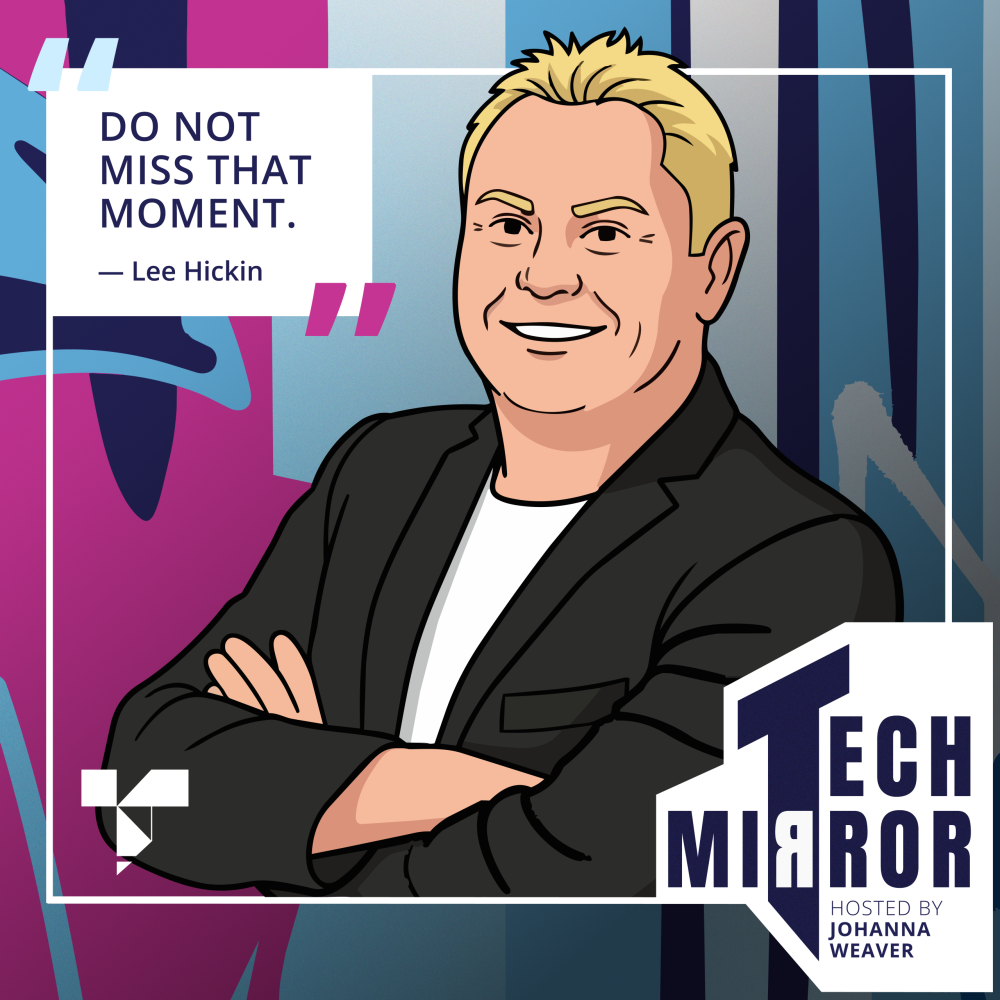
“I wanted to make a difference, and I wasn’t getting that fulfilment in the private sector anymore,” says Lee Hickin. After decades at some of the world’s largest technology companies, including Amazon, Microsoft and IBM, Lee wanted to shift the impact of his work away from corporate goals towards the broader public good.
Now leading Australia’s National AI Centre (NAIC), Lee’s challenge is to help position the nation to seize the opportunities of AI while giving organisations the confidence, skills and agency to navigate a rapidly evolving technology ecosystem.
In this episode of Tech Mirror, Johanna Weaver speaks with Lee on a sober perspective in the ‘race for AI’ and how the government’s strategy is constantly evolving to keep pace. By taking an intergenerational approach, Lee gives a clear piece of advice: learn how to use AI, but don’t become dependent on it.
Links:
AI Agency Toolkit Expanding AI Sovereignty to AI Agency | Tech Policy Design Institute
ai.gov.au | National AI Centre
Anthropic researcher believes more than 10% chance AI ‘could kill all humans’ | BBC
Transcript
Johanna Weaver: [00:00:00] The Tech Policy Design Institute acknowledges and pays our respects to all First Nations people. We recognize and celebrate that among many things, indigenous people were Australia’s first tech innovators.
Lee Hickin: You are in a generation where we have access to a technology that if you know how to use it, can unlock any piece of information, any knowledge, any idea, anything you want to learn about, be better at, understand, it is at your fingertips. In the history of humanity, you have something that has never been ever had before.
Do not miss that moment. If you haven’t educated yourself and you find yourself engaging with AI and it is taking down that wrong path, well, if you don’t have the skills to know that, then bad things are going to happen.
Johanna Weaver: I’m taking us down a rabbit hole.[00:01:00]
Welcome to another episode of Tech Mirror. I’m Johanna Weaver, your host, and this is the podcast where we talk about how humans shape technology and how technology is shaping our world. And today, we’re talking with Lee Hicken. He’s the head of the National AI Center, and he’s gonna tell us what that actually is and what they do.
Lee Hickin: Thank you, Johanna. Thanks for having me. You’ve set me up to fail ’cause I don’t know what I do half the time, but I’ll do my best to explain what I do at the National AI Center.
Johanna Weaver: I think, um, anyone who claims they know what they’re doing in this field, um, I would probably not trust them, to be honest.
It’s evolving and changing so quickly. So Lee, why don’t we start with a little bit of an intro of you. So you’ve worked, uh, mainly within tech companies- Mm-hmm … throughout your career. What drew you to tech in the first place?
Lee Hickin: Gosh, what a good question, and a, and a really difficult one to answer, not least of which because it was 35 years ago, which kind of, you know, feels like a, literally a lifetime.
But [00:02:00] also I think… and I’ve had this conversation with, with my son, as it happens, who’s at uni, on, like, what it means to start in the tech industry. And you kind of have to cast your mind back 35 years ago to sort of late ’80s, early ’90s, I think. ’89 I think was my first job in tech. It wasn’t an industry that…
or at least it wasn’t in the way that we think about it today. It was a handful of companies that were kind of defining this PC era that we were sort of gliding ourselves towards. And so I didn’t… and I didn’t really choose it. It chose me. Like, side story, Johanna. When I was a young boy and I was learning how to program dBase III Plus, so your listeners will kind of age me by that.
Ooh. And I found myself both fascinated by what you could do when you write code, like this idea that you could write instruction into a computer and it did exactly what you said it would do, and it also turned out I was kind of okay at it. Like, I was… you know, I had the logic to understand code. It didn’t seem alien to me.
It seemed logical to me. And so I sort of fell into it. Mm. And then it’s just been… you know, I’ve… uh, it’s been hard work, but it’s been [00:03:00] a happy accident for me that technology has become the single defining factor of the last four decades of the world, and I’ve been able to ride that ride in just some amazing places and amazing companies and amazing moments.
Johanna Weaver: But how do you go from working for all of these different tech companies, and maybe if you just give us some names for listeners who maybe aren’t familiar with your CV, to deciding to come into government and head the National AI Center. What was the thought process for you behind that?
Lee Hickin: Yeah. So well, look, I’ll drop some names ’cause it’s a really short list, ’cause I don’t know if it’s a good thing or a bad thing.
I worked for IBM for, let’s call it a decade. I’ve worked for Amazon Web Services for about two or three years. I worked for Microsoft for not… just short of 20 years. And in between all of that I spent a little bit of time, I call it my sort of mid-career, um, crisis, where I left IBM and spent two years working at a startup, sort of working for a company that [00:04:00] was…
If you kind of remember back days, back to the days just before SharePoint took over the world and we had products like Plumtree and that and others where kind of the… and WebSphere, where sort of becoming the… web portals were the thing. And I joined a startup that was building a web portal and I… it was a great experience, but small part.
But yeah, the good part of 35 years at… and not just tech companies, big tech companies, big American tech companies. Sorry, I missed one. RSA Security, I worked at for a while as well. And so about a year and a half ago I just sort of decided to come work for government. And your question, what made me decide.
Look, you’ll want to probably unpack this. There’s two things that happened, Johanna, one of which was I found myself looking at me and the tech industry and what we did and thought, “Is this what I want to be a part of?” And that’s not to say that the tech industry are a bad industry. But it didn’t fulfill me anymore.
It was kind of reaching a point where I felt like it was a, you kind of, you’re, you’re on a sort of just doing the m- the motions. You know, what are you [00:05:00] actually delivering? What are you actually doing here? Partially tied to the AI moment, again, which might be interesting to talk about. But I did that, and then the other part of it, of course, is like most people who leap into government or any kind of public service, I wanted to make a change.
I wanted to make a difference. I had the opportunity in my career to be presented with the chance to run the center and work with some people that I’ve admired from a distance, my boss, Helen, and others. And I thought, “Well, if not now, when?” You know, I’m sort of… I’m not a young man anymore. I’m not early in my career.
I’m at the end of my career. Why not now? So I did it, and then I haven’t looked back, and I don’t regret it at all.
Johanna Weaver: What has most surprised you, having come into government, having worked for these big companies and worked in roles that did have contact with government in all, in most of those roles? What was different than what you had anticipated it to be?
Lee Hickin: Than what I’d expected, yeah. It’s the obvious answer, you know, is, you know, the bureaucracy and the, the, the politics. I mean, yes, of course- Mm … those things were there. But, [00:06:00] you know, I said I worked for Microsoft, IBM, and Amazon. I know politics. I know bureaucracy. Trust me, like, the big organizations- Yeah, yeah
are not really that different to large governments in the sense that everybody has a boss. There’s always a goal somewhere that you need to be kind of aligning yourself to. Everybody has opinions, and sometimes your opinion isn’t the one that gets heard. So I think I was sort of prepared for that. What I don’t think I had realized, there’s two things that I had not realized about government.
is, and yes, I spent the last sort of three or four years of my time at Microsoft in a role adjacent to the government work that Microsoft was doing, so I’d met a lot of the people in government. I’d had that sort of exterior relationship with government officials and ministers and others. But I hadn’t really appreciated that once I got into government and met the team and met the people, just how good these people are and just how committed they are to the right thing.
And it’s really easy from an external point of view, if you’re sitting in any industry body and you kind of have your go- your government affairs team and you have your people that try and sort of scratch around the surface to figure out what’s going on, [00:07:00] and you have a sense of who these people are, but you really don’t understand what it’s like to live in that world.
So I was incredibly impressed by the quality of people and the effort that they put in, the work that they do in dedication to this, kind of this cause, that is often the unsung heroes. Nobody puts a public servant up on a stage and says, “Well done. Great job.” You know, it’s a role for the government and the ministers.
So that was one thing that was good. I think on the other side of it, what I had probably misunderstood is a phrase that was repeated to me often in my first sort of six months, which i- in some version of was, “Your operating authority.” This idea that you run the NAIC, but you run the NAIC, the National AI Center, in the context of the department, in the context of the minister’s portfolio, in the context of like the government, and you start to realize that operating authority is not defined by the role you have, but actually the body of government that sits around you.
And that, that’s a… It’s kind of a jarring experience for someone coming from the private sector.
Johanna Weaver: And so I guess to pick up on, uh, the first point about the quality and the [00:08:00] dedication- Mm … of the people in the public service- Yes … and then to pull on the thread that you said earlier about why you left big tech companies was because you were contemplating whether that was an industry that you wanted to be part of.
Mm-hmm. How would you contrast the attitude and the intent behind the people that you worked with through your career, um, within the tech companies to the attitude and intent of people in the public service? ‘Cause I think often people think one is good or bad, or one understands tech or one doesn’t understand tech.
There’s these sort of stereotypes, but in my experience, actually, most people wanna have a positive impact. Most people want to do good things, and then it comes down to actually the operating environment, exactly what you’re saying.
Lee Hickin: Well, you’re asking me to choose between our two favorite children, sort of- Exactly
way of framing it. The way you played that back to me is really good because it highlights something that I wanted to make a point of. You know, whilst I emphasize that the [00:09:00] fact I necessarily didn’t realize how good and dedicated and d- the people in government were, that’s not to say that the people in the private sector that I work with were not good and well-intentioned people.
To your point, everybody is fundamentally well-intentioned. What I think the difference is, private sector is about you know, largely when you’re working for big tech companies, share price and market growth and competition and winning, you know? That’s, and that is not a bad thing. That is the very mechanisms by which capital markets work.
The people in government are not actually about winning, they’re about doing the right thing, and these two things are not mutually exclusive, but the operating environment, as you said, is the differentiating piece. I’ve been, you know, very lucky. I’ve met and have and consider friends to be many, many good people across both sides of the, my career in tech and in the government side.
So it’s, it isn’t the people, but it is, as you said, it’s the operating environment and the organization. And maybe the way for me to say this best is I, I have, from those early database, DB3 programming days to, to even to now, [00:10:00] I love tech. I think technology is an incredible tool. Anything in technology, it’s just opened up doors for me in my life, but also opened up potential opportunities for so much across the world.
I’ve always loved this idea that we can solve any problem with technology, and we have, largely, over the last few decades. I think the piece that, for me, I got hung up on a bit was I remember the early days of GPT and the Microsoft partnership with OpenAI that I was involved in. GPT-2 was my first iteration, my first engagement with the GPT models from OpenAI, and I remember those moments of wonder and that sense, and I remember I, I traveled the, largely the Asia region, but also the world, telling people about GPT 3.5, as it was, the Interpret GPT that was ChatGPT, and then 4.
And I remember talking to people about this idea that you could put a… This model would be able to interpret this image and tell you what’s in it and then help you work you through it. And we were on the cusp of this kind of magical Arthur C. Clarke [00:11:00] sci-fi moment where we had this technology that literally was the, you know, the, the HAL 9000 or the computer.
And I felt like that was amazing, but then we sort of pivoted to this, well, let’s, let’s build some sort of relatively averagely okay but sometimes crappy products out of it. And I felt like, are we not seeing what’s happening over here? Like, are we missing the point that what we’ve- Yeah … just invented is amazing, and now we think the best thing to do is to turn it into a email summarizing tool?
Not disparaging email summarization, great value. But I think I just sort of went, ah, maybe tech’s not doing the things that I wanted. I don’t know. It’s not as exciting, perhaps, is maybe a way to think about it.
Johanna Weaver: How do you… Given the incentive structures of the companies that are building these, how do we make sure that the technology is actually being used to deliver the biggest benefit?
We always talk about AI being able to cure diseases. Apparently, Dario Amodei said that all diseases will be cured in five years. That’s his latest, uh, statement. But it’s not necessarily bearing out in terms of the direction of the [00:12:00] research where these frontier models are actually putting their efforts.
So I can definitely see that part in what you’re saying. The other thing that really strikes me that I think is interesting and just a reflection, we did a design dialogue recently where we bring together industry, government, civil society, and I think it’s really… I always find the moment when you see people from industry or from civil society, the sort of pin-drop moment where they realize that when they say, “We need to answer this question,” or, “This is a really challenging problem,” and then they realize that the person whose job it is to actually solve that problem and get the legislation before parliament or to get the proposal is actually the person sitting in front of them, and that they are i- operating in exactly the same information environment that they are and realize just how hard that job is for government, um, to be making the right decisions.
And I think unless you’re actually engaging both ways, you don’t necessarily see those [00:13:00] really challenging decisions that government is having to make at the moment.
Lee Hickin: No, that’s true. You don’t, and I think it comes down to this sort of very fundamental capability that the modern world requires of anyone, whether you sit in government or in the tech industry or somewhere in between those two.
Your ability to communicate an idea, a concept, a thought, a, a vision- Mm-hmm … a, a principle. Communication is becoming the key to, to advancement. If you can’t tell your story, if you can’t make it clear, it doesn’t get anywhere, and I see that in tech, and I see it in the government as well. But yeah, I look at…
That ability to communicate it is, is key. But, you know, to, to the core of your, your question as well around kind of how do we get it into the right places, part of the work we want to try and do at the National AI Center is get people just to think about what does AI, what can it do for you? I think there’s this fundamental pivoting problem right now as we’ve gotten to a p- stage where we kind of go, “What is AI going to do to me or my industry or my business or my sector or my country or whatever?”
And we’re not asking the other question, which is, what am I [00:14:00] going to be able to do differently with it? Cure a cancer. Mm. Solve a problem. We’ve found ourselves focused so much on the impact and not on the opportunity.
Johanna Weaver: That’s a good segue for us to talk about what the National AI Center’s mandate is. You know, what’s your elevator pitch for what your job is?
Lee Hickin: Gosh, I should have one, shouldn’t I? Look, it, it, it is in quite simple terms. We are the primary vehicle that the government has to help Australian industry adopt and create value on their terms with AI.
Mm. So it’s really about, about its core: adoption. You know, making sure we’re using AI. That could be using it to build something, so I’m building with AI. It could be using it in my business, simply using it to make my business more effective. But the key sort of delineators there are not just adoption, adoption in a way that adds value to your business.
And value isn’t always money, economics. It’s sometimes it’s time or [00:15:00] improvement in your product or your people’s experience. So it’s in that, and it is fundamentally in kind of upskilling, upleveling, getting us as a nation more capable of using this new technology. Because whether we like it or not, this technology is going to be pervasive across all forms of work in time.
And in the same way that I learned how to read and write as a kid, you are eventually gonna have to learn to read and write with AI, is it’s gonna become a core skill.
Johanna Weaver: We’ve had some really interesting conversations, Lee, around what you mean by adoption, and, you know, I think a lot of, a lot of people think of adoption in what you call experimentation.
Can you just talk us through some of the elements that you think of as adoption of AI?
Lee Hickin: Mm. No, that’s a good way to think about it ’cause adoption is one of those many unclear terms that we like to use that- Mm … you can interpret in lots of ways. And e- and experimentation is, to my mind, you know, you used that word, but it is at the core of this in the same way that most people [00:16:00] learn what they like by experimenting with different things until they figure out that I happen to like scary movies or I like rom-coms or I like dramas.
You watch a few movies and you kind of go, “Ah, well, this is what I like.” And that’s that ex- sort of experimentation. But so when we think about adoption, okay, at least from the National AI Center’s point of view, what we mean by adoption today, and this is still sort of something that we- Think about rewriting because the technology’s moving so quickly.
But it’s really about using AI in a way that is additive and value creating in your, like, realistically work life, but I think we think about it both as a personal and work thing. But it’s, it’s not just putting it in place because it’s embedded in the product you’ve just bought, so you’re using it. Like, you know, firing up Copilot in your Office 365 tenant is kind of using AI, but it’s not really adopting AI in the way I would think about it as a, I’m doing something u- uniquely different.
Johanna Weaver: So it’s,
Lee Hickin: it’s really more about kind of integrating it into the work process as opposed to adding it to what you do as a sort of an externalized [00:17:00] mechanism in some ways. That’s not a very good description- Mm. Mm … I, as I say it, it doesn’t feel very strong. Maybe we need to think on that.
Johanna Weaver: No, no, I th- I think it’s, I think a lot of people use AI, but they haven’t adopted AI.
And I think, um, some of the other sort of levels I think is, like, when you start to have… That you’re actually training staff on how to use AI, when you’re starting to have governance practices around the use of AI, a- as well as that sort of embedding to extract value. And it was actually a conversation with you that, that made me focus on that distinction for the first time, and I think about it often.
I do think the productivity benefits that everybody is talking about, where are the productivity benefits of AI, it’s because we’re using AI, not adopting AI. Uh, and so it’s that sort of step change that needs to come.
Lee Hickin: Yeah. And, and actually, you’re right, and it’s really not a very good word now the more we say it over and over again.
It really doesn’t kind of define it- … because there is so much more. I
Johanna Weaver: know. I’m taking us down a rabbit hole.
Lee Hickin: Yeah. But well, look, the, so that… And I have been sort of using an, a different framing more often in the last, I [00:18:00] guess the last month or two, which is, and I’ve stolen it furiously from yourself and the good work that your organization’s, has done, which is about agency.
Your, your work and the thinking that the, that TPDI’s kind of looked at was the sort of, you know, Australia’s agency in this, in this sort of the AI moment. And the, what I’ve been asking people is, “What agency are you taking in terms of the way AI, AI could or is impacting your life?” Because agency implies you own it, you control it, you decide what is sort of the experience or the relationship you’re gonna have with AI.
Are you gonna build something with it? Are you just gonna use it? Are you gonna dip into it when it makes sense? All of these are good.
Johanna Weaver: Are you gonna choose not to use it? ‘Cause that’s okay, too.
Lee Hickin: That is okay, absolutely. I think that- I would argue possibly that there are maybe some parts of the world that are saying, “I’m not gonna use it belligerently because I’m scared about it for good reasons,” or, “I don’t trust it,” or, “I’ve heard so many bad stories.”
Or it’s, you know, it’s just, “I haven’t been given a good reason.” And I think we all need to… That’s maybe a bit of a blinds down, shuttered approach, and you kinda [00:19:00] need to at least go and look at this thing because it is such a big and impactful thing. It’s like saying, “Well, I’m not gonna drive a car ’cause I don’t believe we need cars.”
Well, I think in a modern world you’d struggle to get around if you didn’t have some form of transportation. I think it’s the same kind of equivalency.
Johanna Weaver: Yeah, absolutely. And to that point about people are scared of it, um, I woke up this morning to news reports of, uh, which I’m sure you saw as well- I did
with, um, you know, a senior researcher from Anthropic saying there’s a 10% chance that AI’s gonna wipe out the world in the next five years. A- And this is by far not the first of these types of predictions and, you know, pausing, slowing down whilst continuing to run fast is sort of becoming a very common narrative out of Silicon Valley.
How do you think about those types of challenges? And I, I was thinking about it in the context of… I didn’t actually have time to do the math, but 10% chance of wiping out all humanity. I don’t know what the chance [00:20:00] would’ve been put of COVID wiping out humanity, but I reckon it was less than 10%, right?
Well, that’s… Yeah, that’s interesting. And we shut the world down.
Lee Hickin: Mm.
Johanna Weaver: It’s just so… And I mean, the difference is there was real verifiable evidence. You had a whole bunch of different experts that w- you could see the negative impact. So there… It’s not a great analogy. But just how do you… Given that your job is focused on the opportunity, adoption, diffusion, but also there is this narrative of…
And genuine fear that people have. How do you, um, balance those things?
Lee Hickin: Yeah. It’s, it’s really difficult, and it, it sort of comes back a little bit to the point we were discussing earlier around this difference between being a private citizen and a public servant. Because one of the key things- Mm … you as a public servant, your job is to service on behalf of the people, but deliver the outcomes of the government.
And so that puts you in a position where you have to think very carefully about your opinion is… You’re not here to lean into your opinions, ’cause that is not your job. Your job is to react, provide frank and fearless- Yeah … feedback, but also to deliver on that. So I sort of find [00:21:00] myself… Uh, that’s my precursor, ’cause I’m sort of a left and right brained bit on this one or slightly split on this.
Because the engineer in me, the technician in me, the software developer in me that, that is my sort of where I started my career, kinda hears those phrases and go, “Yeah, I get it, and I sort of see what you’re trying to get to.” But actually, the AI itself is unlikely to be the cause here. The reality is it’s gonna be human hubris.
It’s gonna be a person that was given the right to do something or didn’t have enough knowledge to do something in the right way or, you know. It’s just that’s what’s gonna trigger… And I’ve… I read that thread this morning from Jacob. I forget his surname now, but the guy from, uh, Anthropic. You know, and a lot of the indication there is that this is…
It’s humans that are ultimately in the sort of the… who are doing the, the wrong thing here. The AI is just developing this capability. So I’m, I’m a bit caught up on this whole, “Yeah, yeah, we keep pointing the finger at technology, but technology is, is still our tool, our servant. We are allowing it to do- Mm
these things, and we should be looking more at ourselves as how we think about it.” But the flip of that, and [00:22:00] if I put my National AI Center hat on and think about, okay, this is the world we live in. We have needs as a country. We have ambitions as a country. We have a global scenario that we need to participate in, both economically, politically, and otherwise.
AI is here to stay whether we like it or not. So what is the best cure for a potential infection? You know, well, we… often we give a, um… As you… COVID’s a great example. You know, you, you get a sort of a vaccine to get yourself ready for it. Well, the vaccine in this case is your capacity to understand this technology.
‘Cause if… Your agency, to come back to. If like, if, if we just say, “Oh, look, it’s really bad. We just need to stop doing this”- We don’t get any better at it. We never figure it out. We just put it on the shelf and just say, “Well, that was never for us. We’ll go back to, you know, where we were back in 1990s,” or whatever era you wanna call it.
So the National AI Center’s work is to say, “Okay, lots of things happening, lots of things to worry about, lots of opportunity that you see out there. Get yourself educated, get yourself skilled, get yourself competent, capable, [00:23:00] confident with this technology so that when it comes at you and you see the worry or you see the fear, or you’re, you see it navigating you down a path that is the wrong path, you know what to do.”
If you haven’t educated yourself- Mm … and you find yourself engaging with AI and it is taking you down that wrong path, well, if you don’t have the skills to know that, then bad things are going to happen. So knowledge is your, is your key here, and knowledge is about learning.
Johanna Weaver: Yeah, and I think that’s actually really powerful, ’cause it kind of operates at all levels, right?
You know, the, the AI agency piece of work that we did, which divides this concept of sovereignty into access to international tools, domestic control, sovereign capability, resilient choice, and, and your leverage if you can export these things. And so actually, that is also, if we’re in a situation where you have AI going rogue elsewhere, the ability for us to have sovereign capability and not just be depending on international capability or having that resilient choice and combination is actually really important.
So [00:24:00] yeah, I like that a lot. And just while we’re on that, as a brief segue and infomercial for people, the TPDi AI agency tool has actually gone digital today. So, uh, you can go to techpolicy.au/aiagency, and this tool, you can now simulate your own assessment. So obviously TPDi did this informed by national consultations and assessed Australia’s national AI agency, but if you don’t agree with our assessment, you can jump in now and do the simulation.
It’s really a very powerful way to look and to measure about where Australia’s national AI agency fits. But you can also use the tool to assess perhaps your organization’s AI agency as well. So… And that was actually supported by DISR, your department, , so thank you very much for that. Um, and we’ll pop a link to that in the, uh, in the pod notes.[00:25:00]
So Lee, I guess the next obvious question that many of our listeners will have is, okay, we have the National AI Center. How does the National AI Center fit with the AI Safety Institute, which was announced and Kate Conroy is heading up, or the more recently announced PM’s Office for AI, not of AI, important distinction there, uh, which is being headed up by Fergus Hanson.
How do these different structures work together, appreciating that actually perhaps some of that is still settling in as, as these structures are very new, many of them?
Lee Hickin: To your point, first of all, it is very new. So, um, you know, on the post the, the Prime Minister’s speech on the 15th of July where the announcement was made of the direction that the government wants to go, and of course with that came the establishment of the Office for AI.
Look, I can, I can really only speak with any authority on the National AI Center ’cause it’s the only one I have that authority and really understand. But I think the important thing to take from that is if you kind of look at it almost- [00:26:00] As a triangle, and there’s actually a fourth one in that, in that now becoming a square that I’ve called a triangle, which is the Department of Industry, Science-
and Resources Tech and Policy division, uh, which is- Of course … you know, sits alongside myself. Yeah, yeah. So in, in that sense, you’ve got the Office for AI that has this sort of coordinating role, but also is very much focused on the AI standard, as has been, you know, publicly discussed in many corners.
You’ve got the Safety Institute, you know, which as you mentioned, Dr. Conroy is leading and, and that is established, and part of that sort of Global AI Safety Institute, aligned very much with the UK Safety Institute on thinking about these sort of frontier and the future-looking approach to where AI risk is and, and is heading towards.
You have the Tech and Policy division who’s thinking about this from a, sort of a, a policy point of view, as you would imagine normal government work to do. And then us, who’s thinking about in the context of all those things, how do we help Australian industry maximize their value, but also find their way towards the, the way that this technology’s going to work for them.
So it actually, [00:27:00] whilst I can only speak for us, I can see the four of those things actually work pretty neatly together to sort of cover all the bases of what needs to be addressed in terms of putting together a, a national approach. And the, and the National AI plan, of course, is central to that in terms of the national plan for how we’re going to do this and, you know, spreading the benefits, keeping Australians safe, and capturing the opportunity are sort of the, the measures by which that, that plan is built.
Is that a good answer and nicely done and politically I keep t- get to keep my job?
Johanna Weaver: It is, and I think, um, you know, I think there’s lots of discussion about how all of these different parts work together. But I do think it’s also important that we also take a moment to celebrate the fact that those, each of those component parts exist because there are many countries that don’t have anywhere near this level of, um, political leadership from the top, and that was what was so exciting about the PM’s speech, separate from the substance of the speech, that he’s taken ownership of the issue, and then that we actually [00:28:00] do have these roles sitting, doing important work.
Um, and of course, quite a lot happening in the defense and national security space as well. So Lee, w- within your role, let’s bring you back within your field of operation. When you’re out talking to businesses, whether it’s small businesses or large companies in Australia, what’s the biggest misconception around AI that you encounter or find yourself constantly having to correct?
Lee Hickin: Hard to pin it down to one, and that doesn’t mean there’s lots of misconceptions. It’s more that, you know, I talk to a lot of different people from different parts of the, sort of the ecosystem.
Johanna Weaver: Mm.
Lee Hickin: But I think the one that matters the most, and that’s, you know, this is thinking in terms of the work we’re trying to do, but also the people we’re trying to help, which for us predominantly is what we refer to as the small to medium enterprise sector of Australia’s economy.
60% of our economy, money fiscally, 90-something percent of our workforce, and, and of that 90%, you know, the m- large [00:29:00] majority of those people are actually five or undersized company and five people or smaller. We, yeah, we are a, a nation that is largely built up of entrepreneurs, individuals who just wanna start something or do have a small business.
And the misconception I hear mostly from that, that community is… And this is not about them missing the point. This is the poor job that I think- We, and I mean we in the sort of tech industry point of view, have done in terms of making it relevant to them… ‘Cause the biggest question I get is, what would I do with it?
Like, why would I even use AI? Yeah. And we’ve homogenized this term AI so much now till it’s almost become the point that you could say Claude or OpenAI and people… That’s what people think you mean when you say AI. They just think you mean-
Johanna Weaver: Yeah …
Lee Hickin: this web browser or mobile phone tool I turn to every now and again, ask it a crazy question, and it comes back with something, and I may or may not use it.
So I think we’ve sort of created a bit of a, a bit of a them and us divide between the [00:30:00] idea that AI is sort of this magical pixie dust from the tech industry, and for most people, they’re trying to figure out what does that mean. I, I was recently on a, did a couple of events with the NAB, uh, National Australia Bank Business Summit, which is their small business summit.
And we did a couple events, and on that panel, I was sitting next to a, a funny gentleman who has a company up in Maroochydore. So he made a point of reminding me every time we spoke how he would go jet skiing on the weekend, and I don’t.
Johanna Weaver: Immediately think of sunshine.
Lee Hickin: Exactly. It’s, uh… You say the word Maroochydore, and that’s what you think.
But he lived up there, and he has a company where he builds custom trucks for, like, blood banks or a food truck or you name it. Like, he builds these custom trucks. And he was up there talking about how he uses AI, and it was so refreshing because he doesn’t talk in consultant speak that we all do. He doesn’t talk about technology from the point of view of it’s just incredible.
He just uses it a lot because… A good example for him was he runs… He has to do a lot of quoting. His quotes are very bespoke and specific because [00:31:00] trucks are quite unique and lots of them are very different. But actually, in reality, there’s a lot of commonality that you just end up… It’s the last mile that’s very bespoke.
A lot of the work you do in quoting for a truck is common. And so he, on his own accord, said, “You know, this is the biggest problem I have. It takes me a week to get a quote out, and the problem is it takes me time away from my family, but also there’s more customers than I can service.” So he started using a AI and he fed it all of these sort of quotes that he’s done previously and asked it to, when he gets a new quote, just to spit out a quote.
And what he was getting was that 80% good enough quote. So he still goes in and kinda does the tweaking and gets the quote right, but he’s cut it down to a few hours from five days. This is life-changing to a small business. This completely rethinks how he thinks about employing people, about the time he uses, about where he invests his, his skill.
And it’s not a very, not a very, uh, exciting use of AI. It’s not a very, um, kind of bleeding edge, but it’s so practical, so basic, so simple, and [00:32:00] he’s figured out how AI works for him, and I think that’s the misconception. For most small businesses, they just can’t see that ’cause we’re not doing a very good job, and me as the naive need to do a better job of making it look like it’s a thing that they can use, and it actually works for almost everyone.
There’s something you can get out of it for everyone.
Johanna Weaver: Yeah. And I think, um, until we are better at that, this concept and the pillar of spreading the benefits will be challenging to be able to do that because people are not going to do meaningful adoption. What about, to flip that, what is the most common opportunity that you’re seeing…
And let’s focus on SMEs ’cause that, that is, uh, as you say, where a lot of your work is focused. What is the most common opportunity that you’re seeing that people are recognizing and taking up?
Lee Hickin: Well, I’m gonna give a small plug to a tool we run on our website, which is on ai.gov.au, which is what we call our Adoption Tracker.
So the Adoption Tracker… And I’m using this because I can’t remember the number right in front of my head [00:33:00] right now, so I’m using this as a way to fill the gap. The Adoption Tracker is, we go out to, every three months, we go out to sort of 400 different SMEs, and we… As, it’s a rolling 400, so it’s not the same group of people, and we’re asking them a bunch of questions about what are you using AI for, what are you value are you getting from it, what, what, what responsible practices have you employed.
We’re really just trying to get a sense of how the adoption curve is moving. And in that, one of the things we pull out is both the highest industries, you know, services is actually top, I think. Top of the list is services. About 51% of the use cases are services. You know, manufacturing, uh, retail and, and other sectors.
And then we also pull out the what are you using it for, the actual AI thing that you’ve gotten to. Chatbots is actually quite high up, but not necessarily always the external facing- Hmm … chatbot, but often the internal tool to allow our team to better understand our internal data. This is a… Most small businesses, they live and die by the…
Their, their customers are so important to them. The data they have on their customers allows them to be- create this very customized [00:34:00] experience, but they’re often hampered by, you know, the tools they use are not the quality that most enterprises get their hands on, so access to information and clarity of that data is a challenge for them.
So many of them are just using AI to unlock that for their field, to their sales teams or for their consultants, so they have access to knowledge and information. But again, I’m trying to remember what the top ones are. But they’re, they’re largely all what you might call fairly pedestrian use cases. Like, they’re not discovering new metallic principles for how we might build the next car or something.
They’re not… It’s not that stuff. It’s really the basic stuff. It’s a lot of summarization, a lot of media content generation, images and words, chatbots, as I said, and, and more base business processes.
Johanna Weaver: And I think we… That’s so often lost in the conversation about, you know, what’s the latest frontier, where’s the jagged frontier, and this sort of obsession with frontier models, that actually the frontier models are not what is delivering the immediate benefit right now.
And of course, the benefits will change as the m- the frontier models change, but [00:35:00] it’s, it’s so… This sort of obsession with the newest and best model versus how do we use what’s already out there to deliver the benefits today is… I think, I wish we focused on that a bit more, but it’s less sexy, so, you know.
I,
Lee Hickin: I agree, and I, and I’m… I wouldn’t say it in the sense that we need to stop- Breaking new frontiers and creating new amazing outcomes with AI. You know, the, the sort of the, the science in me loves the idea that we’re creating new boundaries and knocking down walls that have been built for so long and, you know, discovering new things.
But that’s a different race, as you said, to the people that are just trying to figure out how to use it today, and we can do so much today. But we’re, we’re sort of, yeah, but that’s… Let’s look at the next big thing we can do. And I think we need to sl- I, I don’t wanna say slow down ’cause that will get misinterpreted ’cause it’s not a slowdown.
I think we just need to figure out that there’s two pathways here. And one is about how we get better at doing- Exactly … what we do, and one is about solving the really big things that maybe AI can help us solve.
Johanna Weaver: Exactly. And I think it is two paths that are moving at very different [00:36:00] speeds- Yeah … but which Australia needs to pursue.
Lee Hickin: Yes.
Johanna Weaver: If you weren’t a public service servant, I would push you on questions of how do we actually make that second path work, and I think, you know, there’s a lot of people calling for investment in, you know, public interest compute or high performance computing.
Lee Hickin: But I will add one comment to it ’cause I think it is both aligned to the work that we do in the NAIC, but I think also it’s not really politically sensitive, is whatever is needed and whatever voices are being raised and conversations being had about what needs to be built in terms of those infrastructure pieces, I think it’s important that we don’t forget that in order to have all those things, we need to be investing in people’s capacity to use those things, and that is about- Mm
to my point earlier, about skilling, about confidence, competence, and agency- Mm … of using AI. We, we, you’ve got… You know, you can’t just build it and then hope that we can use it. You actually have to make sure that we are a nation that is excited by it, that is confident in it, that is excited by the opportunity that it provides.
Those two things go well together.[00:37:00]
Johanna Weaver: Where should Australia be putting our focus in terms of skilling in particular? Like, if you’re giving advice to your son or y- or, you know, his friends, but also people who are looking at, you know, mid-career jobs are changing really dramatically
Lee Hickin: I think it’s actually, again, it’s one of these questions that deserves not…
There, there isn’t one answer, because I think if you look at the vast majority of people in Australia today, and I’m talking about people who don’t live in a tech world and are not obsessed with tech and don’t find it to be the thing that actually drives their day. In order for them to find their way, we’ve got to take some of the bullshit out of the AI story and get down to this, the practical, simple stuff.
Like, this is actually what AI fundamentally does at a very, very basic level. They just need to understand what it really is, what it do- does, and how they could use it. It’s kinda simple That is different to, I think, what we need to be doing at that research and science tier of [00:38:00] Australia’s economy, where we actually need to be thinking about where are we gonna differentiate.
What are we going to do to contribute to this global momentum that is coming at us and coming with us, and we’re on it, and we’re part of it. But we have unique capabilities here. I think there’s quite a lot of conversation around AI seems to be about how to catch up in the race. I don’t like the narrative of the race.
I think it isn’t a race. But how do we contribute to the ambition is how we should be thinking about it from an Australian point of view. What is our research doing? There’s so much that can be done, you know, in safety and alignment and all that stuff, but also in rethinking about some of the core model principles and machine learning principles and how do we make these models more adept at bespoke and specific tasks and perhaps tasks that we need in this country, you know, when we think about some of the things that we have as a nation.
So I think those two are actually quite different investments in the conversations that need to be had and the focus we need to have as a country, and there’s probably more, but those are the two that kind of ring in my [00:39:00] ears most often- Mm … when I think about, gosh, what could we be doing tomorrow?
Johanna Weaver: What are you most excited about for Australia in terms of the breakthroughs or changes that might be driven that is Australia’s sort of unique value proposition?
Lee Hickin: Less than five years ago, we weren’t even having conversations like this. We didn’t even think about this because, of course- Yeah … November 30th, 2022 is the date that will be forever imprinted in most people’s minds who live in this world, and we know it. But even just thinking forward from here, there’s two things I would say.
One is more generically, and it doesn’t really just apply to Australia, but I keep coming back to this conversation point and that is we have to just sort of strip away the hubris and the sort of the, the race that the tech companies seem to be and to do what they want to do. I don’t see it as bad, uh, just not the conversation that we should all be thinking about, and get back to this basics of…
and this is the conversation I do have with my son and my daughter, who are both young adults. [00:40:00] You are in a generation where we have access to a technology that if you know how to use it, can unlock any piece of information, any knowledge, any idea, anything you want to learn about, be better at, understand, it is at your fingertips.
That is, in the history of humanity, you have something that has never been ever had before. Do not miss that moment. Do not not learn that and learn how to use it well and learn how to, how to engage with it and determine when it’s lying to you and you haven’t helped it properly. Be skilled in that technology without a question.
It is the core of, I think, of, of what future work skills will be built around. But then from an Australian point of view, it’s taking all of that kind of mindset of what could you do if you have this, and taking it to those things that are both critically important to Australia as an economic nation. So, you know, we think about the things that we have a business, our business of running a country is built around, minerals, mining, and resources, [00:41:00] some work in life sciences and medical care, obviously in education, but also then in, you know, other sectors like aged care and other things.
Things that we have that are critically important to us, and problems that we might actually solve to the glo- that, that address the global challenges, logistics, supply chain, food. The age-old one that sits in every person who’s been in the tech industry for about 10 years is we come back to this idea of how do we figure out how to synthesize ammonia production, because it is one of the single blockers in food chain production today ’cause it’s incredibly expensive to do, difficult to manage.
We can’t synthesize it artificially. Hmm. But if we could do that, completely changes the order of magnitude of food scale that we need to produce. So I think that’s where you kind of look at this. There’s individually so much more that we as human beings can do, and as a country, we could contribute so much, both to our own national economic view, but also potentially to the global.
That’s where I’d love us to be in five years, and also I’d love to be at a point where a conversation about AI is about as exciting as having a conversation about Microsoft Word. It’s like, why are we talking about this? We just do it. It’s what we [00:42:00] do. We don’t even talk about it anymore, or Google Sheets or Docs, but Word.
Johanna Weaver: I have one cheeky question. What do your son and daughter say when you say, “Jump on board this train”?
Lee Hickin: Did I say that? My goodness, if I did, that’s, I… That if they don’t hit me, then some- I have not taught them well.
Johanna Weaver: No, yeah, exactly. No, you didn’t say jump off a building straight. I did-
Lee Hickin: no, I don’t
Johanna Weaver: think I even said that.
I mean it more… I was summarizing.
Lee Hickin: Yes. Okay. So interestingly enough, this is, and again, this is after 35 years in the tech industry, although my kids are only se- 17 and 19 years old, is this is the first time in history where they have said to me, “So Dad, tell me what it is you do, because it seemingly now is an important part of my life as well.”
So AI is suddenly like- Uh-huh … everything else has been like, “Oh, yeah, Dad just works for some tech company.” Like, I don’t care. But now our lives have intersected, so that’s a really important for me, and that’s interesting. That’s a measure. And not just my kids- Yeah … but, you know, my mom, and my wife, my ordinary people in my life.
Society. I mean, it’s everywhere. Society is doing this. Yeah. So it’s suddenly become something I realize that’s, [00:43:00] uh… And that’s incredibly good feeling that you carry the weight of that in the sense that being in the National AI Center, I have some part to play in Australia’s journey forward, and I take that very seriously because that is the impact.
I tell my kids to learn how to use it, but learn how to not become dependent on it. That’s the conversation I have. And then, then they use it extensively. My son, uh, he’s at uni, at uni study, and he’s bounces between Gemini, Claude, DeepSeek, and OpenAI, is like, he’s just sort of, he’s got five windows open.
It’s like, you know, one of those, as kids do, like just moving so quickly I can’t figure out what he’s doing. But he uses them all the time. Mm-hmm. It’s, and that’s been a real… It’s exciting to watch. I have to keep making sure he’s using it right. But yes, it’s exciting to watch.
Johanna Weaver: Yeah. And I do think given the pushback that y- we’re starting to see from a, a number of the younger generation around boycotting AI or not using AI, I just find it really- Um, yeah, I, I find the more conversations that we [00:44:00] can be having with the people, with young people, the better because it’s just their experience is so different to the experiences of you or I or the politicians who are in parliament making the decisions right now.
Um-
Lee Hickin: Look, it is. And sorry, I look at this. I think there’s two things here that come in my mind all the time. One of which is the fact that they are growing up in this generation and are adapting to it far quicker than many of us are of our generation. Yeah. Gives me great hope that whatever we think are the big problems, some of those problems will be resolved by the fact that the, uh, next generation are just gonna figure their way through this.
Now, and that is something that I have to keep reminding myself is that, you know, they are good at solving problems. They are good at understanding this technology in a way that we were never built to. You know, we understand it, but they understand it in a different level I think.
Johanna Weaver: Yeah, and, uh, that reminds me of, um, you know, when cars were first introduced in, in the UK but also in certain states in the US, how they had the red flag rules, that, you know, you had to have a person, in a populated area you had to have a person [00:45:00] walking in front of the car waving a red flag because they were scared that the cars were going to…
the noise of the car was going to scare the horses, which was still the predominant horse-drawn carriages. And I always think, you know, what are the equivalent of the, the waving of the red flag that we think is really sensible legislation or regulation or governance more broadly now, that we’re gonna look back on and go, “Ha, how quaint,” um, and interesting.
Yeah.
Lee Hickin: Yeah. Oh, no doubt, yeah. No doubt.
Johanna Weaver: So Lee, what does success look like for you? You’re heading, you know… I mean, you talk about the privilege of the weight of leading the National AI Centre, but it also is a weight on your shoulders.
Lee Hickin: Two things. One of which is, as any of your listeners who, who lead teams and, and lead people on missions like this, part of the v- measure of success for me is that that team is happy, fulfilled, and doing work that really matters.
Yeah. That, that they can get behind, and that’s, I think, any leader. You know, that’s primarily probably what I spend most of my time thinking about is how [00:46:00] is the team… ‘Cause that’s the real work. They’re the ones that actually do all the work. You know, they write the content. They’re the ones that put together those things.
They build the websites. It’s, you know, I… You do work, but that’s the job as a leader. But more broadly thinking about it in terms of what does success look like, it’s hard to just put it in a sentence because I think it’s fundamentally Us doing the right things so that every Australian can make their decision about what AI means for them, but hopefully to make the decision that they can…
they use it in a way that, you know, is additive to their life. And I think even though our remit is obviously driving industry and thinking about small business, I think some part of me still recognizes that all of those people that are running a small business or running a, a large business or the people we’re communicating to, they’re actually ordinary, normal people that go home and have family time and friends time and do things outside of work, and the idea that AI should only help in their work life, I think is not success for me.
I want AI to feel like it [00:47:00] is this thing, ’cause it feels like it to me that we’re just on the cusp of great- like, not greatness, that’s the wrong word. We’re on the cusp of the opportunity to do amazing things if we just understand how to do it right, and, you know, that, that’s a… there’s a lot wrapped up in that statement ’cause it’s about governance and policy and everything else.
But it really just comes down to I’d hate to the, I’d hate to think that we’ve put AI on the shelf and gone, “You know what? It was too much. We weren’t ready for it. We’ll come back to it in a decade.” I really hate to think that’s the case. I just want people to enjoy it, use it in the way that I do, and that’s probably the easiest thing for me to measure it against is how I find myself, my life better in ways that I use it.
I want other people to get that same experience.
Johanna Weaver: And also, I guess, the reason that you have that experience is because you understand it, because you have the confidence, because you understand how to configure it responsibly and to do all that, which goes sort of circle back to-
Lee Hickin: Totally.
Johanna Weaver: Yeah … uh, the comment that you were making earlier.
Lee Hickin: Yeah.
Johanna Weaver: So, Lee, if you were gonna leave, um, listeners with one key [00:48:00] takeout or piece of advice in regards to artificial intelligence, what do you think is the most important message?
Lee Hickin: I, and I would normally say at this question when asked, you know, it’s- Just think beyond the first interaction in so much as I think we’ve probably all now at some point touched AI and had a visceral reaction to it.
Either, “Was that it?” Or, “Oh, that’s interesting. I’ll get back to that,” and, you know, and don’t. Or, “Oh my God, this is incredible.” You know, “What do I do next?” But I think the most important thing that you’ve gotta do is it isn’t a simple, you know, you just don’t touch it and it works. You’ve got to put effort into it.
You’ve got to put the time in to learn it, where it fails, where it succeeds, what it’s actually good at versus what you might feel it should be good at or you’ve been told it’s good at. And, you know, and, and thinking about that from the lens of policymakers or people that operate in that sphere, the more you understand something and contextually understand what it is being asked to do versus what it’s capable of [00:49:00] doing versus the directionality of where it’s going as an industry, the more you understand that, the better you will be able to do your job.
And I think more often- Hmm … than not, we’ve become so used to the idea that, ah, you’re talking about AI, and people immediately latch onto that sort of singular experience of the blank window prompt, I type in a question. You’ve got to understand the bigger picture. A, a phrase I heard often like at Microsoft was, “You need to have eyes outside the boat.”
So don’t just stare at the boat, look around the boat, because around the boat is where you’ll understand what’s happening in the tech industry, what other people are doing with it, where it’s actually solving problems but causing issues, and you need to learn all that. It’s not a simple thing. It’s very nuanced, and so you need to put a bit of time into it.
Johanna Weaver: And if people are looking for a good resource to do that, I’m handing you a silver platter for a plug here.
Lee Hickin: Well, I did mention it earlier on, but I will- … make sure I say it one more time in case your listeners missed the, uh, the earlier mention of it. I’m very excited because this, this was one of my kind of primary things I wanted to get, uh, established for the National AI Center was a home base, a, a sort of a, a center of gravity.
So [00:50:00] ai.gov.au. It’s… couldn’t be easier to remember. It’s sort of super simple. Make sure you add the .au on, otherwise you’ll end up at the US site. Very different experience. ai.gov.au, uh, is the center for all of our resources for, you know, learn, learn about AI, learn about what it means for you, learn about what other people are doing with AI.
It’s all on that website.
Johanna Weaver: I really do recommend people go and check out the Australian version of ai.gov.au. And Lee, thank you so much for coming on the pod today, and, um, good luck with the work that you do. We’re here championing and cheering on the work, but also ready to support when we can. So thank you for what you do.
Lee Hickin: No, thank you.
Johanna Weaver: Thank you for having
Lee Hickin: me. And your team. Yeah. Well, absolutely. Thank you for my team, and thank you for your team as well, ’cause I think we, we love working with you guys. Thank you.
Johanna Weaver: Likewise. All right. Thank you.
Well, that’s it for this episode of Tech Mirror, which is brought to you [00:51:00] by the Tech Policy Design Institute. We’re based here in Canberra on the lands of the Ngunnawal Ngambri people. If you found today’s conversation useful or thought-provoking, please do share it with a friend or a colleague, or leave a review and subscribe wherever you get your podcasts.
If you’re watching, please don’t forget to like and follow. For show notes, you can visit techpolicy.au/podcast. And this podcast was made possible with thanks to the generous contributions from government, industry, and philanthropy to the Tech Policy Design Fund, the full details of which are available on our website.
The team at Audiocraft produced this pod on the lands of the Gadigal people of the Eora Nation. Music is by Thalia Skopelis. A big thank you also to the team at the Tech Policy Design Institute, without whom this pod would not be possible. Thank you for joining us, and as always, get in touch and get [00:52:00] involved