
As AI becomes more embedded in our lives, how do we make sure we retain the capabilities, connections and agency that make us human, and how do we find the courage to shape what comes next?
In this episode of Tech Mirror, Johanna Weaver speaks with Yasmin London, former professional athlete and NSW police officer, tech executive, entrepreneur and founder of First Movers. Her new book, First Movers: Courageous Leadership for a Human Future in the Era of AI, explores what it means to step forward and act, even when the path ahead isn’t certain.
Together, they explore the disproportionate impact of technology on women and girls, bias and whose voices shape our technological future, and why we all have a role to play. Yasmin also shares her three priorities for staying human in the AI era: protecting the human, preserving the mind and powering human connection.
Content warning: This episode includes discussion of suicide. If you or someone you know needs support, contact Lifeline on 13 11 14.
Links:
First Movers: Courageous Leadership for a Human Future in the Era of AI | Yasmin London
Victorian Women’s Trust research: Gender and AI: Where’s the Harm? | Victorian Women’s Trust
World Economic Forum Global Risks Report 2025 | World Economic Forum
Meta shelves fact-checking in policy reversal ahead of Trump administration | Reuters
Add blood, forced smile’: how Grok’s nudification tool went viral | The Guardian
Australia’s Social Media Minimum Age legislation | Australian Government
Controversial Sydney data centre project pulled amid community anger | ABC News
Digital Duty of Care Policy Spotlight | Tech Policy Design Institute
Transcript
Johanna Weaver: [00:00:00] Hi. Just before we dive in today, a quick note that today’s episode includes some discussion of suicide, which some listeners may find distressing. We encourage you to make a decision about whether today is the right time to listen to this podcast. If you or someone you know needs support, you can contact Lifeline on 13 11 14 The Tech Policy Design Institute acknowledges and pays our respects to all First Nations people.
We recognize and celebrate that among many things, indigenous people were Australia’s first tech innovators
Yasmin London: I’m gonna get on my soapbox here. Do it. What’s the level of harm that we’re prepared to accept when it comes to these mistakes that are made? You know, listening to a lot of the, the tech bro-ligarchy excuse these mistakes or mishaps or minimize them, like, I just kind of think in any other industry, this would be [00:01:00] absolutely unacceptable.
You know, women aren’t in the positions of influence. We’ve gotta find a way to move the needle. We’ve gotta find a way to get more women into these workplaces, creating products, creating industries with lived experience. If we address them, we are more powerful and stronger as a society, and that’s the future that I wanna see.
Johanna Weaver: Hello, and welcome to another episode of Tech Mirror. This is the podcast where we talk about how technology is shaping our world, and oh, my gosh, is it or not. But also, how we, the humans, can shape technology back. And our guest today is particularly qualified to talk about this question. Yasmin London is a…
It’s difficult to sum up what you are, Yasmin, actually.
Yasmin London: It’s always interesting seeing people stumble over the introduction, [00:02:00] because it is a non-linear career if there was ever one. So, uh, I’m interested to hear what you say, Jo.
Johanna Weaver: Well, let’s maybe touch on a few of the things that you’ve done. So s- you’ve been a professional athlete.
Mm-hmm. You’ve been a police officer. You’ve been a executive in tech companies with a particular focus on online safety, and now you’re adding an author to, uh, a feather in your cap. So welcome to the pod, Yas. It’s wonderful to have you here.
Yasmin London: Thank you so much for having me. It’s a real pleasure and a privilege to be part of these really robust and important conversations, so thank you for having me.
Johanna Weaver: Thank you. The catalyst for having you on is this book that you have just published. It’s called First Movers: Courageous Leadership for a Human Future in the Era of AI. There’s a lot that we’ll dig into in that, but I wanna first touch on or first focus on this First Movers concept, ’cause it’s actually the name of your company as well, if I’m [00:03:00] correct.
Yasmin London: It is. It is.
Johanna Weaver: What is it about this term First Movers that has grabbed your attention so much?
Yasmin London: I think where it all began for me was, like, people had sort of asked me for a- advice over the years on how to be courageous or how to, I guess, step into their power in different ways, because they’d sort of seen this non-linear career that I ha- had taken.
And I guess when I had to sit back and think about why I’ve been able to make things work in different facets and different industries, it came down to this concept of not being afraid to step forward first, to be the first to make a move, to put my hand up to say something needs to change. And I think one of the really interesting things about, that I think is important for people to understand, is it’s not necessarily just a, an, a, a nature thing.
I think this is a learned behavior. And I guess when I apply it to the world of technology, I just think this is such a, a critical point in time that we are at as a [00:04:00] society, as human beings, and I just think that it’s never been more important that we have people, civil society, uh, people who are armed with facts and knowledge, who have agency to stick their hand up or to make moves to make sure that we create a better future for all of us.
And I guess founding a business based on this first mover concept, which I guess in terms of a definition is the people in organizations willing to shape the future, uh, and who know that in order for progress to actually be realized, somebody has to be the first to go first. But I s- it really sort of came to fru- fruition to me, for me, uh, in January 2025.
So I can remember being in my local cafe and opening my phone while waiting for my long black and seeing that video of Mark Zuckerberg announcing not just DEI rollbacks, but the, uh, implementation of Community Notes and the removal of third-party fact-checking across Meta platforms. And I remember just [00:05:00] watching this video and being so outraged at the c- casual nature in which he shared that information.
And knowing, I guess, from my work in digital safety, the impact that would have on people in their physical world environments. So looking at that, that meant that, yes, we were trying to protect free speech in many ways, but it also meant that, you know, the community guidelines stated that a transgender person could be referred to as it, or a woman could be referred to as a man’s property.
And we know that that has direct and physical world consequences on parts of society that perhaps don’t have the voice that the privileged few do. So that was kind of the, the initiation, and I sort of had to take a little bit of my own medicine, uh, and make those first moves to try and just say, “Look, who else is coming to save, save this situation?
Not many people, so I’ve gotta do what I can do to try and, um, create that change.”
Johanna Weaver: The phrase that you used, uh, the casual nature [00:06:00] with which those changes were implemented, I think that is what often sort of takes your breath away when people real- don’t … It’s like the c- the consequential nature of those changes, but the casual way in which they are or were communicated.
One of the things that I love about your book is the way … It’s a beautiful book in terms of, um, the way that it has art and pictures and quotes all the way through it. One that really jumped out to me was the, “Some people want to make it happen. Some people wish it would happen. Others make it happen.” And that’s from Billie Jean King.
And I think that epitomizes what you do, but it also, I hope, epitomizes what we’re doing at the Tech Policy Design Institute as well in terms of the, we can be shaping technology rather than having it shape us
Yas, we are gonna dive right into lots of the different tech pieces, but maybe can you just talk us through your career path? And [00:07:00] you describe it as non-linear, but was there and has there been a through line through the different parts of your career?
Yasmin London: Yeah, I think that’s a really great question. My answer to that would be absolutely yes.
There’s always a golden thread, I think because our values drive us, you know, what we want to achieve in the world, what we feel is our ikigai, you know, what we’re good at and what we care about, and that lovely moment and place where it meets in the middle. So if I go back to my professional career, uh, you know, joining the police force was definitely not on my bingo card.
Uh, by nature, I’m a bit of a rebellious type of gal. You know, if you’d spoken to my parents, you know, I was the kid that was defiant, that jumped off the garage roof into the swimming pool after the 15th time being told not to do it. So I am a bit of a rebel by nature. So joining the police force is, uh, was a bit of a, a, a weird and questionable choice.
However, aside from, you know, being one of those young girls that was [00:08:00] definitely under the Scully effect, that, you know, the X-Files- Mm-hmm … sort of created, I wanted to do good in the world. I wanted an exciting career, and I wanted a diverse career, and I, I looked at the police force and thought that it could really deliver a l- a lot of those elements.
Um, I’m probably a little bit ADHD, undiagnosed. I get bored easily, so I wanted to have different options in front of me. And so I worked in lots of different areas. Um, you know, I worked general duties, domestic violence, mental health. I even… I laugh back at this moment because I did a stint undercover, and I remember one of our recidivist offenders, when we were downstairs in Newtown Police Station in one of the jail cell- cells, said to me, “Do you know what?
We’ve got a, uh, we’ve got a, a nickname for you, miss.” And I said, “What is it?” And they said, “We call you Roxette, ’cause you’ve got the look.” So my time undercover was short-lived, but, um, uh, the majority of my service I worked in the eastern suburbs of Sydney in a, uh, a [00:09:00] location called Rose Bay, and it was a really interesting place to work because there was this r- real misconception that it was a very privileged area, therefore the problems that happened there weren’t the same that everybody else experienced, and I found it to be the complete opposite in many ways.
And there was a location there known as The Gap, which lots of your listeners would probably be familiar with as a, a very popular suicide hotspot. And as an officer there, I was called there sometimes several times a week, if not several times a shift, to deal with people who were suffering suicidal ideation.
And I had an incident in 2012 with a 14-year-old girl over the incorrect side of the fence over a cyberbullying incident that had happened on Instagram. And at the time, I barely knew what Instagram was. I’d heard a bit about social media, but I was completely ill-equipped, really, to have a conversation other than, you know, connecting with her and trying to use every strategy that I had.
I didn’t have a good [00:10:00] foundational knowledge of, of what had actually caused her to reach the ed- edge of this cliff top. And it was just one of those lessons that it sort of spun me off in a whole nother direction, ’cause I couldn’t understand how something that was s- said to this girl online could actually bring her to a literal cliff’s edge, wondering whether her worth was, her, her life was worth more than what people had said she was on an Instagram post.
And I wanted to do more, and I guess that’s probably part of the, the commonality in my career, is not being prepared to just go and accept that this is happening, but actually want to try and create a better outcome And so that led me into doing a lot of education in schools. I co-founded a, an organization called ySafe, which is still in operation today, teaching in schools all across the country.
But it sort of took me through this journey of leaving the police force, um, then sort of our company was acquired by a tech company, so I ended up working, uh, as a global brand director and a subject matter expert [00:11:00] for a brand called Qoria. Um, and that’s sort of taken me now, I guess, off into First Movers as well, because while children will always be a significant part of the work that I do, it has sort of, you know, dawned on me that the adults around children need a lot of help in understanding how technology works, um, the unintended consequences that can happen, and what we need to do to build a better future where technology serves us, not the other way around.
Uh, so yeah, becoming a, a first mover, I guess, has, has sort of been present in all parts of my career, uh, and not being afraid to step into things even if I’m not confident, but knowing that I’ll learn along the way as well.
Johanna Weaver: Yeah, and I think, I guess, that’s where the courageous part of courageous leadership really, uh, starts to come through in your story.
It’s interesting to me reading the book that it really is about navigating change writ large, right? For young people, for adults that are dealing with it, [00:12:00] for leaders who are dealing with it, but you do really focus on this lens of women and girls. Can you articulate why you’ve had that focus, but then also why your solution is not that this is a problem for women and girls to fix?
Your, your call to action is much broader than that.
Yasmin London: Yeah. Well, it is absolutely a bit of a Trojan horse book to try and empower this space, absolutely, and I think that’s probably stemmed from personal experience and what I’ve observed happening to women a- across the globe, and the disproportionate impact of AI and technology at large on, on these segments of society.
You know, looking at the disproportionate impact, for example, of, of image-based abuse on, on women and girls, and even going back to that story of the girl at the Gap, while that didn’t necessarily have anything to do with AI at the time, the severity of comments that were directed at this girl, and in particular, the, uh, focus on her [00:13:00] physical appearance, is something that women suffer much more than, you know, m- men will in terms of an abusive situation.
We see the statistics. You know, we know now that, um, I think there was some research that was delivered last week by the Victorian Women’s Trust that actually created 20 different differentiators of harm that women are suffering as a result of AI versus any other segment of society. So- I’m passionate about it because we need women who are able to participate, to build agency, to have decision-making capability and influence on technology that is impacting them more than any other part of society as well, and we know that we don’t have enough women in these positions of power.
We don’t have enough women in AI as an industry. And I guess on a personal level for me, I have two daughters. I have a 12-year-old and a 10-year-old, and whatever I can do to try and clear the path so that they have an [00:14:00] equitable future where they can choose to do whatever it is that they wanna do, I wanna do those things.
Um, and it isn’t a woman’s job to fix. I think that’s something that’s very important to me and for every listener listening in to this conversation today to understand. They’re not in the positions of influence. Men, by and large, are in the positions of influence to create change, to create lasting change, to be focusing on things like inclusion.
Uh, so, you know, we’ve gotta find a way to move the needle. We’ve gotta find a way to get more women into these workplaces, creating products, creating industries with lived experience. Because ultimately as well, it’s a, it’s a business opportunity that we’re missing, too. You know, we’re missing out on great talent pipelines because we know that women in leadership positions in Australia are reluctant to take them on, partly because of the public-facing role and the harassment and intimidation and defamation that can happen as a result of that.[00:15:00]
Uh, there’s all these unintended consequences and blind spots, and if we address them, we are more powerful and stronger as a society, and that’s the future that I wanna see.
Johanna Weaver: I would like to see that future, too. And thank you for helping to paint the vision of what that might look like. Before we go into the future, though, I wanna go back into the past.
And in the book, you, uh, use some of the most famous figures from history, uh, going right back to mythology in some instances, to draw out particular lessons. So let’s take a few of them through. So we’ve got, um, people like Nike or Medusa or Eve. Mm-hmm, mm-hmm. Um, let’s take a few in order, and can you tell us what is the key story that you want people to take from Nike?
Now, this is, um, the way you’re framing this chapter is that it’s the goddess who chose before victory was certain. What is the message you [00:16:00] want people to take from this? And in effect, you’re almost Not re-crafting, but I guess telling the stories through a different lens through the book
Yasmin London: Yeah.
Absolutely. I think looking through Greek mythology, and l- and there’s lots of different mythology in the book. There’s Persian mythology and Egyptian mythology. I was obsessed with ancient Egypt when I was in school. So I think we’ve all got a bit of a fascination with the past. And when I started to look into these stories, particularly Medusa, for example, talking to a couple of different friends who worked in, um, women’s rights, uh, I didn’t know the truth behind the truth of that story.
I just thought that Medusa was, you know, this snake-haired villain woman that who, her gaze turned men to stone, and that was kind of where the story ended. But it was pointed out to me that actually, that’s only half the story. If we look back in time, Medusa was a, a priestess that lived in the, uh, the Temple of Poseidon, I believe it was, and she was raped by [00:17:00] Poseidon there.
And as a, I guess a, a punishment, Minerva, uh, who was in love with Poseidon, turned her to Medusa because of jealousy and rage. And I just found that fascinating because I’d missed that entirely. And when you look at that situation, you know, that was, I thought there were similarities between that proximity to power and the jealousy and, and I guess, um, queen bee syndrome that can happen between women when we get to the top.
Uh, and that there’s this competitiveness that starts to be influenced and ingrained within us, and I thought that was a nice, a nice story to unpack and to try and learn from, I guess, so that we don’t continue to make those mistakes in the future. I think there’s a lot of truth and a lot of information that we can take from those historical stories.
If we look at, you know, Nike or Nike, however people wanna pronounce it, you know, she was the goddess that moved before she was certain. She took the side of Zeus [00:18:00] in, in the wars that were going on at the time And I thought that was a really interesting sort of reflection because so often we wait for certainty before we pick a side.
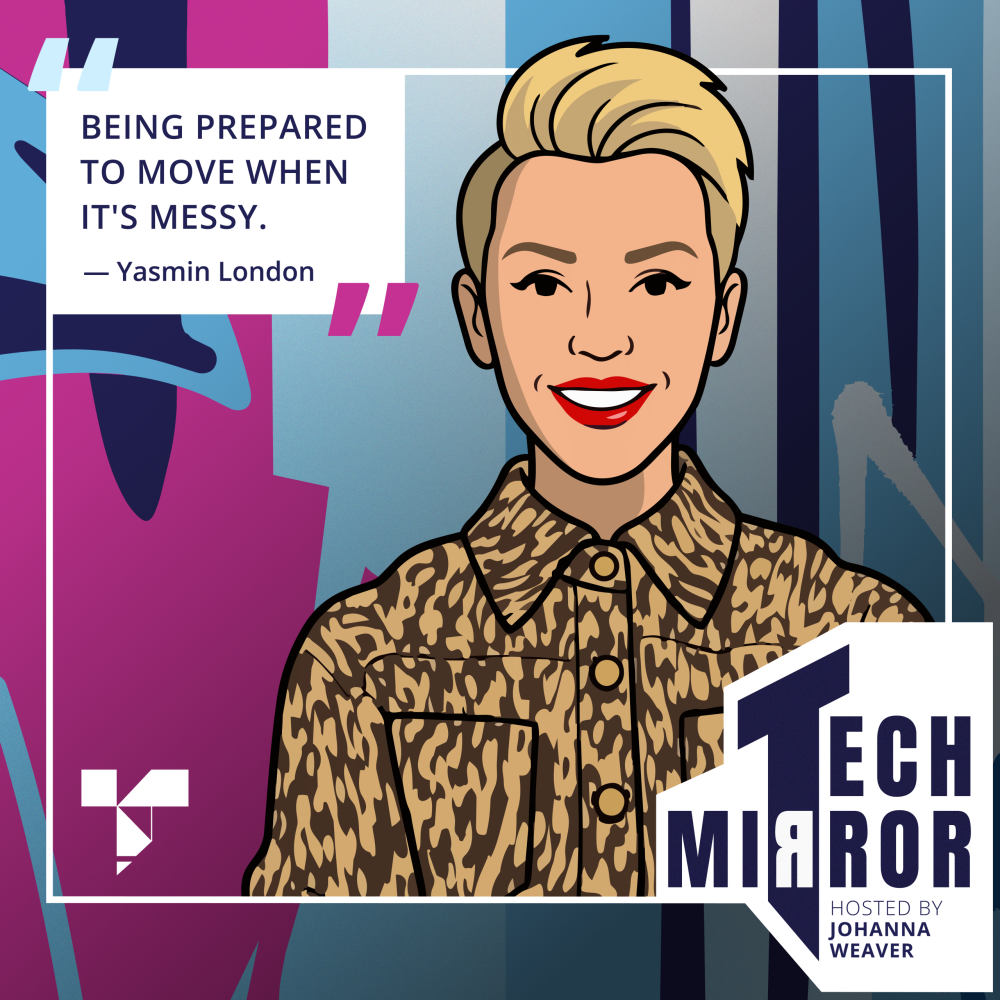
We are often paralyzed by perfection or thinking that somebody else is gonna be more qualified than us to step forward. And at its, you know, foundation, that’s the concept of the first mover, is being prepared to move when it’s messy, to not expect perfection from, you know, yourself or from others, but to be prepared to move anyway because we have, you know, that confidence that we will learn as we go along.
Um, so the, the book has a framework within it, which is an acronym for the word first, and the I in that is igniting courage. And in that sort of theme of confidence versus courage, I focus a lot more on courageous action and understanding that confidence isn’t a prerequisite. It’s a result of taking that courageous [00:19:00] action.
And I think that we can all be inspired by that in some way, shape, or form, whether it’s to try and address the inequalities of technology or whether it’s something smaller in our own day-to-day lives. I think we’ve all just got to get a little bit better at being prepared to make a move and take a chance and take a side, just like Nike did.
Johanna Weaver: Mm. And I think, um, the way you build throughout the book, your … Is it, are they called plunge prompts? Am I- Plunge prompts. Yeah. Yes. I love it because it’s … I mean, it’s a beautiful book just to read, but y- it’s also very practical in the sense that you’re giving people a framework and then sort of challenges to go out into life and put that, bring that into action in their own day-to-day lives.
Before we move on, I just wanna touch on a couple of the other figures that you cover in the book. I’ve recently traveled to Egypt, I was very lucky, and became obsessed with, um, Hatshepsut. Yeah. Uh, but I, I can’t pronounce her name properly, which is actually an indictment on the world-
Yasmin London: Isn’t it interesting?
Johanna Weaver: And also [00:20:00] myself. Yeah.
Yasmin London: Isn’t it interesting?
Johanna Weaver: Could you tell us her story?
Yasmin London: Because she was erased.
Johanna Weaver: Yes.
Yasmin London: Yeah. So it’s really interesting. Like, it’s … I pronounce it Hat- Hatshepsut, but even when we were doing the referencing for the book, there was, there were anomalies even in the way her name was spelt, depending on what reference you were looking at.
So it’s really interesting because she was the very first female pharaoh of Egypt, but she … W- when her reign finished, and what I should say before, before that is that she was one of the most successful pharaohs of all time. You know, she created trade agreements. She brought Egypt into a, a, a moment of thriving and opportunity.
There was, uh, many incredible things that she did during her reign. But when she passed away, there were steps that were taken by members of the royal family to erase her. So statues that were built in her name were knocked down. Her name was taken out of record books, and she was essentially [00:21:00] Erased. And it was quite interesting as well, even with the quote that was used at the beginning of that chapter being by George Orwell, that same situation happened for him in terms of erasing con- contributions from his wife as well in terms of his work.
So I’ve tried to link in, I guess, lots of different elements of, of erasure through that chapter. But ultimately, it’s about who controls, you know, the past controls the future, and who controls the future controls the past. It’s this ability to take and leave people who are convenient or inconvenient to us and make sure that they’re recognized or not recognized in the future and, and in our society.
And we know that women’s achievements, their accomplishments over time have actually been erased or they’ve been allocated to men. Um, so a really good framing for that is a thing called the Matilda Effect, which has happened for years and years. Ada Lovelace suffered it. You know, Charles [00:22:00] Babbage was able to, uh, take the accolades of a lot of her ideas, which it has only brought to light now what she’d actually contributed to society in terms of her ideas around coding and algorithms.
So, you know, when it comes to women, it’s important that we correct the record, that we don’t allow these voices to be erased. And I guess, you know, I use a, a term a lot in my business, which is what we make visible shapes what others believe is possible. And the more women and their achievements that we can showcase inspires the next generation of women to believe that they can as well, and to stand up, to participate, to put their hand up to say that they demand inclusion in this cr- this future that we’re creating.
And so there are consequences of erasing the past and, you know, we’re certainly seeing the impact of that AI bias in systems that are creating opportunities today. You know, that Victorian Women’s Trust research that I mentioned earlier They actually found that [00:23:00] 44% of the 133 AI systems that they analyzed contained significant gender-based bias.
You know, we’ve gotta start asking the right questions. We’ve gotta be curious. We’ve gotta be prepared to interrogate and challenge these systems so that we can create an equal opportunity and future for everybody.
Johanna Weaver: Mm. And to recognize that if we’re not standing up asking those questions, well, then who is?
And again, I think that leading at a time when you don’t necessarily have the answers, it was something- Mm-hmm … so we did a, uh, Zoe and I, my co-founder, made a presentation and, and had questions at the Joint Select Committee on Friday, and it was interesting. One of the things that had come up was, um, mistakes that had been made, um, by particular companies recently.
And I think we really, we have to recognize that mistakes will be made. You know, no one has dealt with this type of change, the speed and scale of the change, and there’s a certain amount of humility that comes from recognizing [00:24:00] that mistakes will be made, but we need to recognize that, correct them. You know, have really stringent things in place to be able to learn as we’re shaping that environment.
So does that ring true- Yeah … for you?
Yasmin London: It definitely does. And, you know, I think there’s always gonna be mistakes that are made, but I think there’s also a greater question on what, what are the, what’s the level of harm that we’re prepared to accept- Yeah … when it comes to these mistakes that are made. You know, listening to a lot of the, the tech bro-ligarchy excuse these mistakes or mishaps.
Like, I just kinda think in any other industry, this would be absolutely unacceptable. Yeah. If you were to talk about the 80/20 rule as a real concept, where 80% chance that we’re gonna thrive as a society, 20% chance of extinci- extinction, that is unacceptable. When we listen to Sam Altman say, “Well, you know, the difference between the responsible AI types and us is that we believe that there’s going to have to be, you know, a, a certain level [00:25:00] of sacrifice and harm caused for us to reach this, uh, you know, this utopia that they’re selling,” you know, society.
And I should say, I’m not anti-AI, right? I think AI has great potential and opportunity, but I am not gonna be dictated to by tech bros whose intentions differ so significantly from what I know to be the things that help people thrive. You know, if we’re talking about- I’m gonna get on my soapbox here Do it But if we’re talking about a universal basic income, right?
This is what they’re selling us. This is what they’ve decided is best for us, by the way. But if they’re selling that to us, it just fundamentally misdiagnoses what we as human beings need to thrive. Like, yes, it might sound great that we can be on holidays all the time, and we won’t need to worry about money, but if we look at a job, and I know that there’s a lot of people that perhaps don’t enjoy their jobs, but if we look at a job, it is so much more than a paycheck.
It is [00:26:00] community, connection, challenge, growth, development, belonging. It is everything that research for decades and decades has said we need to thrive as human beings. Like, if we look at the Harvard Study of Human Development, very, very famous study, has gone on for 85 years, I think it is, that studied the single biggest factor and predictor of a happy, healthy life for human beings.
It’s not money. It’s not fame. It’s not a great job. It’s the quality of our relationships. And so when you understand what humans need to thrive, it is not necessarily having all the money and never having to work again. It’s actually creating connection, community, in real life experiences, opportunities for us to feel that we have created a sense of accomplishment and achievement for ourselves as humans.
And so the more that I watch them get up and talk, and the more that I hear this PR spin, and even the, you know, the race with China, [00:27:00] right? That we have to beat China before, you know, they beat us. China is regulating their AI. They are regulating way more than the Americans are or we are in this part of society.
So it requires us as human beings to interrogate what they’re saying to us, and to challenge it, and to have a baseline understanding that allows us to do that, and that’s where that agency com- component comes in. I could talk about this forever, but it just, it needs interrogation- Absolutely … and courageous action.
Johanna Weaver: Oh, absolutely. And, um, actually, the, the episode before this one was actually with Madeline Carr, who was looking at how China is regulating artificial intelligence. So if you haven’t listened to that episode, I encourage people to go back. She’s a, she’s an amazing Australian academic, um, who was based in Beijing when we recorded that episode.
I, I… On the issue of regulation, uh, Yasmin, we’ve got the digital duty of care [00:28:00] currently before Parliament. That is obviously a piece of legislation that is looking, at least at its principle level, to be addressing many of the things that you’re talking about. It’s saying, you know, “If you are a tech company You owe an obligation to, uh, the, the users of your platform in the same way that an employer owes an obligation, um, to ensure workplaces are safe to their employees, for example.
How do you think about that piece of legislation? Is it something that you welcome? What framing would you have for people who are considering whether that’s something that we should be getting in behind to support?
Yasmin London: Yeah. Well, I think, uh, in of itself, a digital duty of care is a, is a great step, right?
We’ve gotta be leaning into this space. We’ve gotta make sure that a focus on regulation and controlling technology so that it doesn’t harm people is absolutely essential. I think safety by design as an idea and a concept needs [00:29:00] to become far higher in profile, and it needs to be integrated into all of the products that are being developed.
So, you know, making sure that there’s that accountability and transparency, that service provider responsibility is clear, and that, you know, the burden of safety isn’t on the consumer. Uh, and that there is user empowerment and autonomy. Now, when thinking about the digital duty of care, and, you know, I was part of your, your round table discussing this, and it was such an interesting conversation ’cause we talked about whether it should be separated in terms of, of children’s digital safety or everybody’s.
Uh, and there was this discussion that if we try to do too much to, you know, cover too many different areas, that it has the risk of failing, which I think that’s a genuine concern. If we don’t get it right, if we try to, you know, hit all the birds with one stone, it may not be as effective as we hope. But I think one of the big things through this conversation that [00:30:00] I’ve observed is that we need to make sure that policymakers, and regulators, and legislators Have a good knowledge of how technology actually works so that what we do decide actually is enforceable.
And that’s where it becomes, as you know, Jo, very complicated and a little bit muddy. And if we look back to, you know, decisions that were made, for example, with the, you know, the social media minimum age, for example, there was a lot of discussion with that around the online world being just like a nightclub, and that we need to have an ID to get into a nightclub.
And as we’ve all seen, the online world operates significantly differently to a physical world nightclub. And so we need to make sure that whatever we do decide here is actually enforceable, that people who are relying on legislative changes like this, as small business owners, as, you know, enterprise businesses, as consumers, can actually see the impacts and the [00:31:00] effects of that and, you know, make sure that actually it’s fit for purpose at the end of the day.
So it’s a little bit of a broad brush answer to your question, but I think, you know, we’ve gotta take the time to get it right and make sure that it is effective in the end.
Johanna Weaver: Yeah. And it’s interesting, the, uh, the bill has just opened and been pushed to a committee, um, so there will be a committee hearing on it shortly.
Um, it’s a, I think, a two-week turnaround, so by the time this goes to air, it will be getting close to the close of the deadline for those submissions. And I think there are two things, um, that stand out to me that require, um, further attention. One of them– Uh, and both of them go to this point of enforcement that you’re talking about.
One is that the bill doesn’t include a private right of action, so at the moment, enforcement rests solely on the eSafety Commissioner or, in some limited instances, potentially the Privacy Commissioner. The private right of enforcement would allow citizens or, for example, um, class actions to be [00:32:00] taken against the companies.
And I know people often say, “Well, would any individual actually do that?” But we have seen in the US those types of actions be quite successful. Very different legal environment, but I think still quite useful. And another thing that I think is quite interesting that I’m hearing more and more about Which we also discussed, Jas, at the design dialogue for, on the duty of care, is this concept of a multi-commissioner model.
Yes. Yeah. So everyone knows Julie Inman Grant, who- Mm-hmm … has just done a fabulous job as the eSafety Commissioner. She will be finishing up, um, shortly. And, uh, it was recommended in the independent review that, uh, by Delia Rickard, that that be evolved into a multi-commissioner model. And I thought it was interesting that at the Press Club there was a question when Minister Wells last week gave an address on the digital duty of care.
There was a question from a journalist who basically framed it saying, you know, the eSafety Commissioner has to be one of the toughest, and no one would want that job-
Yasmin London: Mm …
Johanna Weaver: uh, jobs in Australia. And I do think there is something to be said for evolving it [00:33:00] into that multi-commissioner model because it is every other regulator has that multi-commissioner role, and it’s just recognizing the evolution of that portfolio.
Yasmin London: Absolutely. And, like, to add to that, you know, the, the personal consequences for Julie in this role just cannot be understated. I, I remember going to, um, I think it was the New South Wales Government Social Media Summit where we were gonna start talking about the online safe- safety amendment and seeing her turn up with a police escort because of threats to her life, credible, significant threats to her life, to the, her family.
So, you know, going back to, I guess, the purpose of even First Movers and the book and why this sort of work is so significant to protect women and girls is because of situations like Julie has experienced. You know, taking on Elon Musk resulted in hundreds of thousands of death threats towards her, threats to her family, and it results in most cases, in many [00:34:00] cases for women, in a phenomenon called the silencing effect, and this is the agenda.
This sort of abuse and harassment and intimidation is intended to silence women’s voices. And who could blame her if your family was threatened or if your children were pu- perhaps put at risk, or you were, you know, needing to restructure the front doors of your office because it was deemed unsafe? Who could blame her for perhaps stepping away or maybe choosing not to make a call where maybe Australia was asking her to, but the fear that actually might have come wi- with that decision and the weight of responsibility of a role like that.
So, like you, I fully support a, a multi-commissioner approach so that, that, that risk is minimized as much as possible.
Johanna Weaver: And there’s, um, there’s real benefits of accountability as well when it’s not all sitting with one person, and I think there’s a lot of, um, a lot of focus on sort of the transparency and oversight of [00:35:00] that role, which would be enhanced by having that multi-commissioner model.
Now, Yas, one of the f- one of my favorite chapters in your book, um, or sections in your book is, uh, where it starts with the heading of A Better Name For Chaos. Yeah. Now, I don’t know about anyone else, but I feel like my life is pretty chaotic at the moment. Yeah. So what is the better name for chaos that we should all be using?
Yasmin London: Oh, look, well, chaos, if you go back to Greek mythology, is not the same definition as we use in the modern day. So chaos essentially is a, a, a, a gap. You know, this is an opportunity period for us to create change. And in this chapter I also talk about Gaia, and Gaia representing the Earth that forms in this, in this y- yawning gap, I think I’ve, I’ve described it as.
And Gaia represents [00:36:00] foundation. It represents truth-telling. It represents a, an opportunity for us to stand on solid ground, to make solid and sound decisions as a result of that. And, you know, it’s a, it’s a little bit, um… It’s not woo woo, it’s not woke. It’s, it’s just a different way of thinking, I guess, about the opportunity that’s in front of us right now, and the potential, if we are to speak truth to power, if we can speak truth to each other, if we can take the time to get things right in terms of the decisions that we’re making when it comes to legislation, regulation, our own education, then we’ve got a real opportunity to solve for the problems that we see today, and realize the great benefits that technology is offering us as a human race.
But if we don’t take the time to sit in the void, to get it right, to speak truth, to create that solid ground, if we are led astray or if we are- Led [00:37:00] down the garden path by people sharing a very one-dimensional view of what that future must look like, then that’s where we’re really going to run into risks.
So that’s the situation I want to avoid by telling that story.
Johanna Weaver: And when you think about the frame of courageous leadership, does courageous leadership in those different roles in this point in time, does it look different, or is it the same common theme that runs through it?
Yasmin London: Look, it can be different for everybody.
I mean, the people that you just spoke about have varying levels of influence and power, and they’re also placed in situations where their capacity to make the decisions perhaps internally they want to make is sometimes limited, right? It’s a bit of a quid pro quo sometimes. But I think in the end, it’s making that next right choice.
It’s about gathering the right information and deciding whether it’s a, a 1% move or it’s a very big change to do what is right [00:38:00] for human thriving, to not necessarily make sacrifices that are gonna have those knock-on consequences that we aren’t going to be able to change. It’s also very personal. You know, as I talked about at the beginning, this is ultimately It’s a book about courageous self-leadership set against the backdrop of one of the most consequential times in our lives, being the AI era.
But this book is about understanding that pause before the plunge. Now, we talked about plunge prompts, that moment of hesitation, that moment that all of us feel in our lives, whether it’s at work or at home or anywhere in between, where we hesitate because we fear taking that next step or what it might look like or how we might be perceived.
And I guess what I’m asking people to do is to take that plunge, to learn while doing, to be that person, and this can be difficult in politics, I know, but to be that person who’s okay with being seen trying. Like, [00:39:00] how amazing would it be if our politicians for a moment stopped attacking each other, showed a bit of vulnerability, authenticity, and courageous self-leadership to say, “We didn’t get that right, but we’ve fixed this, and now we know what we’re going to do next, and this is the reason that we’re doing it.”
But ultimately, I think the Australian public are sick of the nitpicking. We’re all past that. We wanna make sure that we’re getting good decisions made that actually are serving people in this country and around the world. We’ve gotta leave the party politics behind, and we wanna see courageous leaders who are making good choices, good decisions, and are charging towards a future that’s actually gonna help us thrive as a society.
Johanna Weaver: Yeah. And so much of what you are focusing on in the book is how to retain our humanity in the face of this really consequential change that is happening at the same time. So for you, what does it actually [00:40:00] mean to be human in the AI era? And I kind of- I cringe at the AI era because I feel like it’s similar to saying the online/offline dynamic.
We’ve got to get a better way of articulating what this change is, ’cause it’s not actually about AI, it’s about the impact that it’s having on the world.
Yasmin London: The areas that I think we need to think about to stay human in this world, to make those good decisions, really come down to what I call the three Ps.
The first one is protecting the human, the second one is preserving the mind, and the third one is powering human connection. And to me, this is almost like the Maslow’s hierarchy of needs of the AI era. Like, what do we need to do to create the conditions for these good decisions to be made? The first one is understanding that we need basic safety, right?
We can’t be under threat. We can’t be feeling like we’re, you know, going to be abused physically or virtually. We can’t operate from a place that is going to create sensible [00:41:00] outcomes if we’re the victim of a deep fake image-based abuse image or video. So how do we protect people? And that really speaks to the digital duty of care, the safety by design ethos.
Then the next one, which I do really think is possibly the biggest-ticket item when it comes to how AI is impacting us as human beings, is preserving our minds. You know, there’s this real risk of over-reliance happening now, and AI automation bias that people are experiencing. We’re in workplaces today where people are in, you know, fast-paced, high-volume roles where we don’t allow ourselves time to think, let alone analyze things properly.
So, you know, we’ve got businesses at the moment that are not seeing the returns, the significant returns of productivity because of AI, and we’ve actually got the flip side here, where we’ve got perhaps more burnt-out workforces where AI has intensified their workloads, and we’ve got the risk of a mistake [00:42:00] scaling significantly.
So we’ve got to really rethink how our brains and our cognition are gonna operate in a human-AI-augmented future. And I think the businesses that really are going to thrive here are not the ones that are gonna focus on the tech and the tools. They’re the ones that are gonna focus on human intelligence and readiness and how we operate with this technology, uh, rather than outsourcing and atrophying our, our cognitive value there.
So I think that’s a really big one. And as a side note to that, if you look at the World Economic Forum saying that, you know, mis and disinformation is one of the biggest risks to humanity at the moment, especially over the next sort of two to five years, we know that, um, they’re focusing on things like brain capital as the, the future skills of the workforce.
So critical thinking, digital literacy, entrepreneurial mindsets, adaptability, agility, all of those things are where we need to be focusing our attention, and that means we need to keep our brains sharp The third one, [00:43:00] and I’ve talked about this and I’m a very big advocate, but it’s about powering human connection.
It’s about creating opportunities for us to spend more time together in real life. You know, that places not platforms thing comes up there, too. I think we need a different, different word for it. But, you know, we’ve got to recognize that actually our ability to connect with each other, our relational skills, our ability to communicate, you know, how are we helping kids who have a digital-first communication preference?
How are we helping them have the hard conversations? How are we making sure that they don’t outsource their thinking or the difficult situations that they have to AI companions? There was a, um, a really interesting study from YouGov that came out last year, and I, I talk about th- this a lot in the keynotes that I do.
But they studied, I think it was about 1,300 Australians in November last year around their AI companion use. And they found that, uh, 17% of people had at least one [00:44:00] intimate conversation with a chatbot in the preceding 12 months. That, uh… Sorry, 23% had done that. 17% would prefer to s- regularly speak to their chatbot than a real human being.
And then 12% could realistically see themselves in a relationship, an intimate relationship with a chatbot in the future. Now, those aren’t really fringe issues anymore. They’re things that are starting to impact our workplaces, our families, our children. But there were two findings from that study that I thought were particularly interesting, and it was really about why humans would choose a chatbot over a human being.
And they found that the first reason was that they didn’t feel confident starting a conversation with someone, with a stranger. And the second thing was that they couldn’t continuously think of things to talk about. So if we have generations of people, whether adults or young people, coming into our society, into our workplaces [00:45:00] who aren’t confident approaching someone and having a conversation and can’t think over a period of time about different things to talk about, then we’ve got massive problems.
You know, how do we create psychologically safe workplaces with people who can’t speak up? How do we stop products being designed like, you know, the Grok X AI put her in a bikini product feature, which created image-based abuse videos and images of three million people worldwide? How do we stop that happening if we don’t have people that are able to speak up and who don’t have the relational skills and capabilities to communicate a message to try and stop that situation from happening?
So there’s a lot in it, but those are the three key, key areas I guess I like to look at in terms of ways that we can move the needle for the future
Johanna Weaver: If there’s one key message that you want people to take from this book in terms [00:46:00] of how we can flip that paradigm, how we can encourage people to take that first step, to become that first mover even when they don’t necessarily have that confidence in place, what is it?
Yasmin London: I think it’s understanding that we all have influence by moving in small ways, and to not be dissuaded by the fact that you might not identify necessarily as a big mover and shaker. That’s not really what this is about. This is about all of us understanding that we play a role. Um, if we look at even the activity that’s happened across Australia when it comes to data centers, community collective action of coming forward and saying, “We do not want a data center in our backyard.”
There’s one in, I think, Lane Cove in New South Wales recently, where that community came together and actually had a successful outcome. So it’s not about feeling like you have to move and shake everything, but it’s about building your own tech literacy, your own [00:47:00] agency, and understanding what’s happening at your front door.
It’s about having conversations with people and having the ability to maybe, you know, unpack what might be mis- or disinformation. I mean, I’ve seen this happen even with my 80-year-old dad and my 70-year-old mom. Like, my dad was bloody addicted to TikTok a few months ago. You know, trying to help him understand what is fake and what isn’t, and how to take small actions to curate his feed so he’s not getting You know, useless crappy content that’s, was, uh, to be perfectly honest with you, influencing his perception and decisions around ch- the geopolitical situation that was occurring at the time.
So it isn’t about massive moves. It’s about small ones, the 1%s, the consistent decisions that we might make about our feeds, or the conversations that we have the capability to have with our children when they come home and they might be talking about something [00:48:00] problematic that they have seen online.
It’s about building capability and not having, you know, the wool pulled over our eyes by flashy, charismatic or uncharismatic tech bros that, you know, are, are quite happy to own the world. So it’s just about stepping forward in small ways. That would be my message.
Johanna Weaver: Yaz, if people wanna get a copy of the book, where do we go to?
Yasmin London: Oh, probably easiest thing is you can go to my website, and on the menu bar there is, uh, the word First Movers book. You can grab it there. It’s on Amazon. It’s on all the major book publishing websites, Dymocks, uh, wherever you wanna find it. But, um, yeah, definitely please get in touch if you’ve enjoyed it as well.
I love hearing the messages that people get from the book, I should say, and what they found beneficial. It’s been amazing. And again, never, ever thought I’d ever be an author. It’s just not been on my bingo card, but here we are. So if I can do it, you can do it too.
Johanna Weaver: It’s a [00:49:00] beautiful book. I really do encourage people to take a look.
We’ll put the links in the pod notes. But Yasmin, thank you so much for coming on the podcast, but also for all of the work that you do. Um, I encourage people to follow Yaz. She’s, um, a fabulous commentator on these things, and really good about making it accessible to every Australian, because these are issues that we need every Australian to be engaged in.
Yasmin London: Thank you for having me. It’s been great to be part of the pod.
Johanna Weaver: Well, that’s it for this episode of Tech Mirror, which is brought to you by the Tech Policy Design Institute. We’re based here in Canberra on the lands of the Ngunnawal Ngambri people. If you found today’s conversation useful or thought-provoking, please do share it with a friend or a colleague, or leave a review and subscribe wherever you get your podcasts.
If you’re watching, please don’t forget to like and follow. For show notes, you can visit [00:50:00] techpolicy.au/podcast. And this podcast was made possible with thanks to the generous contributions from government, industry, and philanthropy to the Tech Policy Design Fund, the full details of which are available on our website.
The team at Audiocraft produced this pod on the lands of the Gadigal people of the Eora Nation. Music is by Thalia Skopelis. A big thank you also to the team at the Tech Policy Design Institute, without whom this pod would not be possible. Thank you for joining us, and as always, get in touch and get [00:51:00] involved