
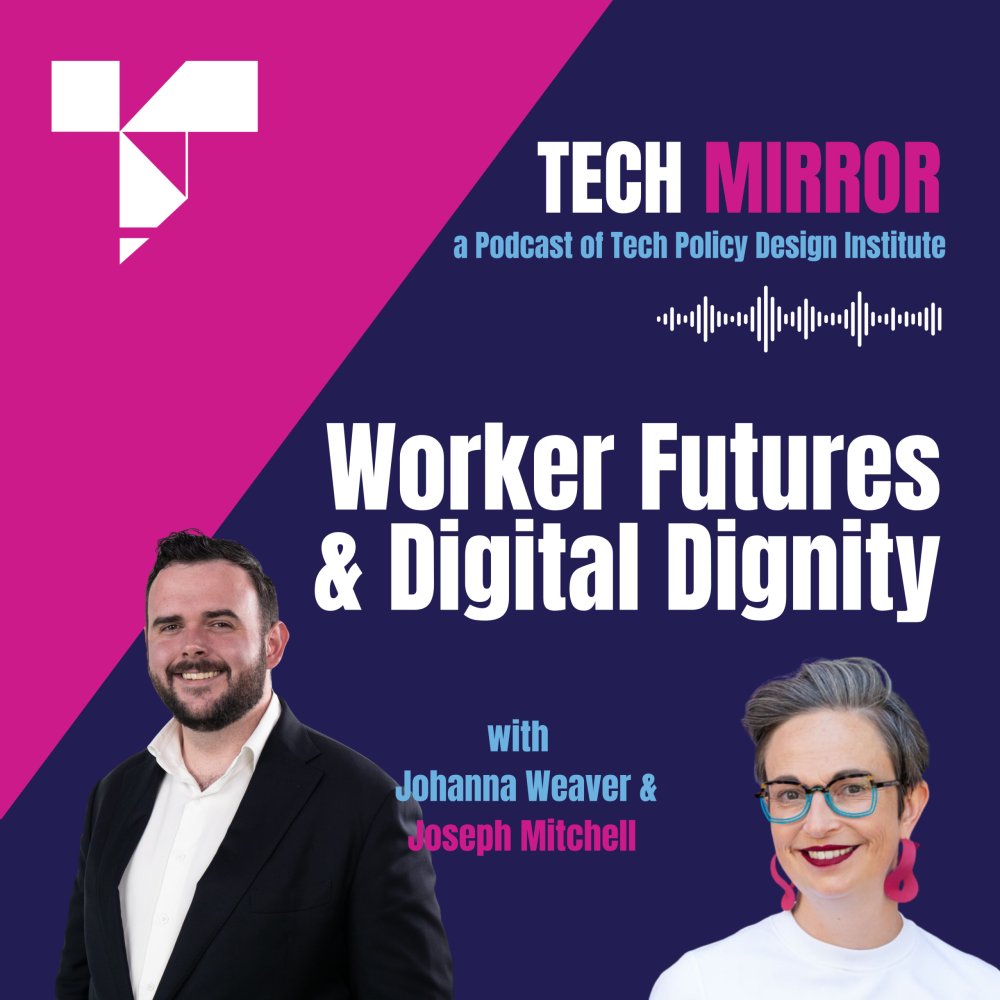
The nature of work and jobs is being reshaped by artificial intelligence. Is it the building block to a worker utopia, or a more bleak, disruptive reality? In this episode of Tech Mirror, host Johanna Weaver sits down with Joseph Mitchell from the Australian Council of Trade Unions to unpack the opportunities, risks, and power dynamics brought on by the rollout of AI in workplaces around Australia. He argues that AI is being used increasingly to meet new efficiency benchmarks and worker surveillance. Johanna and Joseph ask, can the voice of unions, policy makers, and individuals shape what happens next, and will the future of work remain deeply human — even in an AI-driven world?
Links:
Australian Council of Trade Unions: www.actu.org.au
Encyclical Letter, Magnifica Humanitas, of His Holiness Pope Leo XiV, on safeguarding the human person on the time of artificial intelligence: https://www.vatican.va/content/leo-xiv/en/encyclicals/documents/20260515-magnifica-humanitas.html
Fair Work Commission: https://www.fwc.gov.au?utm_source
National Employment Standards (Fair Work Ombudsman): https://www.fairwork.gov.au/employment-conditions/national-employment-standards
Daron Acemoglu
- MIT Economics: https://economics.mit.edu/people/faculty/daron-acemoglu
- Building pro-worker artificial intelligence https://economics.mit.edu/sites/default/files/2026-03/Building%20Pro-Worker%20Artificial%20Intelligence.pdf
For transcript and full show notes visit techpolicy.au/podcast
Transcript
Johanna Weaver: The Tech Policy Design Institute acknowledges and pays our respects to all First Nations people. We recognize and celebrate that among many things, indigenous people were Australia’s first tech innovators.
Joseph Mitchell: There are places in Australia that adopt AI really well and places that have learned their lessons. Where artificial intelligence has been adopted the best is just at that central basic point of giving workers agency and power in making the decisions that affect them, giving them security of employment, permission to experiment, and then working with workers to adopt it in the most effective and productive way
Johanna Weaver: Welcome to TechMirror, the podcast where we talk about how technology is shaping our world and how we, the humans, can shape technology back. I’m Johanna Weaver, your host, and today my guest is Joseph Mitchell. He’s the assistant secretary at the ACTU, the Australian Council for Trade Unions. And the ACTU is the peak body for unions in Australia.
They represent about 30 different unions, or 38 different unions to be precise, around Australia, and together they represent about two million different Australians and their families. So I’m quite sure we’re gonna have a fascinating conversation, uh, with Joseph today about AI and the future of work. Uh, so Joe, welcome to the podcast.
Joseph Mitchell: Thanks so much for having me.
Johanna Weaver: So Joseph, I was really interested looking at your bio. You studied economics and finance and then ended up in a union. That’s not a common pathway I would have thought. So how, how did you, or what prompted your interest and how did you get involved in the union movement?
Joseph Mitchell: Uh, I got involved in the union movement through, uh, in the same way so many other people do, just by volunteering on workplace campaigns.
My first exposure to the union movement was through the campaign to protect penalty rates for working people and oppose those cuts that were recommended by the Productivity Commission. Um, and, you know, as a waiter at the time, uh, as a hospitality worker, you know, seeing just how unfair it is when major institutions that have no connection with what working people do and how they make ends meet can make decisions that affect people’s wages is just so deeply unfair.
And so while I was studying economics and arts at ANU, I, um, you know, got involved with the union movement in that way, applied for a job desperately to work for the ACTU so that I could keep, you know, expressing those values and keep working- Um, for the kind of causes that I deeply believe in, and stayed at the ACTU for the last 10 years.
Johanna Weaver: Yeah. And I’m gonna focus, uh, our conversation predominantly today around AI and the future of work. And for those of us who are big nerds following, following this space, the sort of, one of the latest things that has come out is the Pope has come out with an encyclical, which I’m not Catholic, and so I was like, “What is an encyclical?”
But for those who, who don’t know, it’s, um, basically the Pope will put one or two of these really important documents out during their popeship. And this one is really interesting ’cause he’s talking about AI, how it’s gonna shape the future. And obviously there’s lots in there about religion, but it, it also recognizes the importance of labor unions and movements.
And I thought that was quite an interesting observation to be made from someone who is bringing that religious perspective. But putting the religion aside, can you describe, like, what the role or how you see the role of unions in shaping the future as artificial intelligence is sort of rolling out through our economy?
Joseph Mitchell: I mean, yeah, as, as not a very good Catholic, I found reading the Pope’s encyclical just unbelievably insightful. And I think that- Mm. You know-
Johanna Weaver: It’s a really incredible document.
Joseph Mitchell: Yeah. And, and the Pope in choosing Leo actually chose the name of a person who, a former pope, who deeply respected workers’ rights as well, and I think that there’s a bit of a statement and a theme coming out of his tenure.
The, um- The, what unions have and what the interest of working people have is the same as we’ve had for every major technological disruption that’s affected working people. Working people demand a say and agency in the future of their workplace, the future of their industry, and the future of their society.
Mm-hmm. And I think that something that comes through that document and through so much of what the union movement is advocating for is a real centering of humanity, of people connectedness and workers over the interest of technology by itself, because it has to serve somebody- and it should serve real people.
Johanna Weaver: Well, it just so happens that TIPD’s mission is to shape technology for the benefit of humanity, so there’s some strong alignment- Yeah … strong alignment there. I mean, there’s so many different forecasts that exist around the impact that artificial intelligence is going to have on work going into the future.
Your, uh, y- one of your key parts of your portfolio is thinking about that. So what are the types of scenarios that you and your colleagues are thinking about? Maybe the ones that worry you and, and maybe also positive, because I don’t think it’s all negative.
Joseph Mitchell: Yeah, it’s definitely not all negative, and we see artificial intelligence and new technologies being applied in workplaces that have really, really good outcomes for working people and for businesses and for processes as well.
But I think that, you know, when the union movement first started grappling with what are gonna be the large systemic impacts of artificial intelligence, really in 2023, we, uh, in an early way saw it in sort of three streams of impact. The first is artificial intelligence as a tool at work, where AI is being introduced to change or augment work, sometimes with the intent to automate and displace jobs.
And we’re seeing that in white collar areas like finance, banking, services, technology, where artificial intelligence is rapidly changing how work is done and being introduced to complement or in some cases replace working people. We’re also seeing automative technology, uh, occur in transport in particular, but also other logistics places where it’s being rapidly accelerating its adoption.
You know, the second stream is artificial intelligence as a tool of management, where AI is being adopted to extend management’s prerogative and control over the workplace. And this is where actually where most people’s first interaction with AI is, where it’s being used to make rostering decisions, hiring and firing decisions.
It’s been used to overlay existing, um, surveillance software or existing CCTV cameras and used in performance management and performance engineering as well. And we’re seeing some really pernicious uses of artificial intelligence or just general automation technologies in management that have deeply negative outcomes for working people.
And then the third is artificial intelligence as it affects industries, and this is where AI isn’t being introduced into the workplace by either the employer or the worker, but it’s still having a dramatic impact nonetheless. We’ve got, in the education space, the nature of teaching rapidly changing as ChatGPT infiltrates its way all the way through students’ work, and you have to think about really deeply what pedagogy and assessment looks like as a result.
Or you have the wide-scale theft of creative workers’ content, of journalists’ work, of academics’ work, and of Aboriginal and Torres Strait Islander cultural property dramatically changing those workers’ lives and something that we absolutely have to deal with. Similarly, our institutions are also under enormous pressure from artificial intelligence.
If you think about the Fair Work Commission, you know, receiving more applications this year than it did for the entirety of last year, largely driven by artificial intelligence really choking up the systems that we rely on to work efficiently. It’s been divided into sort of these three camps from a really early stage from the union movement, but what we’re seeing is really deep and really rapid and broad adoption across different workplaces and, and the experience of workers being extremely diverse.
Johanna Weaver: When you’re looking at the fears that people have around artificial intelligence, uh, do you– You know, you mentioned there about hiring and firing. Are there examples that you have already seen? So, you know, uh, um, perhaps a case study that you can give us of something in, in that space.
Joseph Mitchell: Yeah. I mean, we can choose from so many different industries.
But I think I’d like to focus- Mm … on two, and just to show how broad the impact is. I think the first one is the experience of a couple of nurses in a public health facility in Australia who were told to use an artificial intelligence tool to complete their job, complete their work. They could not control the outputs of that tool, and if you’re not super familiar with how health regulation works in Australia, we have protected titles.
If you’re a nurse, if you’re a registered nurse, a, a practicing nurse, if you’re a doctor, you can’t use those words or that title willy-nilly. You have to have… You have to be a professional to use those titles. This artificial intelligence tool that the employer required these nurses to use misrepresented their position, and those nurses couldn’t edit that, and then they were called for disciplinary action by the regulator.
And while the union was able to resolve this, it shows how when artificial intelligence tools are introduced without the ability for workers to say no, and without consultation or the ability- Mm … for workers to have meaningful agency over its use, it can result in really negative outcomes. I think the second is one where workers have been, um…
You know, there was a retail worker. Mm-hmm. She, um, was working on the checkouts at a large retailer in Australia for 30 years. A really productive worker. And new CCTV footage and cameras were put in, and an artificial intelligence overlay was put over the top of that, and she was given a final warning by her employer for failure to meet an accuracy standard.
Now, this accuracy standard was never explained to her. It was not explained how the accuracy of her inputs were measured against anything, and it was never explained to her that she was also being newly monitored in this place. And we also know that AI isn’t particularly good. Her accuracy was 99%, but she still failed some benchmark that she wasn’t informed of.
And now, obviously, the union managed to keep this person’s job, but it shows how, you know, AI systems being introduced without workers’ knowledge as well is genuinely negatively impacting their work. And this can create an enormous strain where you’re just not sure of the benchmarks you’re being measured against.
You’re not sure of when- Yeah … or how you’re being watched, and you’re not sure if the AI is even right when it is making decisions that could affect your employment and your livelihood.
Johanna Weaver: Yeah. And so I really wanna come to these points about what the workers’ rights are in response to this- Mm … and also if we need to evolve those rights and things like the right to consultation, which you’ve sort of hinted at there.
But before we go there, I just wanna stay for a little bit longer on the big picture piece, and in particular looking at things like the forecasts that we have. So, you know, you have someone like Sam Altman, the head of OpenAI, saying, you know, it’s gonna ablish- obliterate white collar jobs, and him saying things like, you know, “I hope I’m wrong, but I, I’m not wrong.”
How do you think about that, particularly in terms of entry-level jobs? And what… I guess there’s also a, a… If there’s a big focus on the impact this is gonna have on the entry-level jobs, but also the impact that these types of predictions, which vary widely, have on people’s engagement and willingness to engage with artificial intelligence.
Joseph Mitchell: Yeah, I mean, we’ve heard these kind of doom and gloom predictions for many years, and often gleefully stated by these large AI developers and owners talking about the, a white collar wipeout. You know, there’ll be no jobs within five years. There’ll be no… 50% of all entry-level jobs will be automated within five years.
You know, another company said 18, 18 months and we’ve got all white collar work automated. Mm. Um, a part of us thinks that that’s just marketing. You know, there is a huge incentive, right? When your biggest customers are the biggest businesses in the world where they might be rubbing their hands together about the idea of automating jobs.
Um, we are though increasingly worried about the massive transformative effect that artificial intelligence could have on the labor market. You know, we know that jobs will change. Jobs are already changing. Mm. We’ve seen early cases of redundancies at WiseTech and Atlassian where artificial intelligence adoption is at least driving those, not necessarily task replacement, but at least it’s partially to blame.
And we’ve also heard, you know, so many annou- announcements out of the US about artificial intelligence leading to job cuts, and while there is an idea that that might be AI washing- That’s probably true for a lot of them, but it probably isn’t true for all of them. Mm. And you have to pay attention to that.
You have to pay attention to the idea that there may be really negative effects on the labor market if these technologies are introduced in a way and with an intent to automate jobs rather than grow them. And I think that We think that what’s really important is that we have choices that we can make when we introduce these technologies, and we don’t accept that the only choice that businesses can make is to automate jobs and replace them and sack workers as a result.
But, you know, if we hear these, we have a… If we hear these predictions coming out of the tech industry and being lapped up by, um, big business in Australia, of course we’re gonna be skeptical. We’re gonna be really skeptical about in whose interest this is in. And, you know, working people are, Australian working people are some of the most skeptical in the world when it comes to artificial intelligence, and that’s not because we’re Luddites, it’s because we are very discerning about whether or not this is gonna be in our interests or not.
Johanna Weaver: Mm. Or can I challenge that a little bit? Maybe we are Luddites, but Luddites doesn’t, isn’t a bad term, as in I think people think- I should, yeah … the Luddites have a ba- I should stop- Have a bad name. Me too.
Joseph Mitchell: I should stop using the word Lu- Luddites were unionists, so I really should- Yeah, exactly … stop using that word.
But, you know- Exactly … you know, in the popular understanding of it, we’re not technophobes. That’s probably- Yeah, exactly … a better way to put it, right? Yeah. Exactly. We aren’t. But we understand that there are choices that can be made, and, and unfortunately, so much of this technology which could have benefits, could have great productivity benefits, could lead to a more equal society if it is applied well, and shorter working hours, and greater distributions of wealth.
Um, but it, it doesn’t seem like that’s what Sam Altman wants, and it doesn’t seem like that’s what a lot of people in the tech industry want. We sort of have a pretty good guess about what they really want, and that’s in their own pockets.
Johanna Weaver: Yeah. I think, um… So the reason I’m so fascinated by the Luddites is, A, that they’re synonymous with anti-tech, but actually what they were arguing for was actually when these mills, you know, when the looms get introduced to the mills, we want the workers to be involved.
We want to evolve. It… Many of the conversations we’re having now are exactly those same conversations which, of course, you know better than most, Joseph. But so you, the… You’ve spoken there about productivity, spreading the benefits. This is obviously one of the key pillars, one of the three key pillars in the National AI Plan.
From a union perspective, what would that actually look like? So if the government has set this objective, and it’s a Labor government, has set the objective that we want Aus- all Australians to have some benefit from artificial intelligence, can you kind of paint us a picture of what that future would look like?
Joseph Mitchell: For us, we think that there… Like, first of all, the National Artificial Intelligence Plan, having so much in there about workers needing to benefit, about making sure that workers’ rights are fit for purpose- … um, going forward into any tech future are really, really important, um, statements of principle that the government should make.
You know, that kind of document is a really important foundational document to how government will approach artificial intelligence challenges going forward, and there’s a lot in, you know, guiding principles and statements that help us achieve Um, and help us realize where policy is going forward. In terms of how workers will practically benefit, a lot of this might be determined workplace by workplace, industry by industry, but we also have really big levers available to us as societies.
You know, the National Employment Standards are just one of the many levers that we have available to us across employment to ensure that we have a fairer distribution of wealth, work, and rights. And, you know, the union movement is absolutely, um, campaigning for and arguing for the need to have shorter working hours for the productivity debt that we’re already owed.
Over the last 15 years, productivity has not been fairly shared in Australia, and working people are working harder, companies are making more, and they’ve banked that productivity growth for themselves, and workers often hadn’t received real wage increases to compensate for that productivity. But what we could see instead is shorter working hours.
You’ve got two ways to share productivity. It’s w- it’s in wages or it’s in hours. Mm. And, you know, we’re pretty comfortable with discussing both.
Johanna Weaver: And just when you say the employment standards, for people who- Yes … don’t live and breathe this world- Yeah … that’s essentially the standards which are set federally that say if you’re working in this particular industry, 37 hours is a standard work week.
Is that what you’re referring to when you say the employment standards?
Joseph Mitchell: Yeah. The, the National Employment Standards are the minimum conditions that every worker has rights to that apply across every industry in Australia. And, um, every award and enterprise agreement and individual contract has to be set with reference to the National Employment Standards.
Johanna Weaver: And so when you’re looking at what rights workers currently have with respect to artificial intelligence as it’s being rolled out in any one of those three ways that you described at the start, so actually being used in a workplace management or industry shaping, what rights do workers currently have when it comes to artificial intelligence?
Joseph Mitchell: Workers currently have the right to be consulted on a change that’s coming to their workplace. When AI– when the employer has made a decision to introduce artificial intelligence, that employer has an obligation in law to consult with workers, and also has an obligation in law to mitigate adverse effects of the introduction of that change.
Now, technology is one of those, um, things that employers have to consult about, and we’ve written to employers reminding them of this obligation. Um, and the best way to enforce that obligation is through their union, because we can get better outcomes collectively, but we can also get more information usually than employers are willing to offer up in the first instance.
Johanna Weaver: Mm.
Joseph Mitchell: Um, what we’ve seen, though, with the introduction of artificial intelligence in a lot of places is that employers aren’t abiding by that minimum obligation. Mm. They aren’t treating the introduction of artificial intelligence like a major change with significant effects when it obviously is, and that’s not good enough, and we are going to collectively, as a union movement, hold employers accountable for when they don’t do the right thing
Johanna Weaver: What would good consultation look like?
So presumably that’s gonna differ depending on what your industry is. But I, I’ve sort of heard some conversations on this and, and made the po- ha- have heard the point be made that it doesn’t need to be some sort of formal, overly, um, scripted set of consultations. It’s actually just having a genuine conversation with workers.
Am I understanding that correctly?
Joseph Mitchell: Yeah, that’s exactly right. Mm-hmm. Good consultation is pretty consistent across every industry. It’s about being honest with workers about what you are doing, what your goals are, and inviting them to be a part of determining the outcomes. The, um, you know, it’s not even just best practice obligati- application of the laws.
Best pract- best practice adoption of artificial intelli- intelligence is done in co-design. Yeah. One of the fa- one of my favorite people to read, Daron Acemoglu, has a paper called Pro-Worker AI, which is phenomenal, and des- describes how some of the most productive applications and adoptions of artificial intelligence are done, uh, through a process of co-design with the workers who are going to be using the technology.
Because ultimately you’re making people more productive when you adopt this really well, and workers will use this technology well because they are experts in the work that they do. They wanna get the job done really well and, you know, when you allow them to express themselves in a secure way, knowing that they are going to be contributing for a long while after the introduction of change, then it’s gonna be really good.
Johanna Weaver: Mm.
Joseph Mitchell: Yeah. It,
Johanna Weaver: It makes really obvious sense, right? It… The people who do the job will wo- will know how to use artificial intelligence and get the most out of it to deliver the productivity. So I think it’s, there’s obviously a legal obligation to do it, but there’s also a productivity… You know, a manager, um, sitting on high saying, “You should use artificial intelligence in a particular way,” I suspect is gonna get far less productive outcomes out of it than- Yeah
than other people, or creative uses of it as well.
Joseph Mitchell: Yeah. That’s exactly right. I mean, so often we see the introduction of AI with how work is imagined to be done- Yeah … rather than how work is actually done.
Johanna Weaver: Yeah. Yeah.
Joseph Mitchell: And it’s that kind of, it’s nearly insecure insistence on a use of wo- through a particular process rather than allowing workers to have feedback and genuine contributions just leads to a really negative outcome.
It leads to a lack of trust, leads to lower adoption. Outside of what is best practice, you know, if you just want the thing done- You’re better off having, uh, allowing working people to contribute in a, in a genuine way to the outcome rather than just put things on rails. It’s a really important point you make about people and employers often ritualize consultation.
It is not a ritualized thing. It’s not a scary thing to meaningfully consult working people about changes that are coming to their workforce. It’s also not a scary thing to share with working people that you’re not sure where this is gonna end up. But consulting them nonetheless about what the am- ambition is and what the goals are, and then hearing concerns is just such an important part of the process.
Johanna Weaver: Yeah. Yeah, I couldn’t agree more and, and again, that sort of fits so strongly with the ethos of the work we do at, at TPDi, is making sure that you’re getting all of the different perspectives on whatever the issue is, and making sure that you’re listening to all of those voices because the outputs are inevitably going to be so much richer because of that.
So y- you’re referring there to rights that workers already have. Are there any particular initiatives that the ACTU is looking to bring into force? So additional protections that you would like to see come into play recognizing, you know, this is quite a significant step change for our society and for our economy.
Joseph Mitchell: Yeah, I think that one of the big changes you know, we wanna make sure that the rights that workers already have are effective through the change of technology that’s occurring, right? You know, and one of the areas that we’re really concerned about is intrusive surveillance, where it is a very different thing to know that your manager can look at your emails or look at your Slack messages or come by and look over your shoulder, to having your manager read every email, read every Slack message, and constantly sit behind you while you do your work.
And what has changed since the introduction of AI is that existing surveillance measures, which might be a CCTV camera in a warehouse, it might be, you know, the ability and the right for an employer to look through emails, have changed to that camera being there passively, to that thing being analyzed actively by an artificial intelligence.
Mm. Or calls being recorded, transcribed, and then being sent to managers with things like sentiment analysis. You know, we’ve had examples of workers in the finance sector who are in the call center and, you know, they might be having a conversation with a work- with a customer and saying, “Oh, look, terrible weather, isn’t it, today?”
And the artificial intelligence that’s listening to the call transcribes the words “terrible,” sends it immediately to the manager, and that worker is called into a disciplinary hearing saying, “Why’d you have such a negative conversation with this customer? Can you explain what’s going on here?” And, you know, it leads to a lot of stress and leads- Mm
to a lot of self-policing, and it’s not something that was possible before the overlay of artificial intelligence on existing technologies, but something we’re really, really concerned about, uh, now. What’s further as well is privacy. You know, workers are generally not covered by the Privacy Act, um, and employee records aren’t.
But we’re worried about how, you know, with this new era of data being collected about workers about their work, but also about their personal lives, being extremely valuable to employers, you know, who has a say in how that data is used? Right now, workers don’t get a say. They’re not protected by the Privacy Act.
They don’t have to… Though that sort of information can be on-sold by employers, which we think is not right. Mm. And we think that- I
Johanna Weaver: would agree.
Joseph Mitchell: There, uh, there is a difference in, you know, not having to worry about the Privacy Act when what you’re doing is just trying to keep employee records to figure out how much to pay them and where to send- Mm
the check. Uh, we understand, you know, how this sort of thing came about, but it’s a very different era now and, you know, we need to make, make sure that our laws are fit for purpose.
Johanna Weaver: Yeah.
So Joseph, I’m gonna switch tack a little bit now. So moving from the legal reforms and the rights that workers have, to look at… I was really interested in a piece that that your boss Sally McManus, uh, had in the AFR today about a sovereign AI capability. Do you wanna just talk us through what the union is calling for in that context?
Because it’s actually, um, it goes to the core of a lot of the work that TPDi has been doing recently around sovereign artificial intelligence, and looking at that and across the full spectrum of what that actually looks like. And I think people maybe wouldn’t necessarily make the link between the union calling for that and the impact that has on workers.
Joseph Mitchell: So the union movement’s been thinking about artificial intelligence for a really long time, and in just recognizing the potential for this to be an extremely important part of governments, of our critical infrastructure, and our largest businesses. And we are worried that if this becomes something that is genuinely [00:28:00] industrially disruptive, that is a critical input to so many of our big businesses, our public sector, our public services, and our infrastructure, that this input would be something that is completely, um, foreign-owned, foreign-controlled- Mm
and accountable to people that aren’t Australians. And the amount of decisions that are made by artificial intelligence companies that are consequential for their applications is something that we have been thinking really deeply about. You know- How do we ensure that there is values alignment in the adoption and the input of these technologies into our businesses, our society, and our key public services?
We’re also worried about a huge loss of economic capacity. Mm. You know, if these things end up do being industrially disruptive, we start seeing a loss of jobs and this, these jobs being replaced by spend on artificial intelligence, and all of that money goes offshore, uh, then that’s a genuine loss of economic capacity.
The Minister for Artificial Intelligence, Henry Charlton, has been talking about an Uberization of our economy, where the taxi industry was once, you know, completely held in Australia, and the economic value of that industry was kept in Australia. But when Uber came in, workers got less, you know, tax… Like, workers in ride-sharing got less money.
Australians paid a bit less, but now are paying about the same as they were before, and a huge amount of economic value went offshore, essentially untaxed. We’re seeing that in Google as well, where Google has… essentially dominates a marketing industry in Australia now, uh, accounting for about 70% of the marketing spend in Australia, where that used to be an entirely Australian industry.
And Google does not pay nearly as much tax as they should in Australia. So we’re worried for a few reasons about this piece of technology, which is a critical input that is controlled by people that are not accountable to us, that is housed in countries that like to weaponize trade relationships in the US and China, that could lead to a loss of economic capacity in Australia and a genuine loss of sovereignty for Australia.
And we’ve been paying really close attention to countries like Switzerland, Sweden, France, Germany, Korea, India, Malaysia, who are all concerned about sovereignty in a AI-dominated world, where the power of this technology to make decisions, the power of this technology to be, um, built into layers of critical frameworks might lead us to dependency on these technologies rather than them being enhancements to us.
So in calling for sovereign AI We are calling for safe, regulated sovereign AI.
We believe that this is a technology which is dramatically different from previous technologies. You know, we can’t say on the one hand that Anthropic’s mythos is so powerful that it needs to be held back and only given to a select few companies and national security agencies, and also say that it’s no different from Microsoft Word at the end of the day, and we didn’t regulate Word.
We can’t hold those two thoughts in our heads simultaneously, and we can’t allow ourselves as a country to, um, be– wait to be invited to places where these technologies are being, are so consequential and so critical. We need to have a bit more spine, and we need to have a few more teeth when engaging with these really big players, and a licensing regime is a really effective way to do that.
And it would also allow us to ensure that, you know, these models are not being trained on stolen material, they’re not stealing Aboriginal and Torres Strait Islander cultural property, and that they are transparent with at least our government about the guardrails they put in place and the- Mm … and the measures that they are taking to ensure that there are not unsafe uses of this technology and the decisions that are being made are consistent with Australian values, laws, and norms Ultimately, how this technology benefits workers will be in whose interests it is being made for.
If this technology is being developed with the intent to automate, and those who are in control of the technology selling it with the intent to capture these people, to capture these businesses with sort of a vendor lock-in, and their incentive as the technology developer is to increase the dependency on the technology by automating as many jobs as possible, then we’re at risk of losing a lot of economic control all at once.
So if there is an Australian version that is accountable to Australians, accountable to the public through either governance or public equity, then there is an alternative to ensure that it is developed in a pro-worker, pro-job, pro-growth way, rather than in a way that benefits private interests.
Johanna Weaver: I couldn’t agree more, and one of the things that we, which may be just released by the time this podcast goes live, is an analysis and an assessment that we’ve done across 103 different AI capabilities that form national AI capabilities.
Looking at this concept of sovereignty, but expanding it to look at where we have access to a particular technology, so that might be a foreign provider. Where we have control, so where that’s something that is made and built and controlled in Australia. Where we have choice, so some combination of that which gives you resilience, um, which is really important.
But then also where we have export leverage, so where we actually have… We’ve built so much capacity that it’s something that we’re actually exporting. The reason that we’re looking at it across the 103 capabilities, and I think why I was particularly interested in Sally’s comments today, is because it allows you to look and find the areas where it makes sense for Australia to double down and build the capability here because we have competitive advantage.
And where it might make more sense to say, “Okay, we may allow that particular part of the AI stack to come offshore if we’ve got access, but we can use the leverage that we’re building and what we’re good at to make sure that we’re able to maintain that access.” And I think so many people look at foundational models, but the reporting at least of, of what the ACTU is calling for is actually, like, quite nuanced, looking at domain specific nodel- models and areas where Australia does have that competitive advantage.
So things like computer vision, which is somewhere that Australia actually leads the world in. We should be leaning into these types of domain s- specific things. So do you wanna talk a little bit, or is that getting too down in the weeds for you, about the particular areas that you think Australia should be leaning into?
And feel free not to, ’cause I’m… I have spent a lot of time in the last few days looking at this, so.
Joseph Mitchell: Yeah. I mean, o- our goal with this intervention is to try and increase Australia’s ambition- Mm … to have more sovereignty over more of the tech stack. You know, we see a strategy basically which is defined by we have a good amount of leverage basically through our workforce, our clean energy, our strong democracy, our very stable tectonic plate for data centers.
Mm. We have a good amount of understanding and leverage over smaller applications or an application layer. We have good leverage over quantum computing, and we should just double down on areas we are strong in. We think that we need to be thinking a bit harder about increasing our resilience in areas that we’re not yet strong in.
And while we’ll never build ChatGPT or Claude and we won’t be thinking about computer… Sorry, we won’t be thinking about consumer products in the same way, we should be thinking really deeply about what are the essential inputs that will form critical parts of our public health infrastructure our other critical infrastructure, our public services, our national security, our key large businesses, our finance sector, so that we do have resilience where interests diverge.
We also just want to think really deeply about, you know, not being overly reliant on vendors who have accountabilities completely elsewhere. The idea that Donald Trump would have put on a to-token tariff and, you know, there’s only two ways to get out of a tariff from Trump. You either bribe him or you beg, and, you know, neither of those seem particularly attractive.
You know, we want to make sure that we have some resilience and leverage to fight back on that as well. The projects that peop- that countries like France, Germany, Korea have embarked upon are not projects to create Claude France or ChatGPT Sweden. They are projects to give themselves at least a differentiating amount of resilience, and that’s the kind of thing that we should be thinking about.
We’re also not saying do one project and hope that project succeeds. This kind of thing will only ex- only work if we have, you know, uni- collaboration between universities, industry, private finance, and government showing that there will be a customer, there will be, uh, funders that are willing to take risks, and there will be more than one team that is developing things because these kind of things don’t work out all the time.
We need to have a bit more of a pro-risk approach to developing our true sovereign capa-capability in this space.
Johanna Weaver: Yeah. And so I’m not gonna, um, we’ll do a, we’ll do a separate episode on, um, TPDi’s findings of where we- Yeah … have particular competitive advantage. Um, but I think one thing that we’re also encouraging Australia to think about is that it’s not– we don’t need to have sovereign control over everything in the stack, right?
It’s actually finding those things that it’s critically important to us to have it because we want to avoid, um- That’s right … the risk of you know, trade, um, implications, whether it’s from China or the US. The issues we’re talking about here are quite big, right? We’re talking about systemic changes that are happening to industries and to society.
When you look back at history, we’ve spoken a little bit about the Luddites, but are there lessons that you think Australian policymakers can take from technological changes that have happened in Australia in the past, and where Australia might have got things right or wrong, um, and how we can sort of avoid some of those mistakes?
Joseph Mitchell: Yeah. When the union movement’s been thinking about the impact of artificial intelligence and its potential to be, you know, hugely transformative, we think about things that are broader than technological changes. Yeah. Correct. We think about things like the removal of tariffs in Australia under Hawke and Keating, where we saw a dramatic changing of what kind of industries existed prior and what exists now.
Mm. Mm. We’ve think about a strong parallel for us is the climate crisis and the impact of the transition to clean energy, and how en- entire industries in Australia will need to change in order for us to achieve net zero. And we need to be thinking about the supports that we have for workers and communities in those places where it is most concentrated, and thinking about industrial transformations that way.
Australia has a terrible track record of dealing with major industrial transformations. Our track record after tariffs left deep scars in the work in, across many industries in Australia, across many workers, and borne by those with the least capacity to bear it. We have seen similar issues where the car industry closed in Australia with no economic support for working people, and still significant scars across those communities and n- and those former workers in finding similar employment.
And we’ve seen it in the early closures of different power stations in Australia, where those communities have received some support, but often it is far too late to have a meaningful impact and to change the trajectory of those workers’ lives. In establishing the Net Zero Economy Agency, we see at least a government that is de– is willing to lean in and to deal with what is gonna be a huge industrial transformation and plan for a better and cleaner economy going forward.
But, you know, that’s gonna take some time. And so when thinking about artificial intelligence, you know, it is gonna be those transitions across entire industries across the entire country. You know, if it, if the predictions are right, or even if they’re half right, or even if they’re a third right, or even smaller than that, it is gonna be a major industrial change to Australia, and we need to be thinking deeply about skills and ensuring that we have the capacity for workers to train and retrain for the jobs that are gonna be created, but also to change careers if they need to.
We need to be thinking about obligations on employers to retain as many jobs as possible so that we don’t see, you know, the tax system incentivize job losses, which, you know, parts of our tax system absolutely do right now And we need to see as much thought as we possibly can to en- to enforcing the sharing of productivity gains.
One thing we have a really bad track record of in Australia is taxing digital services. Basically, Google operated tax-free for a really long time. We have a digital services tax now, but it feels like they don’t pay as much tax as they probably should. And, you know, we don’t have a great track record of taxing multinationals because they’re pretty good at accounting, and I think artificial intelligence companies may be even better at it.
So we’re worried about if we don’t have an Australian alternative to the large language models globally, then as that economic value gets shipped offshore, a large part of our tax base does too. So tax is one way of redistributing wealth. Pr- other ways exist through the NES as well. It’s gonna be a really important set of questions that we have going forward for us.
Johanna Weaver: A- and you mentioned briefly when we were talking about sovereign AI, this concept of licensing. Um- Mm. Can you, can you explain what your– how you see that helping to address some of those challenges that you were just referring to?
Joseph Mitchell: Yeah. Um, we see artificial intelligence, uh, as a fundamentally new and general problem for every regulator to deal with.
Johanna Weaver: Mm.
Joseph Mitchell: The government’s current approach to artificial intelligence regulation is imagining every regulator kind of like a puzzle piece across, and, you know, their domain extends within that puzzle piece, and they can see within that puzzle piece. And what the hope is that across the entire economy and across the entire spectrum of harm, each of those puzzle pieces from those different regulators fit together.
The problem with that approach is that no regulator can see the whole picture, and the bigger problem is that artificial intelligence companies do not develop their technologies thinking about ASIC or the ACCC or our transport regulator in mind. They don’t think about it like that at all. Mm. They design very general technologies with very general applications and uses, and then find later extremely productive uses of this very general capability.
They often design guardrails transnationally as well, and without a clear thought as to which domains it might trip over and in between. So we think that there is a large gap in Australian regulatory capacity because if ASIC wanna know what Anthropic is doing on the provision of financial advice, I think they’d have to win a test case.
And we need, instead of this kind of investment of resources by every regulator, for every regulator to win their own test case in every one of their domains in order to get access to what is much more general guidelines and guardrails than exist anywhere else. We think that there needs to be an enabling layer, someone that does see the whole picture but does not interact with any particular regulator’s domain and enables compliance with Australian law.
I, I said earlier that I’m obsessed with superannuation. Financial services and financial licensing is a model that I think is quite- Hmm … transferable to large language models, where rather than prescribing a very comprehensive set of regulations, you require artificial intelligence companies to have at least a basic level of transparency with the Australian people and enable other regulators to ensure and assess whether the guardrails the companies have in place that affect those domains are effective.
And if they are not- Hmm … the licensing regime can impose license conditions on their ability to operate in Australia. I, I’m a bit You’ve said leverage a lot in this conversation. A lot of Australian history when it comes to the policing and regulation of large multinationals misunderstands our leverage.
It’s the reason why we don’t have the ta- tax settings in gas as good as we do. We don’t have tax settings in other resources as good as we should. And it’s because a lot of the time Australia feels lucky to be invited and a part of these large global initiatives, when actually we have an enormously skilled workforce- phenomenal infrastructure in Australia. We punch well- Mm … above our weight globally. We’re part of the Five Eyes network. We are a highly skilled, highly educated, data-rich nation with clean energy potential out the r- out the roof. We have so much leverage going forward. Mm. And we need to, unlike– Like we missed with gas, we need to apply that leverage really early.
Otherwise- Yeah … we risk missing it with AI as well.
Johanna Weaver: And I think, um, the leverage that we have right now around something like a licensing regime, and there’s various different proposals. Peter Lewis is talking about a sovereign wealth fund, various different initiatives that lay the foundations now. It– we are– All of these things are– We are everything you’ve just said in a world that, to use, um, Carney’s, the Canadian prime minister’s term, in a world that’s rupturing.
And so it makes what we have even more valuable. And so it’s recognizing that and being brave enough for us to put that in place. So maybe… I’m conscious we’re coming up to time, so I’ll just ask two more, two more questions for you. Is there anywhere in the world that’s doing this well? Anywhere that we can look at and say, “Look, this is a really good example,” or maybe a sector that is doing it well?
Joseph Mitchell: I mean, when it comes to developing sovereign capability, there’s a bunch of countries that are doing this really well. You think about France, Germany, Switzerland, Korea, Malaysia, India, all of them are investing really deeply. The Swedish model of developing artificial intelligence in their own large language model, though, is really instructive.
Mm-hmm. They took lots of bets, had lots of collaboration, and coordinated an industry outcome rather than specifically setting a target and then going for that own- only that target. When it comes to regulating artificial intelligence, you know, we see while the US nationally is taking one approach, you see transparency requirements in California, the same in New York.
Illinois is coming up with its own regulation as well. You know, like many things in the US, the federal government is only one part of a very diverse set of approaches from the government. And even Trump is gonna be establishing what appears to be a permit system to operate a model in the US, where he’s got a committee that he’s gonna pull together that determines whether or not a model is able to be released.
It is much more powerful than anything Biden would’ve contemplated, and shows just how fast the politics of this moves. When it comes to workplace, you know, places that do this well in terms of artificial intelligence adoption, there are places in Australia that adopt AI really well and places that have learned their lessons extre-extremely well.
But where artificial intelligence has been adopted the best is just at that central basic point of giving workers agency and power in making the decisions that affect them, giving them security of employment, permission to experiment, and then working with workers to adopt it in the most effective and productive way
Johanna Weaver: Why don’t we end on a philosophical question? We- we’ve talked a lot about how AI is going to reshape workplaces, industries, society. How does this fit, you know… A- and I, and I guess the concept of this is often that we’re gonna have this abundant world, perhaps we won’t need to work as much. Sally is talking…
Sorry, s- the head, secretary of the ACTU is quoted today of saying, “Let’s bring on a three-day work week.” How do you think about the actual role of work in people’s lives, and how that might evolve into the future?
Joseph Mitchell: Work is such an important part of people’s lives in driving and being a really important part of their identity and relationship with broader society.
There is so much value that people get out of meaningfully and productively expressing themselves through their labor, and the contributions that they make in service of others. Mm. Um, whether that be through producing something that’s really good and really useful, providing a service that is critical and effective, providing care, empathy, expressing themselves creatively in a way that brings other people joy and meaning in their own lives.
All of this is just such a critical part of what it is to be human. Um, and I don’t think that no matter how much artificial intelligence improves, that drive to relate to one another effectively, that willingness to be part of a community, will ever go away. And so there will always be a need for work.
What will change, though, is what we value out of it. A lot of work is window dressing for the thing that people derive meaning, value from, and in some industries that’s judgment. In other industries, that’s care and connection, and in other industries, that’s meaning and expression. All of that will be retained because it is essential to the human condition.
Johanna Weaver: Yeah. And I, I think it’s often, it’s easy to focus on the daunting part of what we’re dealing with, this huge transition. But it’s also quite extraordinary that we happen to be alive right now at this time when it’s happening, and that we have people like you and so many of the other guests on the podcast who are actually engaged, passionate about this, and wanting to help shape that positive future.
And so it’s not guaranteed that we’re gonna end up in a positive place, but I am optimistic that we will get there if we have people getting engaged and s- and taking a role, and putting their hands on the steering wheel. So thank you so much for this conversation, Joseph. I measure a podcast by how many times I refer to, “We’ll do that in another episode,” and that’s happened a lot in this conversation.
So thank you so much for being so generous with your time, um, and I hope this is just the first of many conversations that we have with you.
Joseph Mitchell: Thanks so much for having me. It’s been a great conversation.
Johanna Weaver: Well, that’s it for this episode of Tech Mirror, which is brought to you by the Tech Policy Design Institute. We’re based here in Canberra on the lands of the Ngunnawal Ngambri people. If you found today’s conversation useful or thought-provoking, please do share it with a friend or a colleague, or leave a review and subscribe wherever you get your podcasts.
If you’re watching, please don’t forget to like and follow. For show notes, you can visit techpolicy.au/podcast. And this podcast was made possible with thanks to the generous contributions from government, industry, and philanthropy to the Tech Policy Design Fund, the full details of which are available on our website.
The team at Audiocraft produced this pod on the lands of the Gadigal people of the Eora Nation, and Amy Denmade provided invaluable research support. Music is by Thalia Scopellitis. A big thank you also to the team at the Tech Policy Design Institute, without whom this pod would not be possible. Thank you for joining us, and as always, get in touch and get involved