
Sovereignty was never ceded
- AI Agency Tool and Simulation
- AI Agency Tool Explainer
- AI Agency Report
- Australia’s 2025 AI Agency Assessment
- Sovereignty Endures
Part 5 of TPDi’s AI Agency Toolkit: a connected set of resources for understanding and applying the AI Agency Tool.
TPDi acknowledges the Ngunnawal and Ngambri people who are the Traditional Owners of the land upon which this work was prepared in Canberra, Australia. We pay our respects to Elders past and present.
Sovereignty Endures
The concept of AI agency underpinning in the AI Agency Tool does not signal a rejection, dilution or abandonment of the concept of sovereignty. On the contrary, the pursuit of AI agency is grounded in the very objectives that animate the pursuit of sovereignty.
The AI Agency Tool starts by producing a maturity rating for 103 defined AI capabilities. It then situates the traditional binary objective of sovereign control over those capabilities within an expanded spectrum that is fit for purpose in today’s strategic landscape. The traditional control framing is expanded to also consider the management of international partnerships (access), the importance of resilience (choice) and the pursuit of competitive advantage (leverage). We call this the sovereignty spectrum. An assessment of each element of the spectrum produces a sovereignty rating.
The maturity and sovereignty ratings, and an assessment of global scarcity, are then combined into a single view to produce an AI agency score – a measure of national competitive advantage for each AI capability.
AI agency thus offers a pragmatic pathway for advancing sovereignty: pursuing enduring principles of control and self-determination, while equipping leaders to navigate a world of international interdependence (including shared infrastructure and global supply chains) and geopolitical competition.
The diagram below shows how sovereignty is embedded as a core element of the AI Agency Tool.
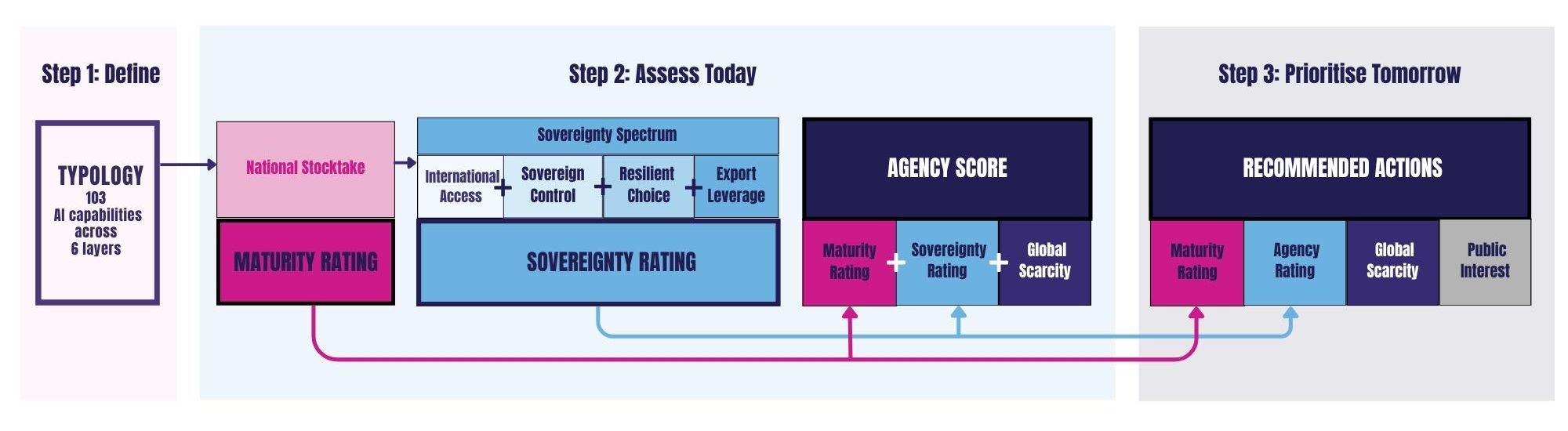
Overview of the AI Agency Tool Process: to learn more visit AI Agency Tool Explainer
Sovereignty never ceded
The creators of the AI Agency Tool affirm that sovereignty has never been ceded by First Nations peoples living on the continent now known as Australia. We recognise Indigenous Sovereignty as enduring and inherent, as well as fundamentally different to the new concept of ‘AI sovereignty’ (to which this work is responding).
Any national conversation about AI should reinforce, rather than distract from, the distinct and profoundly important conversations about Indigenous Sovereignty and governance. The AI Agency Tool emphasises the importance of pursuing both Indigenous Sovereignty and AI agency in parallel. Indeed, they can be understood as reinforcing policy goals.
TheTtool explicitly highlights the importance of Indigenous Sovereignty. First Nations interests and sensitivities are profound and intersecting across all 103 AI capabilities identified in the typology. A review of the typology through lenses of cultural priority, sovereignty beyond a nation-state framing, lived experience, and the risk of structural harm, revealed that at least 38 AI capabilities have particular implications for First Nations peoples. The Tool frames inclusive, empowering and rights-respecting approaches to these capabilities as indicators of AI maturity.
The concept of AI agency will look different in practice for different stakeholders, including First Nations peoples compared to governments and organisations. The Tool is intended to be adopted and applied by different groups, shaped by their distinct perspectives and priorities in implementation. In this way, it acts as both an assessment and a transparency tool.
This approach is intended to support the empowerment of Indigenous voices, leadership and agency in future-proofing communities and shaping Australia’s future.
See page 46 of the Report for further discussion on these important issues.
TPDi’s Independence
TPDi’s independence is our most valuable asset. As a registered not-for-profit, our work is supported by external funding. We only accept funding from entities that agree to be disclosed publicly and commit to respect and promote TPDi’s independence. TPDi does not represent the views of any of our funders; all outputs represent solely the views of TPDi and/or the authors. Learn more about TPDi’s blind trust funding model and how this protects and promotes our independence.