

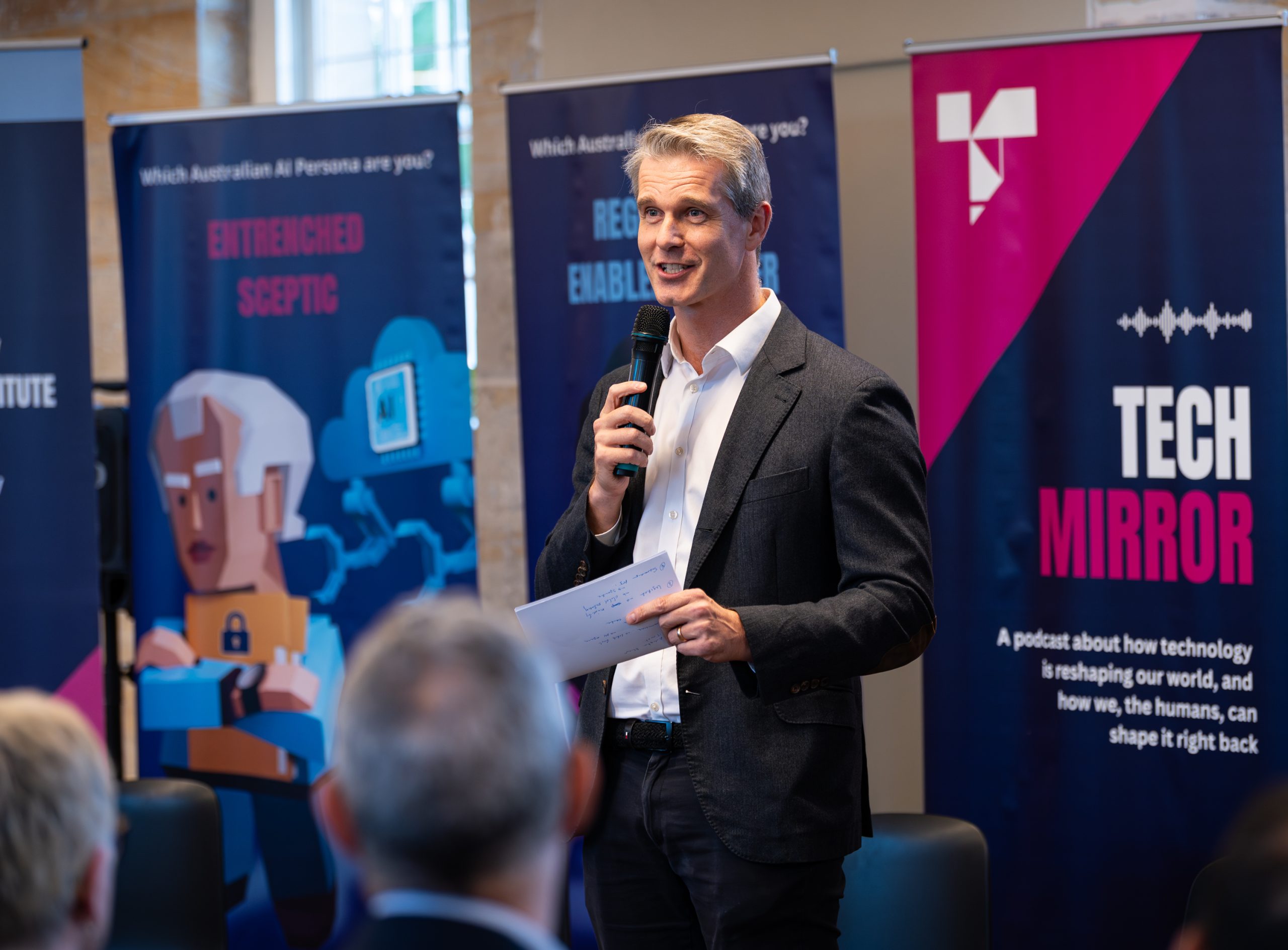
This episode marks the launch of TPDi’s new research around AI, trust and regulation in Parramatta on 5 May 2026. It begins with Johanna speaking with the Assistant Minister for Science, Technology and the Digital Economy, Dr Andrew Charlton, followed by his keynote where he sets out the Government’s plan when it comes to AI and how to get the Australian public to trust and invest in AI. Next up TPDi Co-founder, Zoe Hakwins, presents the key findings of the research, followed by a lively panel discussion which brings to the research to life with each speaker taking on one of the 4 ‘Australian AI personas’:
- Jess Wilson (CEO Good Things Australia) representing Australia’s Regulation-enabled adopters (45%) are the persuadable majority – open to AI but waiting for clear safeguards
- Lailei Huang (Founder & Chair Western Sydney Tech Innovators) representing Australia’s Tech champions (28%) see regulation as an economic enabler
- Peter Lewis (Host of Burning Platforms and What’s your Poison) representing Australia’s Entrenched sceptics (15%) who want protection first, over unconstrained AI promotion
- George Trigenis TPDi Youth Ambassador representing Australia’s Self-assured adopters (12%) prefer to navigate AI on their own terms.
Links:
Read the Research Spotlight: Earning Trust – unlocking adoption for Australians: https://techpolicy.au/earning-trust
For transcript and full show notes visit techpolicy.au/podcast
Earning Trust
Johanna Weaver: The Tech Policy Design Institute acknowledges and pays our respects to all First Nations people. We recognize and celebrate that among many things, indigenous people were Australia’s first tech innovators.
Assistant Minister Charlton: the report says very clearly that by making AI safe, by providing trust, we will enhance adoption, enhance acceptance, and drive those benefits further. I think that’s an incredibly important message
Johanna: Hello and welcome to Tech Mirror: the podcast where we talk about how technology is shaping our world and how we – the humans – can shape technology back.
This episode was recorded live in Parramatta, where we lunched TPDi latest research Earning Trust: unlocking AI Adoption for Australians. The key findings of this report – based on national survey – was that Australian would trust and use AI more if they felt it was well governed.
Will kick off this episode with a brief chat with Dr Andrew Charlton Australia’s Assistant Minister for Science Technology and the Digital Economy.
Then we’ll bring you Minister Charlton’s keynote speech from the launch event where he sets out the government’s approach to regulating AI.
Assistant Minister Charton: We don’t think that AI is a vertical that can be treated as, uh, one discrete thing in our government or our economy. It is a horizontal embedded in every single part of our economy. And therefore, our approach is not to create an AI regulator. It’s to make every single Australian regulator recognize that AI is their job, it is their core responsibility, and the harms in their area related to AI need to be at the top of their agenda.
Next my co-founder Zoe Hawkins will give a brief overview of the research findings
Zoe Hawkins: what’s really interesting that we found that came out in the research is that the more people understand about AI, the more they want regulation.This is not coming from ignorance and fear.
We will round out this episode with a special panel. Like many of the things we do at TIPD, this will be a little bit different. The research breaks down the population into 4 Australian AI personas. Rather than just asking the panelists a bunch of questions, we’re asked them to take on four AI personas – it proved to be an entertaining way to explore the research findings….
Lailei Huang: we need an innovation engine
Jess Wilson: it’s really important that the government, is going to provide the right kind of regulation that means that I am gonna be safe when I’m using AI.
Peter Lewis: We’ll be poorer, warmer, and dumber.
Gorge: there’s a really delicate balance between innovation with human-centered, but also whilst prioritizing innovation
So, with that let’s get this podcast on the road.
Minister Charlton, thanks for joining us today at the Western Sydney Start-up Hub…
Minister Charlton: Thanks for coming to Parramatta.
Johanna Weaver: It’s awesome, and such a great vibe here in the building. So we’re here to launch the Trust in AI report. But before we get into the trust part, what are you seeing, whether it’s in your ministerial roles or whether it’s out in your electorate, about people’s attitudes towards AI?
Minister Charlton: I think people realize this is a big change in their lives. They’re excited about it, and they’re apprehensive about it. I feel like here, particularly in Western Sydney, there is a huge interest in what A- AI can bring, a sense of opportunity, but also a lack of trust, and that’s the lack of trust that you speak to in the report that you’re releasing today.
Johanna Weaver: So you’ve given quite a big speech just a few days ago, looking at the sliding door moment that Australia has with respect to AI. Can you give us the elevator pitch of what that speech was?
Minister Charlton: Sure. I think we are in the critical couple of years right now, where Australia will either build our own AI industry and be able to power our own businesses and export intelligence to the world, or we will import that, adopt from foreign companies,. And that means that a lot of the value from us using those technologies will get shipped offshore. For me, that’s a less prosperous and more vulnerable country, and that’s why my pitch in the last week has been, we all need to take responsibility for which one of those futures we want. And one way that we can support the Australian AI industry is to think, is there an Australian option for the tool that I am creating?
Is there Australian capability? And in my view, there is a ton of Australian capability. We’ve got 1,500 AI startups. We’ve got fantastic companies like Laurakit, like Heidi, like Scutopia, like Relevance AI. I could go on and on and on. What-
Johanna Weaver: Anyone would think you were the minister for science and technology.
Minister Charlton: Chief evangelist for the Australian AI industry. And if Australians back our own industry, I think that brings benefits to the businesses using those local partners, and it just has a huge positive impact on our ability to create an industry here.
Johanna Weaver: Going to the trust part of this, so before you were an assistant minister for science, technology, uh, and digital economy, you were an entrepreneur.
How does that have you think about trust in terms of the adoption of AI, so not sort of in the abstract, but in terms of the need for trust in order to encourage adoption?
Minister Charlton: Yeah. I think, you know, from a business perspective, people need to feel like the tools that they’re using are things that they can trust.
Johanna Weaver: Yeah.
Minister Charlton: And, uh, one of the things that I’ve spoken about for a long time is what I call the digital chill, which is where Australian businesses feel a bit of a sense of insecurity about some of these tools, that they’re gonna expose them to cyber attacks or privacy breaches. And so that for that reason, it holds them back from adoption.
That is a big productivity drag on us. So I, you know, I think we need to make sure that we support Australian businesses to feel confident and secure in their use of these tools, uh, and then to take that same message to Australian consumers And that’s why we are building a regulatory framework that we think is the strongest regulatory framework that can keep Australians safe and can make sure they have confidence in using AI.
The two bad worlds here are, one, where we don’t use AI and fall behind, or where we do use AI but that AI isn’t safe and it makes us vulnerable and causes harms. We can’t have either of those worlds. We need the proper world, the third world, which is where we are using AI, but using it in a way that is safe and trusted and well-regulated, and that’s what we’re shooting for.
Johanna Weaver: That really makes me think of Audrey Tang, Taiwan’s first digital minister, who would talk about we need to stop talking about it either being a brake or an accelerator and hold the steering wheel and steer.
One of the things that was really clear in the research that we are releasing today is that Australians aren’t anti AI, they are enthusiastic about AI, but they are nervous, they don’t trust AI. The good news is that equally clear from our research is that Australians will use AI more if they feel that it is well governed.
At TPDi we think this is a real opportunity. If we get AI regulation right, it will unlock adoption: which means we are much more likely to get that third future you were just describing in which AI is being used in a way that is safe and trusted, but also that the benefits are widely distributed and not concentrated to a few companies or individuals or, even worse, being shipped offshore.
Now we are really keen to hear from you about your approach towards steering us towards this positive AI future – and I know you are going to cover that in your keynote, so lets head upstairs where my co-founder, Zoe Hawkins, and a room full of guests are waiting for us.
Zoe: Good afternoon. My name’s Zoe Hawkins. I’m one of the co-founders here at the Tech Policy Design Institute. And I’m really pleased to welcome you here today for the launch of our newest report, Earning Trust: Unlocking AI Adoption for Australians.
And so it feels significant to be here in this particular venue, and we were just speaking to the minister about this before. It used to be called the Female Factory. Which is, you know, has a very somber history. It’s a place where women, predominantly convicts were, you know, retained and, put to work and had very little control or agency over their future.
And so as a women-founded and led think tank, it’s something particularly powerful about, being here today as a group to talk about how we collectively can shape the technology and the way that that’s affecting people’s lives. Now, of course, that history sits within a much longer one, and we acknowledge the traditional owners of the land that we’re meeting on today, the Burramattagal people of the Dharug nation, and we pay our respects to the elders past and present.
And we recognize the thousands of years of knowledge, and innovation has, offers so much for us to think about today when we’re thinking about AI and society.
today, we’re here at the Western Sydney Startup Hub, an amazing center of creativity and innovation, and we’re so pleased to be partnering with the Western Sydney tech innovators on today’s event.
And what a fitting place to talk about AI and trust. And who better to open our discussion this afternoon than Dr. Andrew Charlton, Assistant Minister for Science, Technology and the Digital Economy, but also, and he might say, most importantly, the member for Parramatta. Please join me in welcoming Dr. Andrew.
Minister Charlton: Thank you. Thanks so much, Zoe. I wanna begin by thanking Zoe and Johanna for incredible work they do at the Tech Policy Design Institute. They have built, in a short time, a reputation for incredibly high quality and impactful research on some of the most important questions in our economy and of our time.
This is detailed, challenging work in a new era of the economy where the government is always looking for partners to help us with expertise from the frontier to make the right decisions in difficult circumstances, in fast-moving environments. So to have partners like Johanna and Zoe helping us think through these challenges, uh, is extremely welcome, and we’re grateful for the hard work you do, and we’re grateful for the supporters who make TPDI possible.
Uh, I also want to acknowledge that we are at the Western Sydney Startup Hub in this incredibly beautiful building. As Zoe said, we are in the heart of what is called the Female Factory here in Parramatta, an institution that used to incarcerate women and put them to work making textiles and other manufactured goods in the early part of the 19th century.
Uh, this is also the site where what is widely described as one of Australia’s first industrial actions, where those self-same women were rising up to complaining about their lack of rations and poor conditions, and they started a riot, uh, here.
Johanna Weaver: I knew we felt at home here.
Minister Charlton: And we celebrate that riot in Parramatta every day on Riot Day.
You, you and your adventurous, bold, uh, policymaking is a wonderful ancestor of that same spirit. I want to acknowledge, Shu Yan. Where’s Shu Yan, who looks after this facility for the people of Parramatta.
Zoe: Downstairs being busy looking after the place.
Minister Charlton: She’s downstairs being busy. She does a terrific job for us here at this hub.
Dozens and dozens of Western Sydney startups come through, meet other founders, get connected with capital and, and ideas, and create the businesses that are gonna drive our region forward. I also want to acknowledge another incredible institution which also uses this as its home, which is WSTI, the Western Sydney Tech Innovators.
And LeiLie is a friend of mine, but just an extraordinary individual. Layla, out of his own kind of passion and interest and curiosity and community spirit and sense that something was happening around AI that was gonna change all of our lives and jobs and our world, created Westie. It started with just a small group of people who were coming together, uh, meeting in the library in Parramatta, learning about AI.
It was a few people, a couple of young people, a couple of school kids, couple of older people, people from all different walks of life, and that Westie community has grown from half a dozen to a few hundred to a thousand to now more than…
Lailei Huang : Three, three, three thousand two hundred.
Minister Charlton: Three thousand two hundred people.
An entirely grassroots organization of people coming together to learn, to share, to recognize that this, this technology is important. But the most important thing about this technology is that everybody understands it and has access to it, and nobody is excluded from it. And that is the mission, the message of Westie, and I wanna thank Layla for everything he does, uh, in our community to make that a reality.
It’s a model that I hope is copied right across the country. This research comes at just the right time, and it has some really powerful messages in it. This research tells us that Australians want the benefits of AI. They don’t want to be left behind. They know that it’s gonna be important for their careers, for their businesses, competitiveness.
They want to adopt it, but they want to adopt it safely. They want to know that they can have trust in it. And more importantly, this report makes the connection between adoption and trust. And it shows that these things are not in tension with each other. Uh, we don’t have to face a choice between do we make AI safe or do we make AI accessible and used by all?
Those are not alternatives. They are not a trade-off. They are something that we can achieve best together. And the report says very clearly that by making AI safe, by providing trust, we will enhance adoption, enhance acceptance, and drive those benefits further. I think that’s an incredibly important message, and one certainly that the government has put at the heart of our approach to making sure that Australia benefits from AI.
Our approach in the Albanese government has been very simple. We want to make sure that technology works for Australians, not the other way around. And in our AI plan released last year, we had three objectives. First, to make sure that Australia captures the benefits of AI, to make sure that we have the companies here, the infrastructure here, the investment here to put us at the forefront, to enable us to remain competitive, to be on the leading edge of the global digital economy.
Secondly, we don’t just wanna see Australia capture those benefits. We wanna make sure those benefits are shared widely, and that every Australian sees something in this for them. This isn’t something which is just a benefit for the big end of town, or the startup scene, or the universities. This is a technology which every Australian and every Australian worker sees benefit for them in.
That the benefits of increased productivity are gonna flow through to their wages. That the benefits of better government services are gonna be seen in their schools, in lower wait times at their hospitals, in more time available for nurses to spend with them as patients. That there are real, tangible benefits in this technology for every person in Australia.
And the third thing that is important for us, the third pillar of our AI plan, was to make sure that we keep Australians safe. That means mitigating the harms, giving people trust and confidence in this technology. At the center of our plan to deliver those three objectives is a regulatory approach which we think is the best approach to keep Australians safe.
And that approach, uh, is not an approach to build a central AI authority. We looked at that approach and we thought, if we try and build a central AI authority, we would end up duplicating a lot of the existing regulatory functions across our economy and across our society. We don’t think that AI is a vertical that can be treated as, uh, one discrete thing in our government or our economy.
It is a horizontal embedded in every single part of our economy. And therefore, our approach is not to create an AI regulator. It’s to make every single Australian regulator recognize that AI is their job, it is their core responsibility, and the harms in their area related to AI need to be at the top of their agenda.
That’s our approach, to make sure that we take the great work that Australian regulators do right across the board and put AI as a core part of their business.
Now, to make that regulatory approach operational, we need two things. Firstly, we need to make sure that all of those regulators have clear boundaries and roles and responsibilities.
And so that’s why we set up the AI Safety Institute. The job of the AI Safety Institute is to identify risks that are coming down the road towards us in AI, then to allocate those risks to existing agencies, make sure that everybody’s clear about who has responsibility for mitigating what risks. And then the third thing the AI Safety Institute does is it then provides the technical capability, uh, where required to make sure that those agencies can mitigate those risks.
So our approach is to have every single Australian agency realize that they can’t abdicate their responsibility to another agency. We’re not duplicating their responsibility in another part of government. The responsibility is vested with them, but they have clear responsibility lines and accountabilities, and they have the support that they need.
We think that is the best way to keep Australians safe. In terms of regulation and legislation, our approach there is to act when we see real risks. And we’ve already acted in areas like privacy, in areas like child safety, to ban nudify apps. Where we see AI risks that require a new legislative response, we have acted and we will continue to act.
And we think this approach of making AI core business for all of our agencies, of acting on specific threats when they come up, is the best way to keep Australians safe and the best way, as this report identifies, to make sure that Australians have trust in AI.
The final thing I want to say, and I’ve been banging on about this a little bit this week, is I think another element of Australians having trust in AI is about Australians feeling like we have sovereign AI.
That not only do we have the best technology from around the world being used here in Australian businesses, but in addition to that, we also have Australian businesses developing their own AI. Australian businesses that are able to create value here, export that value to the world. And this sovereign Australian AI in- industry is in its infancy.
We have a lot of capability, more than fifteen hundred startups, incredible researchers across our universities and government science institutions, but we’re in a critical window right now where those capabilities, where those young companies will either be adopted, embraced by the Australian community, embraced by Australian organizations and corporates, or not.
And we think that if they are, then we build a dynamic, sovereign, domestic Australian AI industry that will deliver prosperity and trust for a long time to come. If we fail to seize that opportunity, we run the risk of being a renter of foreign intelligence, a perennial importer of the technology of the 21st century.
So we are motivated as a government to keep Australians safe. We are motivated as a government to have domestic AI companies, great Aussie Australian companies, including the kind of companies that many of which are represented in this room, how are you Rhett, as well as many of the organizations that are coming up, uh, through institutions like this building right here.
And we’re motivated to make sure they are backed by the Australian government, backed by Australian organizations. Uh, it’s terrific to be here.
Thank you all so much for coming. Thank you for your support for, uh, TPDI, and this is the first report this year. Uh, we look forward to the rest of the work and contributions that TPDI will make. Thanks a lot.
Zoe: Thank you. Thank you, Minister. Thank you so much, uh, Minister. Now, t I’m going to provide a lightning briefing on the report that you’re all, uh, receiving today, the report we’re launching, and to really just give a high-speed tour of what the stats tell us.
And then I’m gonna hand over to Johanna, who’s going to moderate an excellent panel and dig into it even further. But this is just to help set the scene. And so I don’t know about you guys, but anytime I’m in a conversation about AI in Australia, two things come up pretty quickly. Uh, number one, Australians have low trust in AI.
This is an interesting fact, and it’s been, uh, well documented. But the second part, which the minister was also touching on, is this idea of regulate or innovate. It feels very binary, and those two things can end up leaving us feel unsure about what the next step is. So we wanted to ask, what would it take to move the conversation forward. What would it take for Australians to trust AI? This is the key word of, I guess, the research that we’re talking about today.
And so what did we find? I’m gonna provide you the, the sort of five key takeaways from, from the research. The first one is that there is a decisive mandate that Australians are supportive of AI regulation.
And what’s interesting is only two per cent actually oppose the government regulating in AI. And I think there’s sometimes a narrative around the idea that regulation or the desire for it can sometimes be from a fear base or maybe not understanding what’s going on. I think what’s really interesting that we found that came out in the research is that the more people understand about AI, the more they want regulation.
This is not coming from ignorance and fear. The more that an Australian has an, has a general understanding of the technology and its risks, the more likely they are to support this regulation. And we’re also seeing, as you’d imagine, which is what I’d encourage you to dig into in the report, the demographics around those views.
So whether it’s by age, gender, education, there’s some really interesting dynamics. The second finding is that- Regulation would actually enable trust and actually encourage more adoption. Uh, that’s really breaking down that binary and creating space for government, but all of us to think a little bit more creatively about what we can do in the gray space in between.
So 70 per cent of Australians would be more comfortable in embracing AI if they knew that there were strong government regulations in place. And so I think sometimes we think that regulation is a barrier to innovation, but perhaps it’s actually the absence of it. That’s just a different reframing for us to think about.
And the third one is what we kind of already knew collectively, which is that Australians’ trust in AI is still low. That actually hasn’t, hasn’t really changed. We’ve got 1 per cent of Australians having complete trust that AI is gonna be used responsibly. Now, of course, complete trust, I don’t know about you, but most people probably don’t have complete trust in much.
But another one to dig into it more detail is that 44 per cent have not much or no trust at all that AI is gonna be used responsibly, and for me, that’s the one to really take seriously, and what is that doing to our adoption and innovation? But I suppose on the trust being low, I’m trying to flip it. We’re optimists at, uh, TIPD, and turning this into what’s the opportunity there.
So if our current… so the minister was telling us really awesome stats about the activity that’s going on in places like Westie already. That’s what’s happening with that level of low trust. Imagine what would happen if we boosted that trust, and so this is what the report is really setting out.
There is a massive opportunity. So the next question is, okay, Australians want, um, AI regulation, but what type? And the cover that we’re putting on the slide here just to help explain the symbolism of the report is really this idea that regulation… and yes, which Johanna is taking another look at ’cause it’s so beautiful.
It’s really just showing the idea that that regulation being a safety net to give Australians the confidence to leap, essentially, and that we really wanna unlock that. And as the minister was saying, actually context really matters. Australians want sector-specific targeted approaches that really treat AI where it’s at and how it works in their lives, and we saw that across case studies in healthcare, education, law enforcement, and the creative industries.
So encourage you to go and dig into the area that’s most relevant to you ’cause there’s a lot of very s-sector-specific insights. But what we found is that 46% of Australians favor either sector-specific laws or a combination of sector-specific laws and an overarching coordinating AI act, some sort of framework that brings those sector-specific approaches together.
In terms of what we found what they’re most focused on issue-wise, Australians’ number one focus area is privacy and control of their information. So seeing more in that space is gonna be what they’re looking for, jobs and workers’ rights, misinformation, and a range of other issues there, which again is what Australians would be looking for those sector-specific regulations to particularly address.
Now, I think my personal favorite part of this, uh, work, which is the beautiful artwork that you can see behind me, and the, the theme that we will dig into in the panel, is that to really help dig into moving beyond, like, national average statistics, as valuable as they are, and that’s sort of what I’ve given you so far.
The research actually breaks down the population into segments, which we’re calling Australian AI personas, and it’s really trying to show that nuance of the different points of view that actually exist across the population. So I’ll briefly introduce them to you at the highest level, and then Johanna’s gonna take it down as well with our panelists.
So first up, we have our tech champion. I’m sure there’s quite a few in this building. That’s 28 per cent of people in Australia. They view regulation as valuable, but mostly from an economic sort of enablement perspective, giving confidence and clarity and a level playing field.
We also have the entrenched skeptic. 15 per cent of people, people who are not really sure, uh, that it’s gonna work for them, quite concerned that it’s actually going to bring some of those risks and harms that, uh, the minister was, was talking about as well.
We’ve got 12 per cent self-assured adopters. Those are people really focused on capability as… You know, I’m not super worried – not so engaged on the policy side of things, but more thinking about, how do I use it, what does this do in a practical sense for me day to day?
And if I can equip myself with that, then that’s good enough for me. It’s sort of that perspective. But finally, the one that maybe most of us in this room might relate with, ’cause 45 per cent of Australians certainly did, is this regulation-enabled adopter, which really comes to the core thesis of the work, which is essentially that people are wanting to and open to embracing AI, but they’re kind of waiting for that sense of wanting to feel that they’ve got the protections they need to take that leap.
And so with that, to dig into those personas, I’m gonna hand over to Johanna, who’s gonna introduce our incredible panel. Thank you so much.
And I should say, you should obviously read the entire report because there’s way more stats in there than you just hit.
Johanna: Thank you Zoe. Lets welcome our panelliust
First up we have Jess Wilson Wilson. Jess Wilson is the CEO of Good Things Australia, and Jess Wilson, taking on the persona of Chloe, representing 45% of Australians who are Regulation Enabled Adopters
Next we have Lailei Huang, founder of Western Sydney Tech Innovators, WSTI, and today he is taking on the persona of Rowan, representing 28% of Australians who are Tech Champions
Peter Lewis Lewis, wears many hats, today representing Burning Platforms and Whats your poison podcasts, and Peter Lewis is taking on the persona Chritos, representing 15% of Australians who identify as Entrenched Skeptics
And last but certainly not least we have Georeg Trigenius, who is a TPDi youth Ambassador, today taking on the person of Jess Wilsonica who represents the 12% of Australians who fall in the “Self assured adopters category.
Now for those listening on Tech Mirrors, there are a couple of prts in the podcast where the audio is a little bit scratchy, particularly early on, the hazards of live recording, but we have kept it in because we didn’t want you to miss out on the fun.
we’ve asked our panelists to take on their personas – to help us to bring the researching findings to life. So we ask that anyone listening be kind – please don’t quote them out of character – they are adopting their persona, and we want them to feel safe in being able to really lean into this.
So we are going to start of by asking each of you to explain in a sentence or two is your persona excited about AI, or worried about AI.
Lailei, you are representing Rowan, Tech Champions, how does your personal feel about AI.
Lailei Huang: Yeah. My persona, Rowan, actually very excited about AI- … and see this is as a huge once-in-a-lifetime opportunity to unlock opportunities for himself, for the company, for the business, for the community. So super positive.
So that’s the persona.
Johanna Weaver: And how does that differ from your persona? Your actual persona.
Lailei Huang: I actually share that view, but on, on the other side, I personally also care about the risks and also, uh, the downside if we don’t put the right regulation in it.
Johanna Weaver: So let’s all keep that in mind. He’s playing the persona that holds those risks.
Okay, George, what about for you as our self-assured adopter?
George Trigenis : Yeah, sure. I mean, I’m very excited about the capabilities that AI presents us. I mean, if we think back to the Industrial Revolution, you know, that innovation towards freeing us from doing monotonous labor tasks and processes of the manufacturing process- We can see the parallels with AI, how that also can streamline what we do with, you know, thinking tasks and being able to move on to bigger and better things.
So I’m really excited in using that as a capability, and as an extension to that, I guess what I’m worried about is potentially if we don’t uptake it with an optimistic attitude, then, you know, we could fall behind compared to our peers. Mm.
Johanna Weaver: And does that pretty much align with your personality, or is there a, a deviation from your perspective?
George Trigenis : Yeah, I’d like to think I’ve always been an optimist, to be honest. So, you know, I like to take things, um, full steam ahead and, yeah, I guess find out the upside from that.
Johanna Weaver: Great. Thank you. Okay, Jess what about for you? How does your persona feel about AI?
Jess Wilson: So my persona is a little bit on the fence, and I think, you know, where I, I think it could be a good thing, but actually I’m a bit concerned that the companies that are running this care more about profits than people.
And so I think that it’s really important that we have the right guardrails in place. Yeah. Because otherwise, you know, vulnerable people could be affected, and that’s what I’m really concerned about.
Johanna Weaver: Awesome. All right, and Peter Lewis?
Peter Lewisr: So I’m the oldest persona. I’m 67, so it’s not much of a, a stretch. I’m Christos, that also makes me the wisest. And I know bullshit when I see it. Um, all you shiny suits trying to, trying to make a quick buck. You can’t fool me.
If you tell me I’ve got to move fast, it just means you don’t want to a- answer the hard question.
Johanna Weaver: And Peter Lewis, how does this differ from your actual persona?
Peter Lewisr: Not much.
Johanna Weaver: So we’re off to a good start. Now, it’s really well established that Australians don’t trust AI. So Peter Lewis, do you think the skeptics are overreacting?
Peter Lewisr: No, and I think if you look at the lived experience of somebody like Christos, who’s worked in a, a trade all his life, his experience of AI at the moment is he can’t use his mobile phone anymore because it’s full of scams.
His email’s full of slop. His son’s having a relationship with an AI companion. His daughter’s being bullied on nudify apps, and his other son was told to learn to code because that was the way to get ahead in the world. None of that’s working out that well. So I just think the lived experience of people’s touch points on consumer generative LLMs is just horrendous.
I think it’s a totally rational response to be deeply skeptical.
Johanna Weaver: And so, Laleh, how does the… a tech champion respond to that? What’s, uh, you know, do you think these skeptics are just making us a bit paranoid?
Lailei Huang: I actually fully get that and, and, but, but I wanna bring also the, the attention to the positive side.
Like, even for Westie, we, we’ve grown for the past two months. We did a Western Sydney AI summit and hackathon. We teach about AI, we teach about design thinking. We have local domain expert from healthcare, from housing, from, uh, environmental, from skincare. Lots of different… A single mom. Many, many different communities coming to learn and to innovate, and we’ve actually supported and grown 22 baby AI company, AI startups.
So that’s new positivity and opportunities for us. So that positive side is also true. So I just wanna say there, there is negative side, but also we want to try to be positive and support innovation, too.
Johanna Weaver: So let’s take a step back, and I’m gonna get each of you to explain to the audience what these personas are.
And I’m then gonna get a show of hands for which one you most associate with. So we’ll go one by one. You are allowed to put your hand up more than once if that sort of resonates with you. So let’s start with George Trigenis . Can you describe for us, describe your personality of the archetypal self-assured adopter in Australia.
George Trigenis : Yeah, sure. So the self-assured adopter doesn’t really believe in the government regulation can, you know, totally take control of AI. It believes the control lays in our own hands, and how, you know, comPeter Lewisnt and comfortable we are with using the technology.
Johanna Weaver: Great. Who, who feels like you’re a self-assured adopter?
Yeah, okay. We’ve got a hand… Oh, oh, actually, like, that’s a good smattering in the room. All right. Let’s go next with Peter Lewis.
Peter Lewis: So my persona has a lower level of education, economically vulnerable, older. But I think the most interesting part of their persona is that they see regulation as being defensive, so that g- they grew up thinking government would protect them from bad things, both in the market and broader society.
And I think they’re wondering why government isn’t doing that this time.
Johanna Weaver: Who in the room is an AI skeptic? Oh. I love it. I’m not gonna call out your name, but thank you. A very good friend of Tipti. Um, okay. Uh, Jess Wilson, you are a regulation enabled adopter.
Jess Wilson: Look, I’m an average Australian, basically. And, uh, you know, probably average education in this, I’m actually in my mid-20s, which I’m very happy about. And I work in comms and marketing, which my comms and marketing team are very happy about as well. Uh, but look, I think, I think the key thing for me is that I think it could be good, but I am really worried about safety. Mm. So I’m really concerned about what it means for jobs, I’m concerned what it means for scams.
I’m concerned about, you know, making sure that the humans are first. And so I think I could be persuaded as long as there are the right things in place.
Johanna Weaver: Great. And who’s, uh, self-identifying as a regulation-enabled adopter? That’s good. That’s a, that’s about half of the room, which is actually… So 45% was the response from Australians.
And Lelei, uh, for you as our tech champion, can you describe the archetypal personality?
Lailei Huang: Yeah. So again, I would say this is my persona. My persona, Rowan, is pretty much full steam, and say, uh, we needs to maximize the potential of AI, AI adoption, and it… he sees regulation as an enabler. Like the highways. If we don’t build highways, it’s very difficult to go from one place to another place faster enough.
Johanna Weaver: And who associates with being a tech champion in the room? Interesting. So less tech champions in the room than I was expect- Oh, no, there’s a few more. There’s a few reluctant tech champions , uh, in the room. All right. And so the thing about these personas, just to, to contextualize this for you, we didn’t make up the personas and then get Australians to self-identify.
What we actually did was, uh, this, uh, the national survey, um, a number of focus groups, and then we identified these four personas from the responses. So this is the best representation of Australians’ attitudes towards trust, regulation, and artificial intelligence. So I wanna just raise a, a, a question for the room, and that is, we know that it’s the case that most Australians feel that they don’t trust AI.
Who in this room thinks it’s rational to distrust AI? Who thinks that’s a logical thing? And we pretty much have, I’d say, two-thirds of the room putting their hand up, maybe even a little bit more of people putting their hands up there. So I wanna flip the question now and say, what is the right amount of trust for Australia to have?
So if we are currently distrustful, what is the right amount of trust for us to bring to our interactions with artificial intelligence? So Jess Wilson, as a regulation-enabled adopter, you’re in the middle. You represent the bulk of the Australian population. What does enough trust look like for you? What would it take for you to have confidence to trust AI?
Jess Wilson: There’s a couple of things. Yeah. So one in particular is about making sure that people are safe. So the assistant minister talked a lot about keeping people safe, and that, I think we haven’t yet seen that. Because I’ve seen a lot of people, the increase in scams- The, the, the fact that people are being, you know, are being affected by all of this.
And, and that actually you know, there’s a lot of talk about jobs missing and, and that kind of thing. So I don’t have as much knowledge as I would like to have about what actually happens behind the scenes, and I think therefore it’s really important that the government, who should know about these things, is going to provide the right kind of regulation that means that I am gonna be safe when I’m using AI.
And that actually my job’s not gonna disappear, and that I’m gonna be okay, and the people that I support in my community are actually also gonna be safe.
Johanna Weaver: Mm. And so George, when you hear that, this call for the government to step in to provide regulation, to provide the assurance that the AI is going to be safe.
As a self-assured adopter, what’s your response to that? Do you think that’s an overreaction?
George Trigenis : Yeah, sure. I mean, there’s definitely areas where the government could be effective in, you know, harnessing that trust from us, and that could include more so, you know, transparency from these companies. Like Jess Wilson mentioned how, you know, we’d like to see the behind-the-scenes things happening.
And where I really think my opinion would provide a bit of nuance there is we essentially can be the regulators because in an attention economy where, you know, companies are driven by incentives and, you know, we’re in a capitalist society essentially, that means that we essentially, our attention and focus towards which companies we choose can end up even serving as greater regulation.
Because in the long term, whichever company we tend to use, where, where we gravitate towards, that provides their long-term base of users that essentially then is their support to keep on going with, you know, their company and being able to monetize it. So I believe that we essentially can be regulators ourselves with that added transparency from, you know, government having their role in stepping in, allowing us to then be educated on what these companies are really doing behind the scenes, with then us being able to make a decision as a collective.
Johanna Weaver: That’s very, very eloquently put there. And it’s interesting with this that the self-assured adopter is the… There is the least amount of Australians that identify as a self-assured adopter, right? 12% of Australians take on that particular persona.
Jess Wilson: I think thats great for people that feel confident, but actually what about vulnerable people?
And that’s what I’m really concerned about, is actually making sure that those people who don’t have the skills, don’t have the confidence, are in the kinds of jobs where they don’t have the opportunity to learn about AI, that they’re actually gonna be protected. Because they’re the ones that I’m most concerned about. Johanna Weaver: And the skeptics, how do you respond to that?
Peter Lewis: I just think these companies, um, the hyperscalers, are amongst- The worst people in human history. We’re trusting them to drive our future. Like, I read the internet, okay? I know, I know that Sam Altman and Elon Musk are fighting over, you know, who wears the big boy’s pants there.
I also know even the good guys are involved in technology that drops bombs on kids’ schools in Tehran. I, I don’t think they deserve trust, and I even wonder whether trust should be the, um, objective. I actually think that unlocking our skepticism is a far more, um, civic response to what I think are a, a hostile takeover, the tech overlords.
And you only have to look at Alex Karp’s rants to wonder why we are letting Palantir into Australia.
Johanna Weaver: Thank you very much, Pete. So I’m now gonna pass to LeiLei to respond to that. But I’m actually gonna ask you, can you convince the room that if we actually, uh, enable adoption through the development of innovative Australian technology, that that will set Australia up for the best possible future?
So I want you to convince the room that that is the right approach for Australia.
Lailei Huang : It’s very difficult, to be honest. Because innovation is, is a source of productivity, and Australia, we have a problem of productivity is trending not well for the past decades. And AI is such a big, uh, industrial revolution, like George Trigenis talk about.
No one can deny that, and it’s happening worldwide. Uh, we accept or not, adoption is happening everywhere. I mean, this is actually a arms race m- mentality. Australia, we can’t afford to not innovate and not adopt. Having said that, I, I intend… Myself, myself view kicks in to about George Trigenis ‘s perspective of Palantir, about all the privacy and relationship issues.
We have to address those issues. But I want to kick back to innovation again. That can be addressed by innovation, too. I’ve seen firsthand, we have local residents use AI to address the problems, and also use the problems of AI to bring good to the community. One particular example is Baby Sleep AI company.
Again, one of the 22 companies business startup idea we supported, like, we helped grown. So everyone hate deepfake, right? We don’t want to put the fake ourself, our voice into an AI and do things without our consent, right? But think about what if we have trained a mom’s voice, and then- Sing the lullabies and then soothing and gives the soothing to babies, and let the babies sleep well.
And the mom, newborn mom can take a break and enjoy some quality time with… by herself.
Johanna Weaver: Or just sleep.
Lailei Huang : Sleep. Yeah. Or, or, or just sleep. Again, innovation is the key to so many problems, and we have to innovate. It’s just we need to have a safety net around innovation and make responsible innovation, ethical innovation happen, and put human in the center.
But I believe, I want to convince everyone, uh, innovation is the key itself with extras.
Johanna Weaver: So you’re really saying that regulation, um, should be providing the enabling environment for that innovation that will help us to solve this challenge?
Lailei Huang: To happen, to, to take place. Innovation without good regulation and resources and collaboration won’t take place.
Johanna Weaver: All right, so George Trigenis , as our self-assured adopter, can you help convince the room that we actually don’t even need that regulation to drive the innovation? What’s, what’s your approach? How do you think about regulation, and can you persuade the room that that’s the right approach?
George Trigenis : Yeah, sure. I mean, to touch on my point before with how our attention then drives the economies of, like, you know, which companies we end up choosing, I believe that if we innovate enough with, alongside with transparency, that then those two joined together can then enable us to choose responsibly towards, you know, innovating towards products that are human-centered, as the panelists have, you know, touched on before as well.
So I believe that, you know, regulation is necessary to a degree. For example, if you give me a blank canvas, I can be a bit overwhelmed as to what to draw at first. But if you provide some guidelines and, you know, constraints, then we can use that with a… like, as a direction to then, when we come with a new breakthrough, to be able to break out of that, and then come together with new regulations and guidelines.
So I think that there’s a really delicate balance between innovation with human-centered, but also whilst prioritizing innovation as well, because we need innovation to be able to keep up with the world, and also protect the welfare of citizens with jobs because, you know, with the productivity debates going on in the country as well right now, innovation still is a large proponent as to what will drive up, you know, wage increases.
So that can help at the micro level of people being able to afford a home, for example. So yeah, I think there is definitely a fine balance but, yeah, I believe innovation, again, human-centered of course, can really drive innovation towards better. Mm.
Johanna Weaver: So we’ve just had two arguments for regulation focused on economic incentives.
Pete, why do you think, or why does your persona think that protection needs to be at the forefront of our regulatory events?
Peter Lewis: Because capitalism. Like, because the system will always lead to exploitative outcomes, and there has always been a regulation of the market. And the idea that you would have an unregulated market on something that is being portrayed as this once in a, you know, century innovation just flummoxes me.
Like, you know, I love that our young persona thinks we can just tame these machines ourselves or teach them, but that’s… You know, there are two big risks here. One is that it’s an absolute bubble and the whole thing collapses. The worst one is that everything on the sticker actually happens and it becomes a machine to get rid of jobs and a concentration of profit, not just nationally, but internationally.
And if we don’t put those guardrails in place now, we’re gonna be like those in the Industrial Revolution that had to wait 50, 60 years before they got their act together. Like, the Luddites actually told us how we should be reacting now, and we should be listening to what they did.
Johanna Weaver: And Jess Wilson, you as the, uh, 45% in the middle in Australia, what is your pitch for the regulatory approach that we need to be taking?
Jess Wilson: Well, I just think it needs to be about the things that are most important to us. So it’s about how we protect people. So if, if we’re thinking about those areas where it’s most important for us to be protecting people, so if we’re thinking about health and education and all of those kinds of areas that are high risk, we wanna make sure that what’s happening in those places is, is going to actually protect people and not just be there to benefit the economy.
Because it’s all very well that we’ve got very high productions of, you know, hospitals doing amazing surgery using AI. But actually, if people don’t know about it and it goes wrong, then what happens? And I, I know an example of when, you know, a friend of mine was in a physio and, and the physio had an AI agent in their ear telling them what to do, recording the whole thing, and they hadn’t been transparent about it.
So actually, it’s really important to make sure that not only are the regulations in place, but that people know when AI is being used, that we understand why it’s being used, and that it’s actually a benefit to us, that it’s not actually going to just benefit the pockets of the people that are developing the AI and that are using it.
Johanna Weaver: And so who is convinced that we need to regulate to protect in the room? We’ve got a good portion of the room putting their hand up. Who wants to regulate to innovate? It’s about the same amount of people in the room. Okay. So this is very reflective of the response from the Australian population, right?
They say, “We don’t wanna have to choose between these two things. We actually wanna be able to have both.” So what was another interesting finding coming out of the survey was that we tested, do Australians want an overarching AI act? And The response to that was very lukewarm. I think this is because Australians feel that putting this overarching act over the top is just not actually going to be sufficient to actually provide the trust and confidence th at they need to adopt.
Um, and so what Australians were favoring was that we want sector-specific regulation. So in the same way that AI is so diverse, we actually need to make sure the regulation is going to be diverse. But that we also need to have coordination. And so what TIPD is proposing is that we have this sector-specific approach.
We need to drive forward the privacy reforms, digital duty of care, and these types of things, but we also need to have coordination. And so we like the idea of something we’re calling a care act, so the Coordinated AI Regulation Act, which ensures that businesses have got certainty, and confidence, and consistency, especially for those businesses that are working across sectors.
So how does that land for a tech champion? Does that approach seem sensible to you?
Lailei Huang: Yeah, absolutely. The regulation as an enabler. Without regulation, without rules, like, we can drive off the cliff.
Johanna Weaver: And Pete, would that be enough to convince you?
Peter Lewis: Look, I think the coordination is really critical. I was really disappointed in the government’s national AI plan, not because I wanted to fetishize a piece of legislation, but there are so many different moving parts across government.
My view was unless there was someone owning the challenge, it wasn’t gonna happen. And I did a bit of an analysis of all the different things that the AI plan says needs to happen; privacy reform, copyright, consumer, digital duty of care, kids’ safety, media, blah, blah, blah, blah, across six or seven different ministries.
And if they break down into individual bits of legislation, each one will be a fight between the public interest and the interest of the corporate tech industry, and we will just get smashed. So to have a coordinated piece where we can get all those different interests together to actually set the ground rules now, I think, is Andrew’s number one priority.
Johanna Weaver: I agree, and I think the Australian population also agrees, and that’s what’s reflective in these survey results. Now, we did go into a number of different case studies in the report. So we asked people specific questions around how they would feel about the use of AI in law enforcement, in healthcare, in copyright, and also in education.
So encourage you all to delve into that ’cause there’s some really interesting findings, um, including that people were actually quite comfortable where there’s this public interest, uh, uses of AI. Which I must say surprised me a little bit, that people were quite comfortable provided that we had good governance around use in law enforcement, for example.
But were a little bit more reticent when it came to the personal use, thinking that maybe we don’t need as much regulation when it’s something that’s being used personally by people. So we call this sort of the public-private paradox,So we’re gonna go down the line, um, answering AI in five years. Optimistic or concerning? This is our tech champion.
Lailei Huang: There is a big discre- uh, like… There is a debate there, but majority, even Elon Musk, they, they talk about there will be a period of chaos.
But in up to five to 10 years, they are super optimistic we will be, have a utopia.
Johanna Weaver: All right. That’s, uh, the tech champion speaking. Our self-assured adopter, five years.
George Trigenis : Yeah, sure. Definitely optimistic. I believe, you know, it’s a huge enabler. I think it’s even part of the reason I’m, you know, at this panel today because without AI, you know, university in itself, as a university student, I would be, you know, bombarded with that workload.
But the ability for me to be able to- Gotta pay half thank… Gotta pay thanks to my grades for ChatGPT as well on the side. But, um, yeah, the fact that I’m able to, you know, expedite the learning process and be able to attribute it myself to- Shortcut the learning process then. Um, short- as in to be able to take on other research projects and being able to diversify the experiences I’m a part of because of that, I guess, productivity enhancement.
That’s allowed me to even be here, so I’m optimistic for, yeah, for students, I guess.
Johanna Weaver: And Peter Lewis, optimistic, five years?
Peter Lewis: We’ll be poorer, warmer, and dumber.
Johanna Weaver: And, uh, for our regulatory-
Jess Wilson: Well, look, you know, I think if the right protections are in place, then it’s, it’s a positive future. So I think… But we just gotta make sure that everything’s there so that we can move forward and, and innovate in the right ways.
Johanna Weaver: And, like, to emphasize to the people in the room or the people listening to this podcast, the people who are gonna help shape that future really are the people who are here tonight, and the people who are working with government or in industry, uh, as to what…which of these futures it’s going to be. Okay, one last quick question. We are going to say the biggest risk, uh, that you think Australia is exposed to right now. Peter Lewis, we’ll start with you.
Peter Lewisr Just to be a consumer of the American model of AI and critically accept that without looking at building things either for ourselves or with other countries.
Johanna: Jess?
Jess Wilson: I think the biggest risk is to people. So it is actually about whether AI is going to replace jobs that… and people will, you know, will not have a job and not be able to participate in society. I think it’s whether AI is being used to, to make the wrong decisions about important key life actions and activities.
So I think the biggest risk for us is making sure that AI is used in the right way, in the right places, and that there is the right humans in the loop.
Johanna Weaver: Okay. And George Trigenis ?
George Trigenis : Um, I think the biggest risk would be, you know, with how quick technology is advancing, not, I guess, bringing Australians on with that ride in terms of education.
So not being keeping up with, you know, educating Australians on the uses and, you know, the different transparency statements with companies. I think that’s really important to, again, foster trust in that you know what the technology is, and the providers of that with, you know, their monopolistic powers, you could say.
So I think, yeah, definitely the education part.
Johanna Weaver: And for our tech champion, what’s the biggest risk facing Australia right now?
Lailei Huang : I would say for this persona, we need an innovation engine, and the engine wasn’t in place. From myself, add another thing is the safety net. We need the safety net for our people too.
Johanna Weaver: All right. So we’ll do one wrap-up what happens if we get this wrong, Peter Lewis. And then we’re gonna turn to the positives and end on a positive with the remainder of the three panels.
Peter Lewis: I do think if we, if we get this wrong- We are going to have this technology swamp us.
We’re not gonna think through the way it’s going to affect our workplaces. That’s gonna create a flow on effect in the entire economy. We’re also going to lose our creative voices because we’re not go- you know, we haven’t spoken about copyright, but the greatest theft of the century, what Nick Cave calls erasure by travesty.
My books were stolen. Most authors’ books have been stolen. There has been no reparations. There is no ongoing model for the cultural industry, so we lose our, our voice as a nation. And then when people start outsourcing their thinking to these engines, they lose their ability to critical thought, and then we’re in this hole that we don’t get out of.
Johanna Weaver: So that’s the worst case scenario.
Peter Lewis: Oh, no. There’s a whole book about the worst… If someone builds it, everyone dies.
Lailei Huang: Yeah, I know about that one.
Johanna Weaver: This Is How They Tell Me the World Ends, Nicole Pearlroth. Highly recommend. All right, so let’s end positively, though. So if we get this right, George, what happens if we get this right?
George Trigenis : Yeah, sure. I mean, I believe it’s an enabler and an amplifier of, you know, coming from the optimistic side of it, I guess the good human traits and the good, you know, part of humanity that we want to be amplified. And I believe that, you know, sort of along the lines of the utopia optimistic statement that we wanna go towards, I believe that it can definitely help towards that if we do get it right with the regulation and awareness that’s required for people to be able to be, again, comPeter Lewisnt and comfortable with the technology. And I guess that comes with, you know, awareness around it. So yeah.
Johanna Weaver: All right. And from our tech champion, if Australia delivers that innovation engine that you’re talking about, what does the future look like for us?
Lailei Huang: Yeah. You don’t need to work anymore. No, I’m, I’m… I would say self-actualization. Like, not, do not need to work is just one way of saying it, but you get the chance to really do what you want and to, like, be a creative art.
Like, AI can create things, but of course, human, we want to create. We want to build things. I want to spend our time with our families, with our kids while… instead of trying to do the nine-to-five or, like, doing work in midnight and things like that, just to free us from the mundane, from the repetitive work which enable us to be ourselves, to spend time with people we care about, uh, while the robot can pay us.
Johanna Weaver: Okay. And so we’ve got that tech champion picture of domestic bliss, uh, going on there with the robots. Jess, for the average Australian, though, what would the future look like if we get this right?
Jess Wilson: I think it means that we’re using the technology to solve some of the biggest challenges that we face as human beings.
So like, we know that climate change is a challenge. How do we use it to cha- to actually be able to solve some of those issues? We use it to make sure that people have better access to education and can have, you know, the tutor in the pocket for every student so that they are learning. So that actually it’s enhancing who we are as human beings, that it’s enabling us to have the kind of society that we wanna live in, um, and that it’s not actually holding us back.
Johanna Weaver: Amazing. Thank you so much. What an amazing group of panelists we have. Thank you.
Thank you for being such good sports in taking on board the panel. What we want you to leave with today is that the survey findings are pretty, you know, they’re pretty definitive. That Australians will… They want to adopt AI, but they need to be able to trust it. And so it’s incumbent on all of us in the room to help us to provide that regulatory framework or actually just to articulate to Australians how existing law already applies, how we’re upskilling those regulators.
Um, because this really does have the potential to shape Australia in a very positive way, but we can’t take that for granted, right? We, we actually need to take the wheel and steer. A big thanks to Westy for hosting us today. And a huge thank you to TIPD team, who have just done such an incredible job. If you can wave your hands. Uh, Darina, Helen, Meredith, uh, and Zoe, and all of the wonderful people who’ve been helping us out today.
Johanna Weaver: Well that’s it for this episode of Tech Mirror, we hope you enjoyed coming on the road with us.
If you want to learn more about this report, there is a link in the show notes, or visit techpolicy.au/earning-trust
We also want to thank the Australian Computer Society for supporting the national Survey and focus groups that underpin this research, and to all the contributors the Tech Policy Design Fund, which makes this podcast, and all of TPDi’s work possible.
One of TPDi’s value is fearless independence. All funding TPDi receives is on the basis of a blind trust – this means our funders have no say over the research we do or its outcomes, which are always represent the independent view of TPDi. To learn more visit our website.
If you found today’s conversation useful or thought provoking, please do share it with a friend or a colleague, or leave a review and subscribe wherever you get your podcast.
If you’re watching, please don’t forget to like and follow. For show notes, you can visit tech policy au slash podcast. The team at Audiocraft produced this pod on the lands of the Gadigal people of the Eora Nation.
Music is by Thalia Skopellos.
A big thank you also to the team at the Tech Policy Design Institute, without whom this pod would not be possible.
Thank you for joining us and as always, get in touch and get involved.