
AI Agency Tool Explainer
- AI Agency Tool and Simulation
- AI Agency Tool Explainer
- AI Agency Report
- Australia’s 2025 AI Agency Assessment
- Sovereignty Endures
Part 2 of TPDi’s AI Agency Toolkit: A connected set of resources for understanding and applying the AI Agency Tool.
Explore what the AI Agency Tool is, why AI agency matters and how its evidence-based methodology helps countries understand their AI capabilities, dependencies and strategic choices.
Everyone, it seems, wants ‘AI sovereignty’. But what most need is ‘AI agency’.
The term ‘AI sovereignty’ dominates policy discussions and drives investment decisions but is used to mean everything from strategic self-reliance to cultural preservation and individual autonomy.
Its use as a binary – where AI is sovereign, or it is not – leaves most countries disempowered. There are also more practical confusions. AI is not one thing, so exactly what AI capabilities are we talking about? How do you measure them? What would sovereignty really mean in each case?
Since we published our discussion paper in November 2025, From AI Sovereignty to AI Agency, the debate has gained momentum. Binary notions of AI and sovereignty are increasingly seen as reductive in today’s strategic landscape.
AI agency is the power of a country to shape its AI future.
The global AI supply chain is a complex web, and power comes from the ability to shape relationships, not retreat from them. TPDi’s AI Agency Tool offers a practical solution.
Instead of only asking if a country possesses sovereign control, the Tool assesses whether a country has AI agency to steer outcomes, protect and promote national interests, and capture value in a globally connected system.
Sovereignty is an enduring principle.
The concept of AI agency underpinning the Tool does not signal a rejection, dilution or abandonment of the concept of sovereignty. On the contrary, the pursuit of AI agency is grounded in the very objectives that animate the pursuit of sovereignty.
The Tool provides a pragmatic approach that recognises most countries cannot, and need not, lead and control every AI capability.
Overview of the AI Agency Tool
The AI Agency Tool starts by producing a maturity rating for 103 AI capabilities defined in the typology. It then situates the traditional binary objective of sovereign control over those capabilities within an expanded spectrum that is fit for purpose in today’s strategic landscape. The traditional control framing is expanded to also consider the management of international partnerships (access), the importance of resilience (choice) and pursuit of competitive advantage (leverage). We call this the sovereignty spectrum. An assessment of each element of the spectrum produces a sovereignty rating.
The maturity and sovereignty ratings, and an assessment of global scarcity, are then combined into a single view to produce an AI agency score – a measure of national competitive advantage for each AI capability.
AI agency thus offers a pragmatic pathway for advancing sovereignty: pursuing enduring principles of control and self-determination, while equipping leaders to navigate a world of international interdependence (including shared infrastructure and global supply chains) and geopolitical competition.
The visualisation below shows how sovereignty is embedded as a core element of the AI Agency Tool.
6 Layers and 103 Capabilities
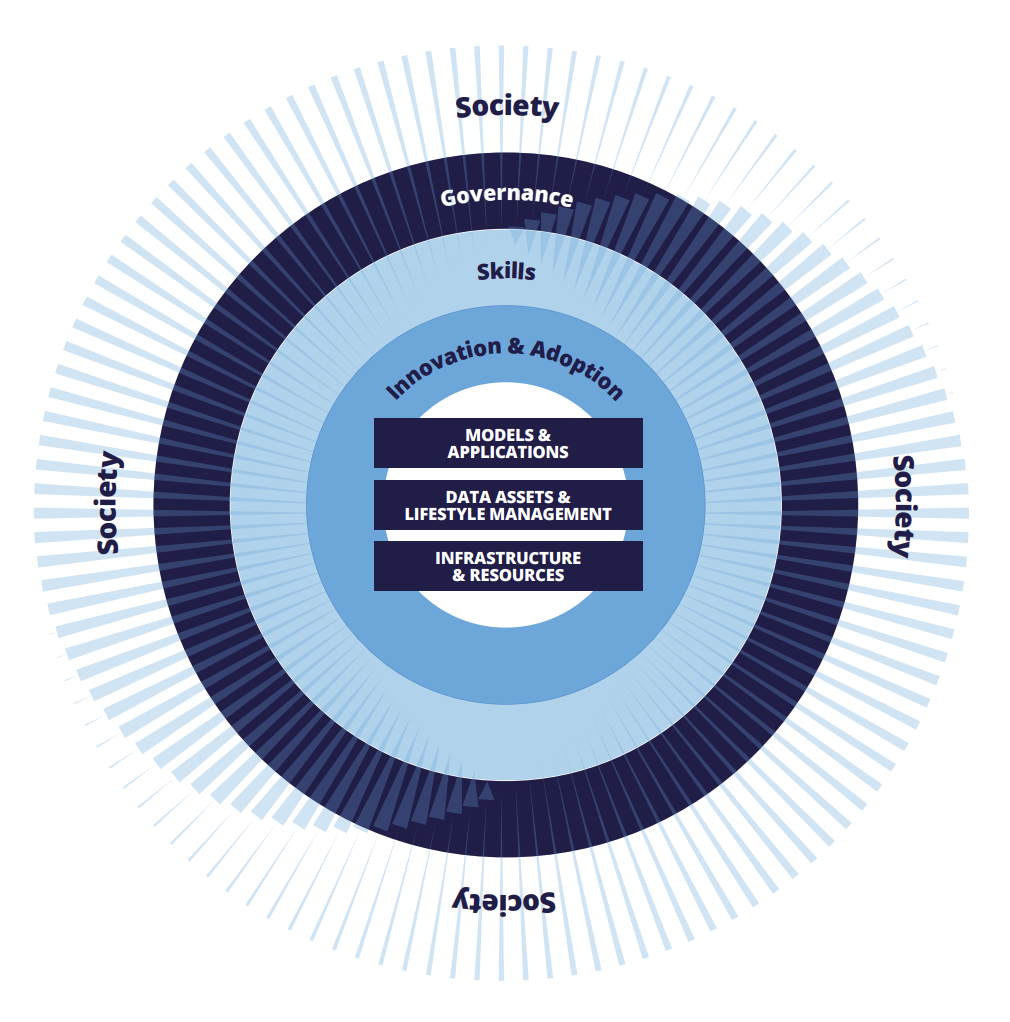

The aim is not to lead in all 103 capabilities – but, rather, to understand strengths, reduce critical dependencies, and build leverage where national advantages exist. The AI Agency Tool provides an evidence-based framework to do this, grounded in data rather than instinct or spin.
How to use the Tool
What is it? The AI Agency Tool is a structured and repeatable method to assess a nation’s AI maturity, sovereignty and agency across 103 AI capabilities, producing prioritised recommended actions.
Why does it matter? The Tool equips decision-makers to pursue AI agency: the capacity to steer outcomes, protect and promote national interests, and capture value in a globally connected system. Used well, the Tool enables nuanced strategies, better-targeted investment and a deeper understanding of trade-offs. The Tool equips leaders to identify their leverage in high agency capabilities and harness it to offset their vulnerabilities.
Who is it for?
- Policymakers of countries of all sizes and stages of AI maturity, particularly where strategic dependence is high and choices are constrained.
- Business leaders navigating geopolitical risk, supply chains and long-term investment decisions.
- Researchers conducting national assessments, tracking progress over time and holding governments accountable.
How does it work? A step-by-step process to gather evidence and make assessments to both inform and analyse strategy.
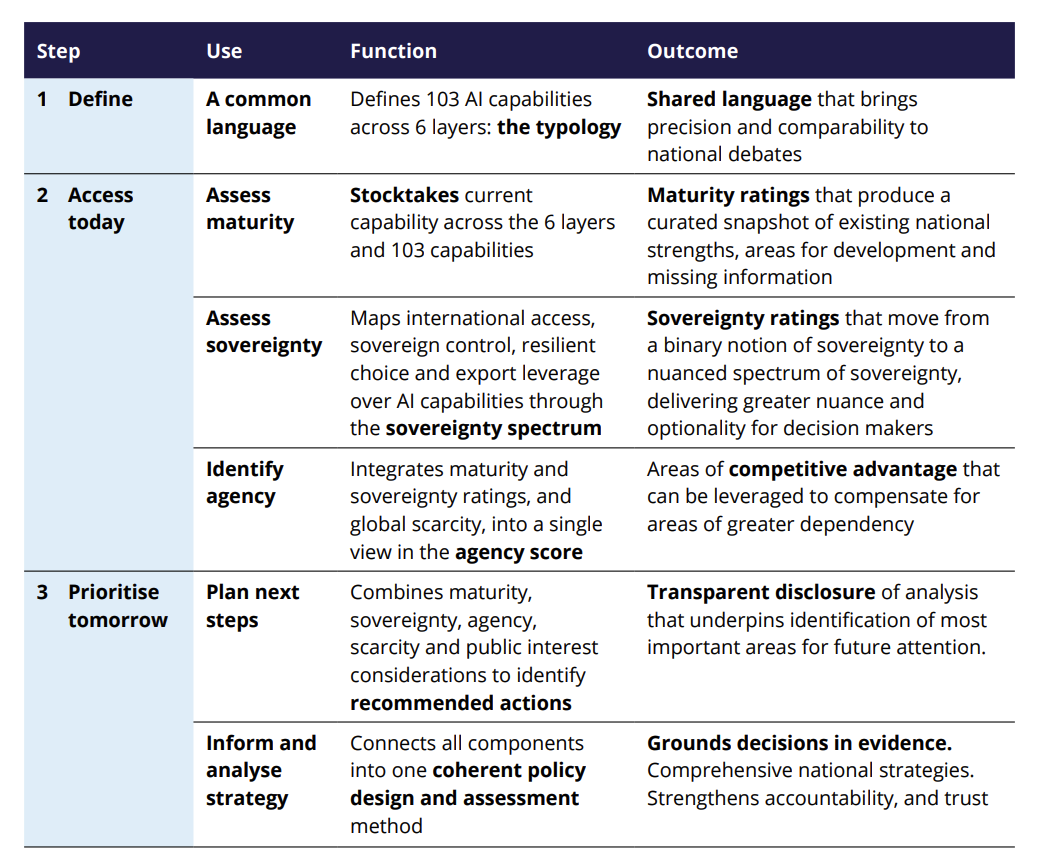
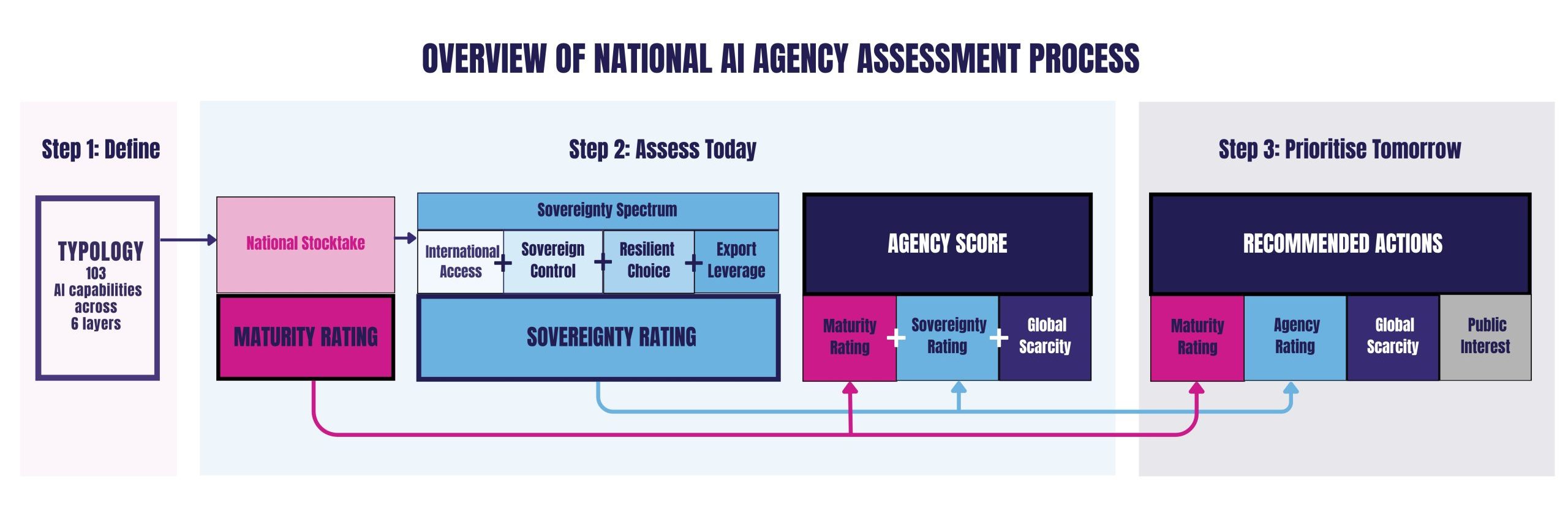
The Tool is adaptable and scalable. The right mix of strategic capabilities will differ from country to country. We invite you to apply the Tool to your country, region, sector, community or organisation.
TPDi’s Independence
TPDi’s independence is our most valuable asset. As a registered not-for-profit, our work is supported by external funding. We only accept funding from entities that agree to be disclosed publicly and commit to respect and promote TPDi’s independence. TPDi does not represent the views of any of our funders; all outputs represent solely the views of TPDi and/or the authors. Learn more about TPDi’s blind trust funding model and how this protects and promotes our independence.