
Australia’s 2025 AI Agency Assessment
- AI Agency Tool and Simulation
- AI Agency Tool Explainer
- AI Agency Report
- Australia’s 2025 AI Agency Assessment
- Sovereignty endures
Part 4 of TPDi’s AI Agency Toolkit: a connected set of resources for understanding and applying the AI Agency Tool.
Explore Australia’s 2025 AI Agency Assessment and TPDi’s analysis of how its findings align with the Australian Government’s 2025 National AI Plan.
Australia’s 2025 AI Agency Assessment is the first national application of the AI Agency Tool.
In parallel to developing the AI Agency Tool Methodology, TPDi assessed Australia’s AI maturity, sovereignty and agency as at December 2025, producing recommended actions across 103 capabilities (the Assessment).
TPDi then mapped the Australian Government’s 2025 National AI Plan against the Assessment to understand how its priorities align with the findings (the Analysis).
Read the key findings and access the full Assessment and Analysis below.
Want to explore the findings in more detail, or simulate your own assessment? Explore the digital tool.
Read the Analysis of Australia’s 2025 Assessment and the Government’s 2025 National AI Plan
⬇️ Analysis: Australia’s National AI Plan: Australia’s AI Agency Assessment
Summary of Key Findings
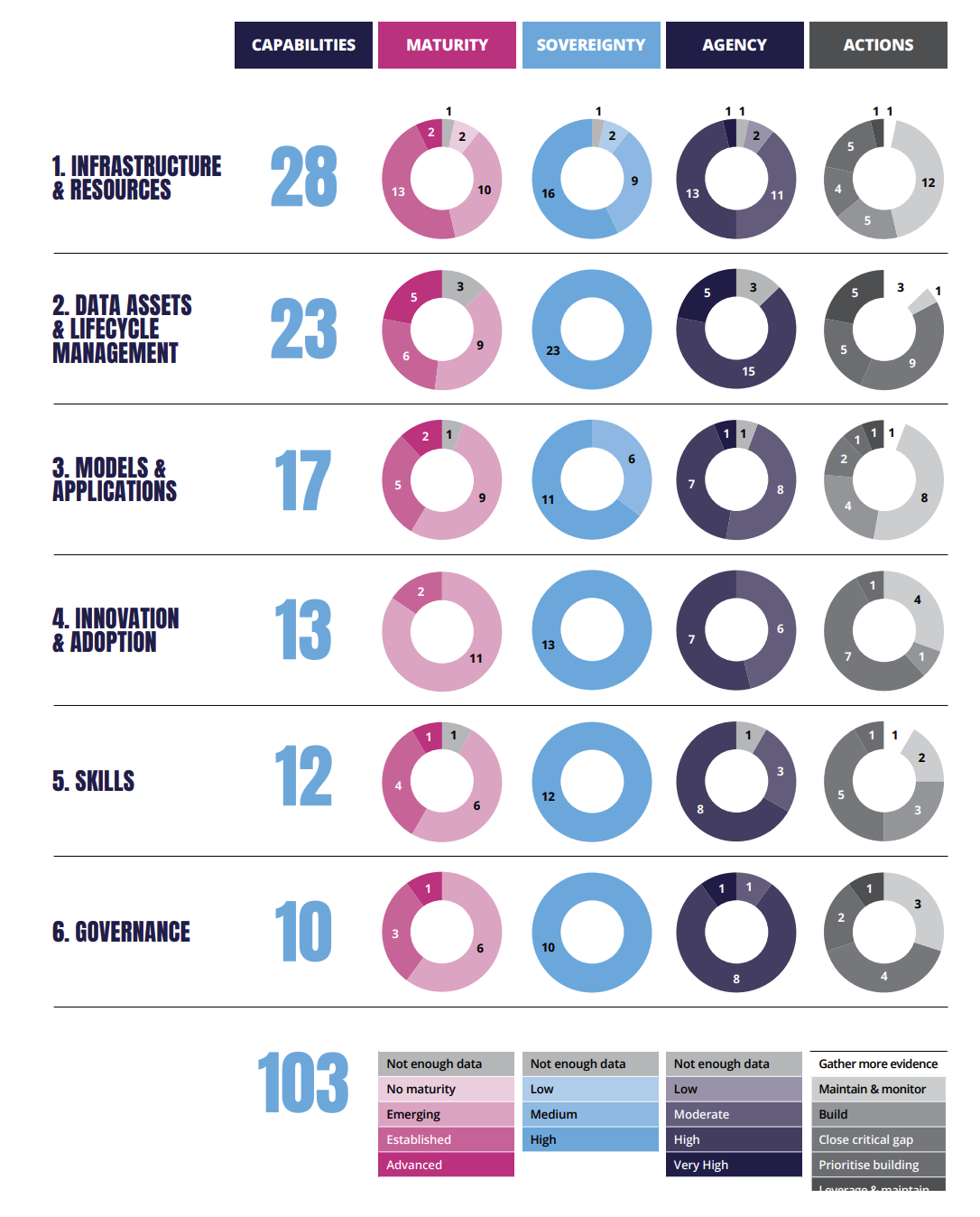
Strategic silences in the National AI Plan align with areas of low national agency.
Not all omissions from the plan should be viewed as gaps. For many capabilities the assessment’s recommended action is ‘maintain and monitor’. Many of the areas receiving limited attention in the plan fall into this category. They are capabilities where Australia currently has low maturity and low agency, or where government intervention is less necessary. This includes:
- accelerator manufacturing
- frontier model development
- most forms of private-sector AI capability.
The government has reasonably adopted a targeted approach in the plan, focusing public investment on what the government has assessed to be foundational capabilities while allowing the private sector to lead where appropriate.
There is untapped potential in Australia’s highest agency capabilities.
While the plan establishes strong foundations, it does not fully capitalise on all of Australia’s areas of highest agency – the capabilities in which Australia has competitive advantage. The assessment identifies opportunities to better leverage Australia’s strengths in critical minerals, strategic data assets and model development in computer vision. These are areas where Australia already possesses very high agency and which could be used more deliberately to strengthen national capability, address weaknesses and close critical gaps elsewhere in the AI ecosystem, while increasing Australia’s international leverage.
Australia’s highest areas of agency
The assessment found Australia has 8 capabilities that fall within the highest band: very high agency. This includes:
- our rich endowment in strategic and critical minerals
- 5 domain-specific datasets (medical, geospatial, environment and resources, demographic and infrastructure)
- our expertise in developing computer vision models
- our proven impact in international engagement (influence and norm shaping).
Every significant commitment in the National AI Plan aligns with the assessment’s recommendations.
Governments have finite resources and must make tough decisions about what to prioritise. It is noteworthy that the plan is strongly aligned with the assessment’s findings on where Australia should leverage, build or maintain agency. The plan’s major commitments focus on areas where Australia already possesses meaningful maturity and agency. This includes:
- data centres and supporting infrastructure
- public cloud
- general AI applications
- government and small to medium enterprise (SME) adoption
- international engagement.
Leaning into these capabilities harnesses existing strengths while also offering enabling benefits across the whole ecosystem.
The assessment found only 2 capabilities in which Australia has the lowest level of agency: manufacturing and packaging of accelerators (AI chips).
There are critical gaps to close
The assessment also identifies several globally scarce capabilities that are important to the public interest but remain underdeveloped in Australia – these capabilities should be the focus of the next wave of government prioritisation. This includes:
- public sector and public interest compute infrastructure
- key data lifecycle management capabilities (such as copyright, sourcing, validation and annotation)
- culturally and nationally inclusive models
- discerning, inclusive, and trusted AI adoption
- general AI literacy
- several specialised AI skills
- regulatory and oversight capability.
Addressing these gaps would strengthen Australia’s ability to support innovation, research, public services and national resilience, while ensuring AI systems reflect Australian values, cultures and identities and, perhaps most importantly, ensure that the benefits of AI are widely distributed.
Read Australia’s full 2025 AI Agency Assessment
⬇️ Assessment: Australia’s 2025 AI Agency Assessment
⬇️ Analysis: Australia’s National AI Plan: Australia’s AI Agency Assessment ⬇️ Assessment: Australia’s 2025 AI Agency Assessment
TPDi’s Independence
TPDi’s independence is our most valuable asset. As a registered not-for-profit, our work is supported by external funding. We only accept funding from entities that agree to be disclosed publicly and commit to respect and promote TPDi’s independence. TPDi does not represent the views of any of our funders; all outputs represent solely the views of TPDi and/or the authors. Learn more about TPDi’s blind trust funding model and how this protects and promotes our independence.